The US version on the UK program Who Do You Think You Are? is scheduled to debut on NBC starting at 8pm next Friday, March 5th. The first person profiled is actress Sarah Jessica Parker.
Other scheduled personalities are:
March 12: Emmitt Smith
March 19: Lisa Kudrow
March 26: Matthew Broderick
April 2: Brooke Shields
April 9: Susan Sarandon
April 23: Spike Lee
02 March 2010
WDYTYA TV schedule

01 March 2010
Dydd Gwyl Dewi hapus
My Carmarthen-born father would be less than pleased that the day was half over before I posted St David's Day greetings.
Researching Scottish Family History
 Chris Paton has a new book, just announced on his Scottish Genealogy News and Events blog.
Regular readers know I often find fodder for this blog from Chris, so the chances are the book will be a winner. I haven't seen it yet but hope to soon. My review copy must be delayed! Nor does it appear to be on sale yet in North America, although amazon.ca indicate they will stock it.
28 February 2010
Book review: The Great Filth
When Victoria became Queen in 1837, just 10 days before the start of civil registration, the annual death rate in England and Wales was 22 per thousand. By the time she died in 1901 the rate was less than 15.
The Great Filth by Stephen Halliday tells the story of how this was achieved despite a mass population movement to less healthy cities; 30% urban in the first census in 1801, 78% a century later. It's the story of the fight against squalor, poor housing, dirty water, sewage, ignorance and laissez-faire greed.
The major part of the book is devoted to the roles of scientists, doctors, public servants, midwives, engineers and highlights the work of the various champions within those professions. For Halliday the real champions are the engineers, like Joseph Bazalgette who was responsible for London's sewage system. He slams the medical profession, with a few exceptions like Dr John Snow, who did everything to protect their income and resist simple measures like handwashing -- "gentlemen don't have dirty hands."
He also condemns public servants and politicians who saw their role as restricted to defending the realm, administering the law and keeping taxes low, a philosophy in which they were joined by the affluent and influential.
The emphasis in the book is on London, a city which Halliday has studied in depth, but other cities are not overlooked, especially Liverpool. In 1841 one inhabitant in 29 died each year in Liverpool compared to one in 37 in London, a result of overcrowded unsanitary court housing. I was not aware of the extent to which 1847 saw Liverpool's situation made even worse by the Irish escaping the potato famine. Over 60,000 refugees swelled the city population in the first half of the year, one of my ancestors was likely among them. Many more landed and went on elsewhere. For those who stayed the conditions were an invitation to disease which arrived in the form of cholera in 1849 at a rate three times that in London.
I enjoyed the approach which profiled some of the individuals involved. The major figures are included in the text while profiles of important but less significant players are in boxes. Only in a couple of places did the personal profiles distracted from the flow of the narrative.
You can order The Great Filth at Amazon.ca link, and at a much higher price from Chapters-Indigo; or do as I did and borrow it from the library.
27 February 2010
Dictionary of Victorian London
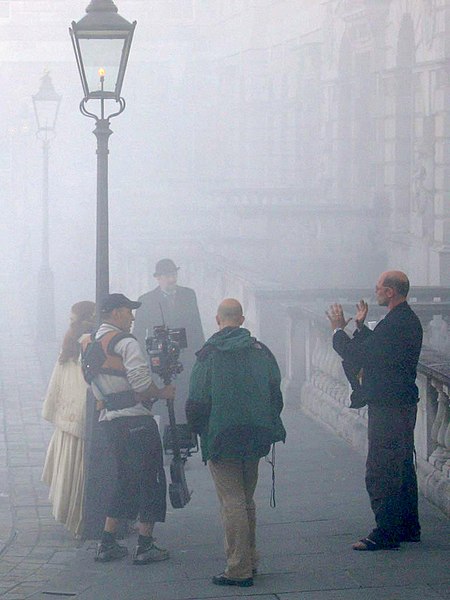
The most intriguingly titled "Rollerskating through Victorian London" is a short interview with Lee Jackson, author of historical novels that focus on Victorian London.
The article gives a taste of Jackson's encyclopedic knowledge. You can see more of it in his Dictionary of Victorian London at www.victorianlondon.org, and even more so on his intriguingly titled blog, which he calls an appendix to the dictionary, at http://catsmeatshop.blogspot.com.
Together they open a cornucopia of other resources ... be careful following the links or before you know it hours will have slipped away.
The photo is © Andrew Dunn, 19 September 2004. Website: http://www.andrewdunnphoto.com/
26 February 2010
Attention Human Genetic History Buffs
There are a couple of people who read this blog interested in their deeper roots -- more anthropology than genealogy. It's not for everyone. Here for them, via the 23andMe blog, The Spittoon, is a nice collection of technical review articles
Attention Human Genetic History Buffs
Posted using ShareThis
Ottawa U history prof laments LAC service
Galen Perras, University of Ottawa history professor, writes in a letter to the editor in today's Globe and Mail:
"For years customer service to the public has been under attack at LAC (Library and Archives Canada) from those who advocate "records management" rather than true interaction with LAC's public clients. Service hours have been cut and I can attest, having visited almost 150 archives on three continents, that LAC's service to the public is among the very worst I have seen."
Despite LAC having responded to the outcry when management reduced hours three years ago Perras is right. A services advisory board was established then, but now appears to have been disbanded. On almost all counts public clients remain an afterthought at LAC.
At the UK National Archives order a document and you will get delivery within 40 minutes. Go to the area where documents are delivered and you can see tubs arriving on a conveyor belt and staff scurrying to make the items available quickly. It's clear they value the client's time. On my last visit when an item did not arrive on time the person in charge hurried away, found some information had to be redacted, and presented me with a free colour copy within 10 minutes.
At Library and Archives Canada even a simple WW1 service file takes at least a day to arrive from another building. Even documents in the building take 90 minutes to arrive, a service standard recently degraded from 60 minutes,
Such anecdotal evidence is instructive, but where is the benchmarking LAC should be doing to compare it's service to similar leading institutions internationally?
LAC is now tinkering around the edges with a modernization initiative, which means repriorizing when what the organization needs is a root and branch review. Ordering such a review is the role of the Minister of Canadian Heritage, James Moore. Moore could be helped along by members of the Commons Committee on Canadian Heritage: Chair; Gary Ralph Schellenberger, Vice-Chairs; Carole Lavallée, Pablo Rodriguez, Members; Charlie Angus, Rod Bruinooge, Dean Del Mastro, Ruby Dhalla, Jacques Gourde, Nina Grewal, Roger Pomerleau, Scott Simms, Tim Uppal. However, judging by the issues they are dealing with in committee they seem oblivious to their role with LAC.
The situation is a sad, sad reflection of the reality that our government regards our national heritage more as an opportunity for press releases than something to be treasured and celebrated.
Deceasedonline.com adds Cambridge, Gainsborough and London (Brent) Cemeteries
UK site deceasedonline.com has just added approximately 220,000 records for: Cambridge City, Gainsborough (in the county of Lincolnshire) and two cemeteries in London, Wembley and Willesden.
You can do a free search without payment. Details on the additions are:
For Cambridge
Cambridge City Crematorium, Huntingdon Road, Girton, Cambridge, CB3 0JJ.
Approximately 32,000 burial and 143,000 cremation records are available, with a mixture of register scans and computerised records. Maps showing the exact locations of graves and digital photographs of headstones are also expected to be added.
Newmarket Road Cemetery also known as Cambridge City Cemetery - Added 23 February 2010
Burials numbered 1 to 31,912, dated 3 June 1903 to 28 June 2005, are available as burial register scans in various formats at between 10 and 20 entries per scanned page. Subsequent data is available only as fully computerised records. In some cases data is available in both scan and computerised form. This has been done where each source contributes different valuable information, e.g. death and denomination (and sometimes occupation) in the computerised record, and death registration detail in the scan.
Cambridge City Crematorium - Added 23 February 2010
Cremations 1 to 104,953, dated 21 December 1938 to 28 June 1996, are available as cremation register scans at 8 entries per page. Cremations from 29 June 1996 are available only as fully computerised records and there are no associated register scans.
Huntingdon Road Cemetery
This is a new cemetery. Data for this cemetery will become available from next year as computerised records only.
Histon Road Cemetery
The Histon Road cemetery was managed and run by Cambridge City Council until 2007. It has since been passed to The Friends of Histon Road Cemetery, and the records for Histon Road cemetery and Mill Road Cemetery are held at Shire Hall. The records for this cemetery are not available on Deceased Online.
Mill Road Cemetery
The records for Mill Road Cemetery are held at Shire Hall, and are not available on Deceased Online.
For Gainsborough
Gainsborough House, 18 Parnell Street, Gainsborough, Lincolnshire, DN21 2NB.
Approximately 24,000 burial records are available, with a mixture of register scans and computerised records. Maps showing the exact locations of graves are also expected to be added.
Gainsborough General Cemetery also known informally as Cox's Hill Cemetery - Added 22 February 2010
Burials numbered 1 to 23,930, dated 1 September 1875 to 23 October 2009, are available as burial register scans in various formats at between 8 and 20 entries per scanned page. Subsequent data is only available as full computerised records.
For the London Borough of Brent
Willesden Old Burial Ground (St Marys) - Added 22 February 2010
12,373 burials dated from 1865 to 6 October 2006 are available, as scans of the grave registers. There have been no further burials to 31 December 2008. Maps should be available at some time in the future, but a release date has not been determined. The information on the scans includes owner and owner address where applicable, together with details of others burials in the same grave. When a successful search shows further information available, this will often show both "Grave details and 'n' other burials" and "Burial register scan". The scan is actually taken from the graves register, and viewing the "Grave details and 'n' other burials" will add no further information, except a best effort at transcribing the names of the persons buried.
Wembley Old Burial Ground (St Johns) - Added 22 February 2010
1,461 burials dated from 28 March 1877 to 24 May 1977 are available, as scans of the grave registers. There have been no further burials to 31 December 2008. Maps should be available at some time in the future, but a release date has not been determined. The information on the scans includes owner and owner address where applicable, together with details of others burials in the same grave. When a successful search shows further information available, this will often show both "Grave details and 'n' other burials" and "Burial register scan". The scan is actually taken from the graves register, and viewing the "Grave details and 'n' other burials" will add no further information, except a best effort at transcribing the names of the persons buried.
25 February 2010
FindMyPast adds London Collection
Findmypast.co.uk launched their London Collection last week. The content is mainly index information, some that's been on the site for a while, such as the City of London Burials Index. Some is new to the site. The complete list is:
* City of London Burial Index – records from all the churches in the City of London from 1813 to 1890
* West Middlesex Marriage Index – detailing 84,863 marriages in 61 parishes from 1538 to 1837
* London Docklands Baptisms – comprising 407,558 baptisms for London's docklands areas 1712 to 1933
* London and West Kent Probate Indexes – mainly detailing wills and administrations from 1750 to 1858
* The Matchworkers' Strike – listing participants of the strike of over 700 men, women and teenage boys and girls working at the Bryant and May factory in East London in 1888, the same year as the Jack the Ripper murders.
www.findmypast.co.uk
Smith and Jones
Do you have a Smith as an ancestor? If not maybe you're on the wrong planet.
According to Wikipedia Smith is the most common surname in English-speaking countries. It's number one in Australia, England, Scotland, the USA, and probably New Zealand. It's 2nd in Canada, 5th in the Ireland, and 12th in Wales.
An article in the Summer 1976 issue of Population Trends, Smith and Jones: surnames in 1853 and 1975, examines entries in civil registration registers for both marriages and deaths in England and Wales. What surprised me was the comment that there are more entries for Jones than Smith in several years of the early period.
The 1841 census indexed by Ancestry has 210,040 Smiths in England, 2,376 in Wales, a total of 212,416. Jones is found 122,723 times in Wales, 86,713 in England, a total of 209,436. With more Smiths than Joneses I'd expect more Smith civil registrations.
These days it's simple and only slightly laborious to compile civil registration statistics from FreeBMD. That database is almost complete for this early period with only a single quarter missing more than 5% of events.
From the start of civil registration in July 1837 to the end of 1853 there were 2,815 more Smith births registered than Joneses, 132 more Smith deaths. Surprisingly there were 2,849 more Jones marriages than Smith. In only three of those years were there more Smith marriages.
Overall for the period there were only 98 more Smith than Jones events registered, but 10 years had more Jones events registered.
The lesson is you can't always take the number of registration events as a good index or surrogate for population.
24 February 2010
Ancestry adds England, Alien Arrivals, 1810-1811, 1826-1869
Ancestry.co.uk have added a data collection containing lists of aliens (non-British citizens) arriving in England between 1810 and 1869.
"The records come from the following National Archives collection series. These records were primarily created as a result of various acts passed by parliament to regulate immigrants and other incoming individuals.
- FO 83/21-22: Lists of aliens arriving at English ports, August 1810-May 1811; 2 volumes of original lists created under an act passed in 1793 “for establishing regulations respecting Aliens arriving at this Kingdom, or resident therein, in certain cases”
- HO 2: Certificates of alien arrivals, 1836-1852; 236 volumes of original certificates arranged by port of arrival
- HO 3: Returns of alien passengers, July 1836-December 1869 (with a gap from January 1861 to December 1866); returns made of alien passengers on ships arriving at British ports as required by the Aliens Act, beginning in 1836; formerly known as Lists of Immigrants; also includes some papers on the drafting of the Act, its administration, and proposals for its revision
- CUST 102/393-396 Accounts of aliens arriving at London (July-November 1826) and Gravesend (October 1826-August 1837); arranged by certificate of arrival number
The exact information recorded in each collection varies, but generally the following type of information is listed:
- Name of alien
- Port of arrival
- Date of arrival
- Ship
- Country of origin, nativity, and/or nationality
- Age
- Profession
- Certificate number"
Gene-O-Rama registration
A quick reminder that the fast approaching early-bird deadline for registration for the OGS Ottawa Branch Gene-O-Rama 2010, this year being held at Library and Archives Canada, 26-27 March.
You can save $5 by registering by the end of February, and more by taking advantage of registering online and not having to find an envelope and stamp.
Information is at http://ogsottawa.on.ca/?page_id=101
23 February 2010
More on The Ottawa Citizen digitized
Since the announcement of the availability of archives of the Ottawa Citizen online on Google in an article by Kelly Egan in the Citizen of 3 Feb. 2010 (p. B1) folks have been trying it out. This posting draws heavily, with permission, on material Prof. Bruce Elliott of Carleton University's History Department as well as my own trials.
Go to www.google.ca; click on NEWS, then on ADVANCED NEWS SEARCH (at top right), the on ARCHIVE SEARCH (for articles more than 30 days ago), then on ADVANCED NEWS SEARCH again. Under SOURCE type Ottawa Citizen, and enter your search terms under FIND RESULTS. There are four options: all words, exact phrase, at least one of the words, and without the words. All words seems to work best. Remember to be creative in coming up with keywords. The more letters in the words you search the more likely you will miss a hit owing to OCR errors.
The rationale for the order in which results appear is obscure, perhaps based on the number of times the search word occurs in the article or how close to the top of the article it occurs.
You can click on the graphs at the top of the results screen to narrow the date, or click on SEARCH OTHER DATES. Try the date range from 1800 to the present. Although the first issue of The Citizen under that title was supposedly published on 22 February 1851, Google's approach to assigning dates to papers has created earlier editions!
Just as you have may have gone to a handy newspaper to check the date, Google used dates found in the paper itself as the date to which it is indexed. The OCR can cause problems, and you will, for example, find issues from 1920 indexed in 1820 and articles from 1959 in 1950. I found one case where an incorrect year was published in the original paper which Google used for its index.
I also stumbled across a mirror image copy of two successive pages.
There are major gaps in the survival of the newspaper in the 1850s and 1870s, but the omissions in the Google news version are more extensive than that. For example, Ottawa Valley Marble Works in Arnprior ran an ad in every issue for several years 1859-61, with the name of the town appearing in each ad twice, once in upper case and once in lower. A search on MARBLE turns up a number of occurrences; a search on ARNPRIOR turns up none.
OCR problems are common. One needs to experiment with various search terms. There is a button "Flag this edition as unreadable". It would be great if Google adopted the National Library of Australia system for adding corrections.
Once you have a hit you can manoeuvre around the page by manipulating the blue rectangle in the thumbnail at top right, and browse back and forth within an issue of the paper. You can enlarge and reduce the image using the buttons on the toolbar. The FULL SCREEN button is the box with four arrows in the toolbar; it allows you to see a little more of the page at once.
"Archive Search Help" explains some of the subtleties and provides a "Get in touch" button that allows you to ask questions: a good step forward as it has been difficult to direct comments or questions to Google in the past.
There are inevitable gaps but it is a free resource, so we should be grateful for it as a 10% full glass rather than 90% empty.
22 February 2010
Ideas from the National Library of Wales
I have a small amount of Welsh ancestry but have never researched at the National Library of Wales. My father and his mother where born in Wales. Prior generations had moved there, likely in connection with the Cotton Panic in Lancashire when supplies of raw cotton were cut off during the US Civil War.
I've written often about the resources at TNA, the UK National Archives, and how looking at what other organizations do should be an inspiration to others.
Judging by a short video at www.llgc.org.uk/index.php?id=2 there are also some ideas, and attitudes, there that could be food for thought for those providing client service elsewhere.
21 February 2010
New Ottawa City Archives
 Construction on the archives is progressed noticeably in the two months since I was last there.
The top image is taken from the corner of Woodroffe and Tallwoods, the north-east corner of the site.
This image is from the northwest corner of the construction site. Both photos were taken on Saturday 20 February 2010.
20 February 2010
TNA podcast: Fashion or ration
A short presentation by Robert Daoust from Feb 4, 2010, who speaks on how the fashionable woman of the Second World War and post war era (sometimes) managed to remain chic in a climate of rationing.
Focusing on the leading fashion designers Norman Hartnell and Hardy Amies, and using sources from The National Archives, the talk considers the fashion industry of the time, and reveals how they not only contributed to the war effort and made a lasting impact on British style. The presentation is quite humorous.
www.nationalarchives.gov.uk/podcasts/fashion-or-ration.htm
19 February 2010
Ancestry.com growth in 2009
Ancestry.com grew healthily in 2009, beating analysts estimates, as announced in a press release on its annual report http://finance.yahoo.com/news/Ancestrycom-Inc-Reports-prnews-2525584512.html?x=0
- Subscribers totaled 1,066,000 as of December 31, 2009, a 17% increase over 2008.
- Subscriber additions were 165,000 in Q4 2009, a 15% increase over Q4 2008.
- Monthly Subscriber Churn(1) decreased to 3.6% in Q4 2009 compared to 4.0% in Q4 2008 and flat with 3.6% in Q3 2009.
- Subscriber acquisition cost(2) in Q4 2009 was $85.21, compared to $79.26 in Q4 2008 and $70.55 in Q3 2009, reflecting investments in new television commercials for both our domestic and international markets.
- Average Monthly Revenue per Subscriber(3) in Q4 2009 was $16.67, compared to $16.45 in Q4 2008 and $16.48 in Q3 2009.
18 February 2010
RIP John Babcock - Canada's last WW1 veteran
News soures are reporting the death of John Henry Foster "Jack" Babcock the last known surviving veteran of the Canadian military to have served in the First World War. He was born July 23, 1900
"Mr. Babcock joined the military at the age of 16, but because of his age he wasn’t allowed on the frontlines.He spent his final years living in Spokane, Washington."
Better competition in UK genealogy online
Brightsolid, parent of FindMyPast.co.uk has won regulatory approval to buy Friends Reunited and Genes Reunited, with the regulator seeing the acquisition adding a stronger competitor for Ancestry.co.uk.
Read more via Chris Paton's Scottish Genealogy News and Events blog at http://scottishancestry.blogspot.com/2010/02/brightsolid-can-complete-purchase-of.html
Europe to America
Wednesday was a travel day for me, from London's Heathrow airport back to Ottawa. For the past few weeks I've been enjoying several history programs on BBC TV, including the "Seven Ages of Britain." "Empire of the Seas" was the story of the Royal Navy told in four hour-long episodes by British-Canadian author and broadcaster Dan Snow. His books include "Death or Victory - the battle of Quebec and the birth of Empire."
The only genealogy program was "Heir Hunters" which is case studies of probate research in England and Wales, mainly featuring the company Fraser and Fraser.
Unfortunately these programs are behind a UK-only firewall.
From British history I switched to American, in the shape of the second episode of Henry Gates PBS series, "Faces of America" www.pbs.org/wnet/facesofamerica/. The program aims to answer the questions "What made America? What makes us?"
Gates was shown presenting documents from the life's of various celebrities and then putting their experiences in context. The focus on Wednesday was on immigration stories. I enjoyed the program but found the approach ready to forgive the transgressions of the US government and society, as in Japanese internment and Irish immigrant support for the South during Civil War, but ready to soft-peddle unbridled British capitalism during the Irish Potato Famine. I wonder if lack of a national health care system and similar US unbridled capitalism will feature in upcoming episodes in discussing "What makes us?"
In the meantime the CBC seems devoid of historical content, and History Television Canada has sunk to the level of "Ice Road Truckers."
Subscribe to:
Posts (Atom)


