12 February 2012

Higher prices for Family History Centre microfilm service


Get ready to pay more for microfilm loans through Family History Centres in Canada and the US.  The FamilySearch website announces that:

Due to the increase in the price of raw microfilm stock and the decreasing availability of this product on the market, it has become necessary for FamilySearch to increase the price of film loans in family history centers. As of 15 February 2012 the following prices will be in effect for film loans in the United States and Canada:          
Short-term Film Loan $7.50
Short-term Film Loan Extension $7.50
Extended Film Loan $18.75
Microfiche Loan $4.75
FamilySearch’s Microfilm Ordering service is your gateway to a vast collection of genealogical and historical records. The service allows you to reserve and loan films to family history centers and affiliate libraries. The loan is free, but there is a small shipping and handling charge for each film.
Microfilm loan from Family History Centres remains a wonderful service even at the increased price. The cost of film seems to have nowhere to go but up which would lead to further price increases, a trend technology driven as film loses economies of scale.

I'm confident the organization behind the ever expanding familysearch.org website, which already spoils us for access, has a plan to move to a service more technologically advanced and economically sustainable for its legacy collection. Maybe we'll see a digitization on demand initiative so that instead of delivering a physical microfilm a digitized version is made available, perhaps still only accessible at a Family History Centre.

via a lead from EOGN

Deadpubs.co.uk

Perhaps if like me there are more pubs than palaces in your family history, you will find interesting the pub history site mentioned by Gail Roger in her talk at Saturday's BIFHSGO meeting.

The Pub history site at deadpubs.co.uk is "a major historical street directory which lists mainly Pubs, beer retailers, taverns and hotels; and street name changes between about 1840 and 1940." It covers pubs in the home counties and a few others: London, Essex, Kent, Suffolk, Sussex, Surrey, Berkshire, Middlesex, Devon, Buckinghamshire, Gloucestershire, Hampshire, Hertfordshire, Cambridgeshire & Oxfordshire, Cornwall, Dorset, Wiltshire, Somerset.

How to pay more for England and Wales civil registration certificates

Suppose you want a birth, marriage or death certificate for an English (or Welsh) ancestor. You can choose to pay more or less. Here are some options:

£9.25 including postage, from the General Register Office for England and Wales online ordering service.

£13.60 from UK GRO Certificates
£13.99 from UK Official Services.
£24.95 from Vital Certificates
US$38.00 from Ancestryshop

According to a post by Else Churchill of the Society of Genealogists the UK Advertising Standards Authority has now upheld three separate complaints about third party websites misleading customers into believing that they were ordering from the government's own website. Those third party sites are: UK GRO Certificates, UK Official Services and Vital Certificates. 

According to Registrar General Sarah Rapson "It is always quicker, cheaper and safer to deal directly with the General Register Office for certificate orders."

Why pay more?


11 February 2012

OGS Branch blogs

A notice came in from Christine Woodcock of the Brant County Branch of the Ontario Genealogical Society drawing attention to a blog post QR Codes for Genealogy Societies on the branch blog, one of 159 published since April last year. I tried the site to make a QR code mentioned.
It sets me wondering about other OGS branches and their blogs. There are only three others.
Durham Region has a blog going since 2007, now with 257 posts. The number of posts has been declining since 2009.
The Elgin Country Branch blog has 31 posts starting in 2007, but nothing new since 2010.
Ottawa Branch has 139 posts since inauguration in 2011 and has posted 11 already in February including their historically informative Timeline posts.

Details on Cheshire burial records at deceasedonline.com


There's a bit more information on the new Cheshire burial records now at deceasedonline.com


Blacon Cemetery, Blacon Avenue, Chester, Cheshire, CH1 5BB
Opened in 1941

19,000 burials, dating from 20th December 1941 onwards, are available as burial register scans containing 30 entries per scan.

Chester Crematorium, Blacon Avenue, Chester, Cheshire, CH1 5BB
Opened in 1965

80,000 cremations, dated 1st November 1965 to March 1997, are available as Cremation register scans containing an average of 10 entries per scan. Computerised records are available from 1997 onwards.

Neston Cemetery, Raby Park Road, Neston, Cheshire, CH64 9SN
Opened in 1906

4,400 burials, dated 18th December 1906 to 12th November 1997, are available as burial register scans containing 8 entries per scan. Computerised records are available from 1997 onwards. Maps showing the section of the cemetery where the grave is located are also available.

Overleigh Old Cemetery, Overleigh Road, Handbridge, Chester, Cheshire, CH4 7HW
Opened in 1850 - To be added

60,000 burials, dated 12th November 1850 onwards, are available as grave register scans containing 12 entries per scan.

Overleigh New Cemetery, Overleigh Road, Handbridge, Chester, Cheshire, CH4 7HW
Opened in 1953

8,500 burials, dated 2nd April 1953 to 10th October 2011, are available as burial register scans containing 30 entries per scan. Maps showing the section of the cemetery where the grave is located are also available.

Overpool Cemetery, Rivacre Road, Ellesmere Port, Cheshire, CH66 1LG
Opened in 1913

12,600 burials, dated 22nd December 1913 to 4th October 2011, are available as burial register scans containing 14 entries per scan.

Wharton Cemetery, Crook Lane, Winsford, Cheshire, CW7 3DR
Opened in 1990

1,000 burials, dated 21st September 1990 to 19th August 2011, are available as burial register scans containing 21 entries per scan.

10 February 2012

WDYTYA: Marisa Tomei

Online Poll @ FluidSurveys.com...

Survey Software by FluidSurveys.com

Book Review: Everything You Need to Know About How to Find Your Family History in Newspapers

Everything You Need to Know About How to Find Your Family History in Newspapers, by Lisa Louise Cooke, 2012.  No publisher, available from www.GenealogyGems.com. No ISBN. Paperback, 156pp, illustrations, no index. $25US

Lisa Louise Cooke is a genealogical entrepreneur, prominent as a genealogy conference speaker and for her online Genealogy Gems podcasts. She spoke at RootsTech, will be at the Who Do You Think You Are? Live event in London later in the month and, rated 9th internationally in our recent rock star genealogist poll. GenealogyGemsPodcast.com ranks 1,667,834 on Alexa.

On page 2 of this book is the disclaimer "To be clear, I am first and foremost a genealogy podcaster. My goal is to teach my listeners and readers innovative ways to use existing online tools specifically for their genealogy research." This book is a natural follow on to Lisa's book on Google and DVD on Google Earth, one suggested by Leland Meitzler when he answered "newspapers" to the question "what book do genealogists need right now?"

The book aims to teach how to determine whether a newspaper existed for the desired time and location; to locate the available copies in whatever form they may exist; and to make full use of the found newspaper by scouring it for every available morsel.  The back cover blurb boast is that it does so with:

- Step-by-Step Instructions
- Worksheets and Checklists
- Tons of Free Online Resources
- Websites that are worth Shelling Out a Few Bucks For
- A Massive Amount of Location Specific Websites
- A Case Study that Puts It All to the Test
The first part of the book, up to page 76, comprises introductory material and eleven chapters. Ten of those pages contain only a few lines or are blank except for the page number.

A systematic six-step approach is advocated and illustrated with a search for marriage information for Lisa's ancestors in early 1900s San Francisco in the final chapter. A strength of the book is the number of web addresses including to videos.

Two aspects surprised me.

First, the option of contacting a local public library where the event occurred to ask for help while mentioned it's not emphasized to nearly the degree to which it is helpful. Say you have a date of death and are looking for a newspaper obit. In my experience local libraries are often helpful, perhaps especially in these days when they are under pressure to justify their existence, and will search the newspaper and return a scan of the article, sometimes without charge if the search didn't take much time. But you must have a good fix on the date for this to be successful.

Second, one of the greatest problems in using digitized newspapers is that the OCR process, transferring the newspaper page image to text that can be searched, is imperfect. That merits no mention I could find in the book, an amazing omission. There are strategies that provide a partial work around.

The second part of the book comprises three long appendices occupying about the same number of pages as the first part. Appendix A lists US newspaper websites alphabetically by state, either locations with physical or digitized collections. Each allows four lines for inserting additional state sources. Appendix B does the same for international newspaper websites. There is a category for the UK and separate ones for England, Ireland, Scotland and Wales. The Times is not listed! Canada's listing has nine entries including the National Archives of Canada (sic). Appendix C is a 21 page listing of US libraries offering Heritage Quest Online remote access free to patrons.

I'm giving a presentation on British and Canadian newspapers for family history at the Ontario Genealogical Society conference in June, a conference where Lisa is also speaking although not on newspapers. Reading the book gave me ideas for slight modifications to my presentation and strengthened my conviction I have significant additional substance to offer.

If you're familiar with and like the pedagogical approach Lisa Louise Cooke takes this book won't disappoint.

Everything You Need to Know About How to Find Your Family History in Newspapers only became available at the beginning of February. It sells for $25 plus postage from the author.

Cardiovascular disease in your UK family history?

A study reported in The Lancet, "Inheritance of coronary artery disease in men: an analysis of the role of the Y chromosome" shows British men in haplogroup I have about a 50% higher age-adjusted risk of coronary artery disease than men with other Y chromosome lineages. Cardiovascular disease is the biggest killer in the UK. The study shows the association between haplogroup I and increased risk of coronary artery disease to be independent of traditional cardiovascular and socioeconomic risk factors.

The map, an extract from http://en.wikipedia.org/wiki/Haplogroup_I_(Y-DNA), illustrates by the darker colour that in the UK haplogroup I is more common in the east of England. If there's a history of cardiovascular disease in your UK family history, especially if that ancestry is from the east of England, you're more likely to be haplogroup I.  If you want to know your haplogroup for sure take a DNA test. 

09 February 2012

BIFHSGO February meeting

The BIFHSGO monthly meeting next Saturday 11 February, starting at 10am, is one I've been eagerly anticipating, and turned down another invitation to attend.

From the BIFHSGO website:
The Hanging Hales
by Gail Roger

There is no such thing as a boring family. If you haven't found something fascinating, scandalous, or downright embarrassing in your family search, you aren't looking hard enough! Some families, though, seem to have more than their share of triumphs and downfalls. Join Gail Roger as she tackles the following questions concerning an engrossing and rather eccentric branch of her family: How is she related to a well-known designer and a goddaughter of the Prince of Wales? Did her great-grandfather once hide under Charles Dickens' chair -- while Dickens was sitting in it? Why did this same great-grandfather refuse to wear a collar, even at weddings? What is a klinker and how do you make a fortune out of it? And finally, why was her great-great-great-grandmother hell-bent on seeing half a dozen men hanged? Listen to a sneek preview of her talk in an podcast interview with Brooke Broadbent.

About the Speaker

Unlike most BIFHSGO presenters, Gail Roger says she is an absolute nobody (not a view shared by people who know her.) She does have a graduate degree which she has failed to use for monetary gain; she used to teach English as a Second Language, but no more. She has been pursuing family history seriously (that is, online and taking courses) for the past eight years and for the sake of her daughters --- who aren't that interested.

Location: Library and Archives Canada, 395 Wellington Street, Ottawa, Ontario, Canada.

Come early and browse our Discovery Tables on England, Ireland & Scotland. Meet with family history experts. Free parking is available in the lots east of the building only on Saturdays. Do not use the lot west of the building.

Extra.  Gail is a Dr Who fan and recently posted this impressive video:

New Warwickshire records at Ancestry

If your genealogy takes you to the county of Warwickshire plan on setting aside some time to examine six databases new at Ancestry, especially if you need to examine those without name indexes.

Warwickshire, England, Land Tax, 1773-1830 is the largest with 248,653 records. Search by name of the landowner or occupier, most often just the surname is given, and find the parish, sometimes the street, the amount of the tax, and the year. The database predates civil registration and the nominal census.

Warwickshire, England, Parish Poor Law, 1546-1904 contains 31,769 unindexed browse records. Information contained varies by record type. Examples of the types of records found include:

  • apprenticeship registers and indentures
  • lists of parish officers
  • churchwardens’ accounts
  • charity deeds and accounts
  • poor law papers
  • overseers' accounts
  • parish account books
  • poor rates
  • removal orders
  • settlement examinations and certificates
  • bastardy bonds
  • constables' accounts
  • parish minutes
  • pauper lunatics
  • lists of poor and apprentices
  • rent books

Warwick, England, Burial Slips from Warwick Cemetery, 1859-1968 contains 14,942 records, each with details on name, age, profession and sometimes residence address, date of death, place of death, date and sometimes time of burial, name of minister officiating at burial, grave details, from what parish removed.

Warwickshire, England, Occupational and Quarter Session Records has 7,283 unindexed records that may be browsed by record type including: boat (canal barge) owners records; flax bounty records; lists of freeholders entitled to vote, largely 18th century; lists of freemasons; hair powder certificates, recording tax levied on everyone using hair powder at the end of the 18th century; gamekeepers records;
hearth tax returns; jurors' lists which can include occupation and street/residence;
printing press owners records.

Warwickshire, England, Bastardy Orders, 1816-1839 contains 1,058 name indexed records with the name of the mother and assumed father, but not the child, the parish and a date for the court action.

Warwickshire, England, Militia, 1776-1825 contains 1,055 name indexed records, primarily certificates verifying a man’s service, account statements related to reimbursements to his family for his service, notices of commissions that were to be printed in a gazette, and documents outlining qualifications to serve as a Deputy Lieutenant.


LAC starts podcasting

The following is a notice from Library and Archives Canada.
Gatineau, February 8, 2012—Library and Archives Canada (LAC) is pleased to announce the release of the new podcast series, Discover Library and Archives Canada: Discover Library and Archives Canada: Your History, Your Documentary Heritage.
Developed and produced by the Resource Discovery Sector at LAC, the series showcases treasures from our vaults and explores topics such as Aboriginal peoples, transportation, immigration, genealogy, government, as well as military and peacekeeping.
With new episodes released monthly, the podcasts will guide you through our many services and introduce you to the people who acquire, safeguard and make known Canada’s rich documentary heritage.
The first podcast, not quite 25 minutes in length, is about Project Naming which aims to identify people in photos from LAC's collection from Inuit communities. Like many of LAC's best project this is probably one which would never have been funded under the so called Modernization initiative as it relates neither to government documents nor publications acquired under Legal Deposit.

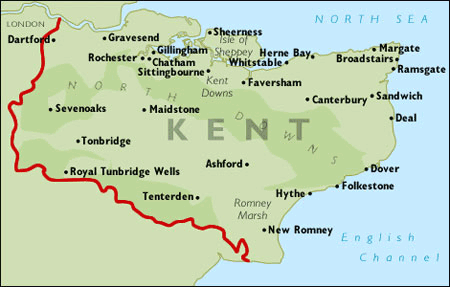
Browseable Kent land tax and probate records new on FamilySearch

A couple of interesting looking datasets for Kent genealogy. Access requires a sign-in which may mean travel to a Family History Centre unless you have access through a qualifying organization.

England, Kent, Land Tax Assessments, 1689-1832 offers 86,160 images organized by parish (380 of them).

England, Kent, Wills and Probate, 1440-1881 offers 347,164 images for the Archdeaconry of Canterbury, Archdeaconry of Rochester, Diocese of Canterbury, Diocese of Rochester, Exempt Deanery of Shoreham and, Peculiar of the Rector of Cliffe.
For the Archdeaconry of Canterbury the record types are: account papers, administration bonds, caveats, guardian registers, inventories, miscellaneous court papers, miscellaneous court papers index, renunciation papers and, wills.

08 February 2012

Deceasedonline.com adds Cheshire burial records


Starting on February 9 about 185,000  burial and cremation records from West Cheshire & Chester Council will become available through deceasedonline.com. Included are records for Chester Crematorium in Blacon and cemeteries in Blacon, Overpool, Neston and Wharton. Records from Overleigh cemetery will be made available in two phases, more modern records (from 1953) will be available later in February and all other records in late Spring.

Searching is free, scans of registers to view, print and/or download providing details such as full names, the deceased’s address details, age, parish and grave reference and in some cases the occupation of the deceased will be on a fee basis.
The burial records will also provide details of all those buried within graves, helping researchers to establish other family links, as well as grave number references.

Information on these cemeteries is at http://www.cheshirewestandchester.gov.uk/residents/births,_deaths_and_marriage/bereavement_services/contact_us/locations_and_opening_times.aspx

In January deceasedonline.com added a large collection of records for West Ham cemetery.

Essex Ancestors

The Essex Record Office have made available digital images of many parish registers and some wills, with no name indexing, through a subscription site at http://seax.essexcc.gov.uk/EssexAncestors.asp
The new issue of Connections, the Quebec Family History Society journal. includes a communication from the ERO drawing attention to the service and commenting that the service doesn't seem to be as well known in Canada as the UK and Australia.
Exchanges on the ESSEX-UK Rootsweb list late in 2011 drawing attention to some poor quality images were addressed in a posting from the ERO informing they had traced the problem to a poorly performing digital camera and that the images are being replaced. From this and other Rootsweb exchanges it appears the ERO is notably responsive to clients. It may pay to find some Essex ancestors; perhaps in your genealogy you think of them as Londoners but family members may have moved to live just across the county boundary in Leyton or West Ham.
Essex Ancestors subscriptions available are: 1 Day (24 hours) - £5.00; 1 Week (7 days) - £15.00; 1 month (30 days) - £25.00; 6 months (182 days) - £50.00; 1 year (365 days) - £75.00
As mentioned last August 537,583 records for the Church of England in Essex, both Parish Registers and Bishops’ Transcripts, are now on FamilySearch here.

Ancestry adds Perthshire, Scotland, Cess, Stent and Valuation Rolls, 1650-1899

These are records indexed through Ancestry`s World Archives Project where volunteers index the records. As Ancestry describes them:

This is a collection of valuation rolls for the County of Perth, Scotland that run from 1885-1988. The rolls contain more information than the cess or stent rolls, which recorded just the tax portion of the valuation, while the valuation rolls deal solely with the value of the property. The (printed) valuation rolls name the proprietor or tenant, describe or name the property and give an annual rental value.
The valuation rolls do have some peculiarities, though. Until 1884, tenants or occupiers with a lease less than one year or value of less than £4 per annum were omitted. Street naming and numbering also didn’t come into prevalence until 1930, which makes it difficult to identify some properties.
The valuation rolls contain:
Parish
Year
Proprietor
Tenant
Description of property
Yearly rent or value

07 February 2012

Celebrating Dickens at 200?

The Guardian has a page in commemoration of this bicentennial of the birth of Charles Dickens, http://www.guardian.co.uk/books/series/charles-dickens-at-200. It includes a short video of Dickens' London, starting with an image of Somerset House, which housed probate records when I first started researching family history.

Now formatting automatically for smartphones

If you visit on a smartphone you will now see Anglo-Celtic-Connections custom formatted for your device. That's a simple option on Blogger so it's not as if much effort was required. Please let me know if it causes any problems.

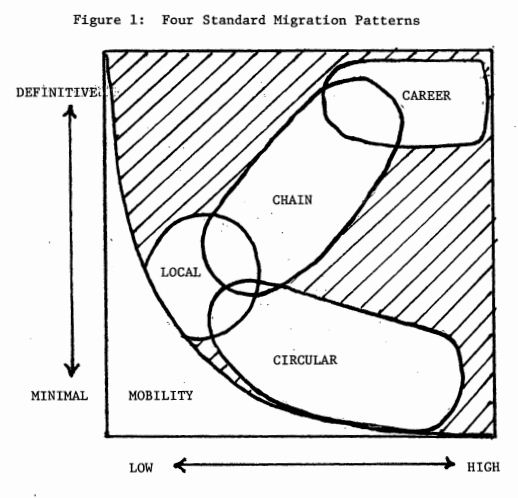
Circular, career, chain and local migration

I'm part way into reading the 2010 book Arrival City by Toronto journalist Doug Saunders. Early, on page 46, Saunders discusses migration in terms of a more nuanced analysis, due to Charles Tilly, than simple push and pull factors where migration happens as the grass is seen to be greener on the other side of the hill.

The diagram from Tilly's 1976 paper Migration  in Modern European History, according to Google it's frequently cited, shows four migration types in terms of the commitment to the change and the distance involved. Simple mobility, such as moving to a different house on the same street, is also shown. It might also involve regularly communting long distances to work in a distant community, even to another continent.
Circular migration might have a seasonal pattern, such as involved with moving grazing herds from low to high altitude pastures, or Dorset fishermen going to Newfoundland for the summer fishing. Chain migration involves a person pioneering a migration of a larger group from the same origin community. Career migration might be a move to a location of greater opportunity for the skill or profession. These three involve a distinct break from the place of origin, if only temporary for Circular, whereas with Local migration the distance and cultural break are less marked.
It might be worth thinking about where migrations in your family fall in this classification scheme in writing a family history.

TNA profiled in another BBC TV program

For a second day I'm having to write that if I was in the UK I'd have been able to watch a BBC TV program that profiled a resource from The (UK) National Archives.
The documentary 'Bomber Boys' told the story of RAF Bomber Command, and showed a document at TNA, the 'Butt Report' within file AIR 8/1356, which demonstrated how ineffective bombing raids were in the first two years of WW2. According to a Wikipedia article:

  1. Of aircraft recorded as attacking their target, only one in three got within 5 miles [(8 kilometres)].
  2. Over the French ports, the proportion was two in three; over Germany as a whole, the proportion was one in four; over the Ruhr it was only one in ten.
That lead to Bomber Harris being put in command, coincidentally at a time when the four-engined Lancaster bomber became available.
Kudos to the communications folks at TNA, or whoever else is responsible for ensuring the organization got proper credit. Exposure through a program such as this, presumably watched by millions, should be a wake up call to those who continue to rely on counts of researchers visiting the organization in person or online as the primary index of its impact.

06 February 2012

Bullets, Boots and Bandages

Had I been in the UK to view the BBC TV 4 program Bullets, Boots and Bandages which aired last Thursday evening I'd have seen the host examining long scrolls, lists of sick soldiers from the time of Henry V, during the Hundred Year's War between England and France. These are part of the collection at TNA, see their notice.

The programme explains the history and importance of supply in making an army effective, the kind of thing the BBC does so well. Did you know tinned food was available as early as the first quarter of the 19th century, or that they had telegraph communications to Balaclava via an undersea cable during the Crimean War.