12 January 2020
LAC Scholars: a closed process
I contacted the LAC Foundation requesting clarification on the nomination process for the Scholars Program, and how it operates.
Here's the response.
The Nomination and Selection process for LAC Scholars is managed by a jury of experts from various cultural heritage fields, overseen by a committee of the Foundation. The nominations are the product of recommendations and consultations conducted by the various jury members. There is no public call for nominations.
Proposed recipients are recommended to the Chair of the Foundation and the Librarian and Archivist of Canada for endorsement.
With no opportunity for the public to make nominations this first stage of the process is open to abuse. If the Order of Canada can accept nominations why not LAC Scholars?
Sunday Sundries
Miscellaneous items I found of interest during the week.
How Victorian Britain anticipated today’s keep fit craze
A Victorian Genealogy
Facebook: a “disinformation-for-profit machine.”
Getting to Know Milton Friedman
The Fraser Institute has now published The Essential Milton Friedman, by Steven E. Landsburg (2019). It's a free e-book, 73 pages long, that offers an intro-level, highly readable nonspecialist overview of many of Friedman's most prominent ideas.
The Old Internet Died
Via Buzzfeed and Documentary Heritage News, many web resources active a decade ago are no longer with us, or shadows of themselves. LAC used to promote items by posting on Flickr — no longer. It was just announced that RootsWeb mailing lists will soon no longer accept new posts; how long will the archived material remain? The web is ephemeral — including this blog.
11 January 2020
Kingston Lower Burial Ground Project
Laid out in 1783 in anticipation of the arrival of Loyalists at Cataraqui after the American Revolution, Kingston's Lower Burial Ground is where many early citizens are buried including prominent residents, black slaves brought by the Loyalists and sailors of the Lakes.
Reflectance Transformation Imaging was used to photograph the burial markers.
A database of burials in the cemetery includes names, dates of birth and death, monument inscriptions and photographs, as well as additional information (where present). The website is searchable and an alphabetical listing by surname is provided as well.
Here's the distribution of the 578 burials in the database from 1783 to 1863.
Findmypast Updates: 1939 Register and British FWW Medical Records
With over 85,000 'closed records' newly opened up the 1939 Register now contains more than 33.9 million searchable records.
Each record includes the names of inhabitants at each address, their date of birth, marital status and occupation. There is also contextual information, including period photographs, infographics, region-specific newspaper articles and historical and contemporary maps tailored to each record.
The population of England and Wales in 1939 is estimated at 41 million although some, like my father who was in the merchant marine, were not registered at the time. I estimate that some 2.4 million under age 100 will still be alive. Perhaps up to 4 million records that should be open are not. That's a very rough estimate.
British Armed Forces, First World War Soldiers' Medical Records
More than 21,000 additional records from TNA series MH106, a representative selection of the original collection, have been added to the collection. The records include admission and discharge registers from hospitals and casualty clearing stations, field ambulances, an ambulance train and a hospital ship.
In addition, more than 1.8 million transcripts are now available in the United States, National Veterans Cemetery Index. Transcripts may include birth years, death years, service, rank, death date, home town, burial place, father’s name and spouse from the American Civil War and the two world wars through to Afghanistan. However, there is a large number of duplicate records; for instance, Thomas E la Bruyere who died in 2002 has 17 separate entries.
10 January 2020
Ancestry Updates
Ancestry lists the following titles as updated on Thursday, 9 January 2020.
| TITLE | RECORDS |
|---|---|
| Canada, Voters Lists, 1935-1980 | 95,335,143 |
| Essex, England, Church of England Births and Baptisms, 1813-1918 | 3,939,834 |
| Essex, England, Church of England Marriages, 1754-1935 | 1,970,323 |
As usual with Ancestry updates, there is no information posted on how major or minor they are.
The 15 best websites for 18th century UK family history
1. London Lives
2. ScotlandsPlaces
3. Apprentices' Indentures
4. The Cause Papers Database
5. Old Maps Online
Go to www.whodoyouthinkyouaremagazine.com/blog/15-best-websites-18th-century-family-history for the links and the rest.
Thanks to Ann Burns for the tip, and remember with access to the magazine through your Canadian Public Library's Press Reader subscription you can access the full text of the magazine for free.
Genealogists and Historians Use of Digital Cameras: Poll Results
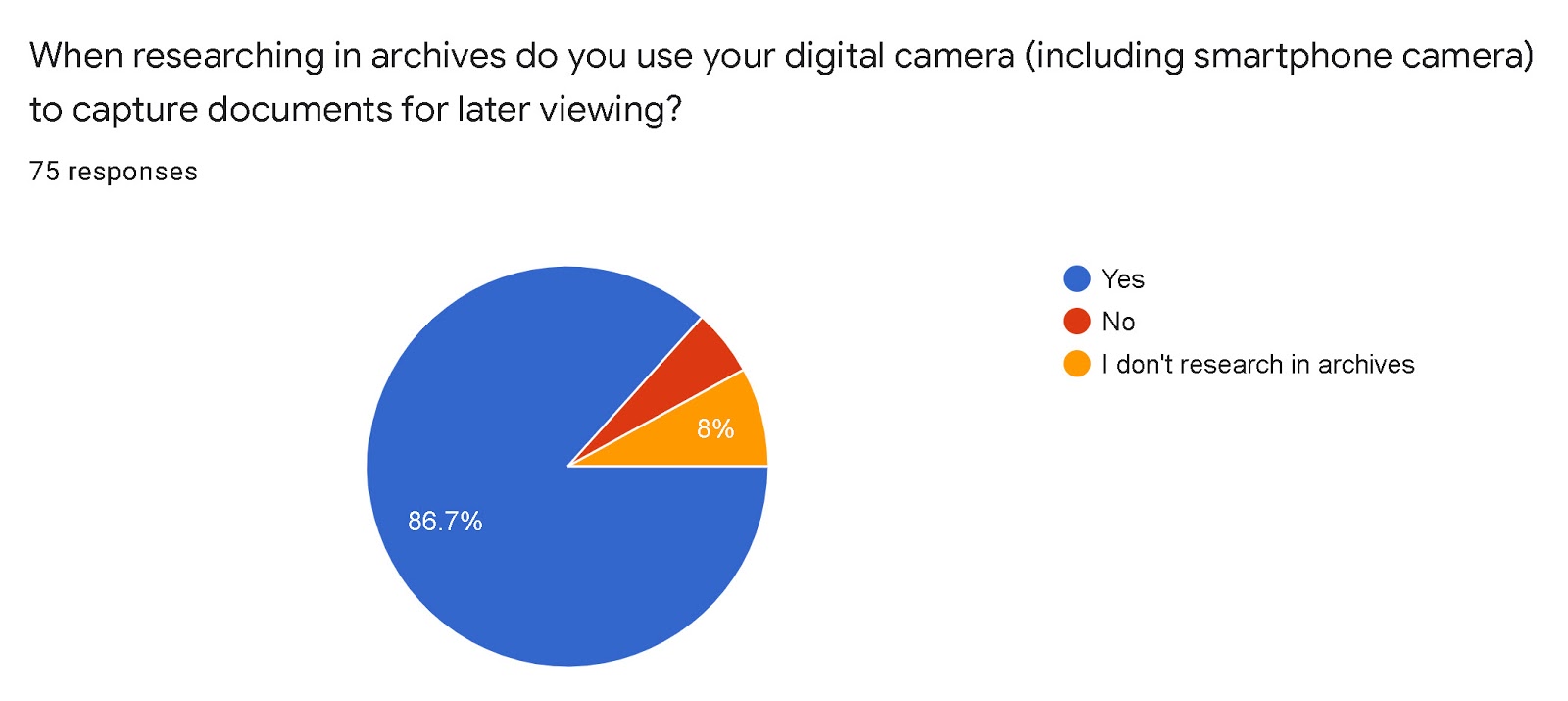
Here are the results of the survey Digital Photography and Research posted on Tuesday. 75 people responded.
The vast majority of genealogists responding, 87%, used digital cameras in archives. A further 8% don't research in archives, Ian Milligan's results for a similar survey of historians in Canada found 85% used digital cameras multiple times and a further 7% once or twice.
Ian's results were based on 253 responses received, a 17.3% completion rate. The 75 responses to Tuesday's survey came from 223 article views, a 33.6% completion rate.
At the 90% confidence level the results from the two surveys are not significantly different, the margin of error for the genealogists being 6.4%.
09 January 2020
French Senate Opens The Way to Genetic Genealogy Testing
Here's good news vis a post on the International Society of Genetic Genealogy Facebook Group.
The Senate adopted this afternoon on first reading the proposal of Senator Olivier Heno submitted on January 2 to allow genetic genealogy tests in France. You will find the full text of the modification at the end of this message.
Here is a crucial first step, although not without limit as you will discover in the text.....
" I. - after article 16-10 of the civil code, an article 16-10-1 is added as follows:
" Art. 16-10-1.-by derogation from article 16-10 of this code and articles l. 1131-1 and l. 1131-1-3 of the public health code, a review of the genetic characteristics of a person can be carried out for family research purposes, with a view to seeking possible close proximity or to estimate geographical origins. It is subordinated to the express consent of the person collected prior to the conduct of the exam, if necessary in a secure and secure format. It cannot give rise to medical information and cannot be covered by health insurance."
UPDATE: This proposal was rejected at a later stage of the process.
The Talk Genealogy Podcast
It's a while since I mentioned episodes of Malcolm Noble's Talk Genealogy Podcast for English family historians. Recent episodes are:
Talk Genealogy Podcast: Episode #46 Tudor Tax Records
What were they? Where can we find the records? What do they contain and, most important, how can they help the genealogist with too much time on their hands. Often you don't need to go to the originals, there are transcripts.
Talk Genealogy Podcast: Episode #45 Rolls of Incumbents
How can these histories of vicars in the family parish help the historian learn more about their ancestors?
Talk Genealogy Podcast: Episode #42 A Golden Age of English Parish Histories
The first half of the twentieth century saw a surge in the publication of parish histories very different from the modern version of the genre. Malcolm Noble looks at these earlier books can be especially useful for today's family historian.
Malcolm informs me that episodes remain “live” for three months before being archived.
BIFHSGO January Meeting
At 9 am: Review of BIFHSGO databases – John McConkey will describe the databases and indexes currently available for public research on the BIFHSGO website. Each of the Home Children,
Military and Migration offerings will be covered in a live demo. The newly released RG17 Index will also be highlighted.
At 10 am: Using family lore, with a grain of salt – Were you fortunate to have received family lore from your ancestors? Lynda Gibson will describe the family lore she had to work with including a memo written in 1900 by her great uncle Letham Gibson. Of course, such information, while absolutely invaluable, must also be taken with a grain of salt to discover the true facts. Follow Lynda’s search for her second and third great grandparents from Canada back to the home country. But where will she find them?
Meet in the spaciousness of The Chamber, Ben Franklin Place, 101 Centrepointe Dr, Nepean, Ottawa.
08 January 2020
New Records Online at IrishGenealogy.ie
On Wednesday, 8 January 2020 IrishGenealogy.ie added:
- civil marriage records from 1845 to 1944
- birth register records for 1919
- death register records for 1969.
Over 15.5 million Irish register records are now available to view and research online. Find out more at www.irishgenealogy.ie/en/news/154-update-to-the-civil-records-3
Now Online: ScotlandsPeople Annual BMD Update
Our Records: Double Wedding Celebrations
FamilySearch adds Ireland, Poverty Relief Funds, 1810-1887
Transcriptions of this dataset obtained from Findmypast, from archived originals ar TNA record series (PRO) T91 are now free at FamilySearch.
The collection contains minute books, loan ledgers and other account books of the Local Associations and County Committees, together with security notebooks, etc, letter books, correspondence and papers of the Directors, etc. The scheme provided small loans to the 'industrious poor'.
This is an example of the information provided in a random search on FamilySearch.
| Name: | |
|---|---|
| Event Type: | |
| Event Date: | |
| Event Place: | |
| Event Place (Original): | |
| Residence Place: | |
| Role of Individual: | |
| Occupation: | |
| Entry Number: |
The original record on Findmypast showed the loan for £2 was made on 9 September and was marked Paid.
All the transcripts I checked showed event type Flourish. Does anyone know the significance?
One of London Metropolitan Archives's Most Popular Holdings to be Digitized
Coram’s Foundling Hospital archive, fragile and vulnerable, consists of over 245 linear metres of records — general registers, inspection books, petitions and other documents revealing the details of the lives of children in its care from the 18th century. Some 112,000 images over the period to 1900 will be digitized, a quarter of the archive which is unbroken to the present day.
The archive documents will be transcribed with the support of a global community of volunteers and will be made accessible to the general public at coramstory.org.uk along with stories and content from the projects created by care-experienced young people, and an online interactive timeline of care.
Digitization is made possible through a grant of £1.26 million from The National Lottery Heritage Fund.
More at Coram to tell the story of care through digital project funded by £1.26m from the National Lottery.
BIFHSGO Conference 2020 - Call for Speakers
The themes:
Researching Irish family history
Finding female ancestors
DNA, in particular mtDNA and use of the x-chromosome in autosomal matchings
If you have a great presentation likely to interest Society members that doesn't fit in the themes submit anyway.
The deadline for proposals is 31 January 2020.
Check out the Call for Speakers page for more information.
07 January 2020
Changes to Document Ordering at TNA
As the reading room is open 09:00–19:00 Tuesday and Thursday; 09:00–17:00 Wednesday, Friday and Saturday, 24 documents is likely as many as you can handle.
Find the details on scheduling when documents will be delivered at Changes to document ordering.
Digital Photography and Research
As a family historian, when researching in archives do you use your digital camera (including smartphone camera) to capture documents for later viewing?
In a survey of historians in Canada, Ian Milligan, Associate Professor of History at The University of Waterloo found that 17 out of 20 have done so multiple times. See slides for a recent presentation he gave here.
Are genealogists/family historians like those who responded to Ian's survey? Please answer below.
Faster Access to New Records Coming at FamilySearch
FamilySearch is releasing a new tool for viewing recently digitized record images. This feature will help you more easily find images that aren’t yet indexed (or text searchable), which gives you quicker access to new records. FamilySearch has more than 300 cameras working to preserve records worldwide. With the upcoming Explore Images tool, new record images can be made viewable on the site in a matter of days or weeks, instead of going through months or years of processing.
CWGC Beechwood Cemetery Burials: Charles F. W. Dreher
Charles Frederick William Dreher was born in Dresden, Germany of British parents on 29 January 1890. His parents lived in Switzerland, a brother in Italy.
A 1912 graduate of MacDonald College he was employed as an assistant in vegetable gardening at the Experimental Farm before enlisting in December 1914 as a gunner with the 23rd Battery of the CFA. He received a gunshot wound to the wrist and subsequently served with the 8th. He was commissioned Lieutenant early in 1918.
In the first quarter of 1918 he married Ethel Marion Clarke in Leicester, England. They had a daughter Irene a year later.
He died of encephalitis on 7 January 1920; his grave is at Lot 15. Sec. 29. 11. at Beechwood Cemetery.
06 January 2020
New Book: The Genealogical Sublime
You may recall her documentary film Data Mining the Deceased: Ancestry and the Business of Family which received funding from the Office of the Privacy Commissioner of Canada.
Publisher The University of Massachusetts Press's summary of the book is:
Since the early 2000s, genealogy has become a lucrative business, an accelerating online industry, a massive data mining project, and fodder for reality television. But the fact remains that our contemporary fascination with family history cannot be understood independently of the powerful technological tools that aid and abet in the search for traces of blood, belonging, and difference.
In The Genealogical Sublime, Julia Creet traces the histories of the largest, longest-running, most lucrative, and most rapidly growing genealogical databases to delineate a broader history of the industry. As each unique case study reveals, new database and DNA technologies enable an obsessive completeness—the desire to gather all of the world’s genealogical records in the interests of life beyond death. Archival research and firsthand interviews with Church of Jesus Christ of Latter-day Saints officials, key industry players (including Ancestry.com founders and Family Search executives), and professional and amateur family historians round out this timely and essential study.
The choice of terminology "aid and abet", "lucrative", "obsessive", "life beyond death" suggests an agenda.