British Isles Family History Society of Greater Ottawa founding member and first Director of Education and Queries, John (Jack) Moody passed away on the evening of Friday 16 May. He was a Society life member and member of the Hall of Fame.
John Wentworth (Jack) Moody was born and educated in Hamilton, Ontario, and graduated from The University of Toronto with a BSc in Metallurgical Engineering in 1950. He furthered his studies at the Royal Military College of Science, in Shrivenham, England studying electronics and weapons. His military service was as follows: Royal Canadian Sea Cadets 1936-39; RC Signals, NPAM, CA(A), CA(R) 1939-49; RCEME, CA(R) 1949-60. Jack served in Canada, England and NW Europe, taking part in the advance from late 1944 into Germany. He retired to the Supplementary Reserve as a Captain in 1960. His subsequent employment was primarily with Canada Post Corporation, retiring as Director of Engineering in 1978.
Jack Moody was a life-time member of several genealogy and historical societies and Past-President of the Historical Society of Ottawa. He served as Provincial Inquiries Director for the Ontario Genealogical Society, and was both the Inquiries Coordinator and Chairman of the Ottawa Branch. In addition to being a founding member of BIFHSGO, Jack was also a member of the Irish Heritage Association, the Suffolk Genealogical Society, the Genealogical Society of Nova Scotia and the Herb Society of America. Jack's own family research included DOANES, MOTHERSHILL, NELLIS, BARTON, HARDING. BRAINE, BUDD, and MOODY.
(Based on material from Anglo-Celtic Roots)
18 May 2008
John Wentworth Moody, 1923 - 2008

17 May 2008
Genea-Cyberquote
It's a long weekend in Canada so here's a puzzle to solve, a quotation of genealogical significance. Decode it by replacing each letter with the correct one -- thus:
NGENNLU
becomes
ADVAARK
The above is not the letter correspondence in this puzzle.
UKCHCKDSV HXG KSTKVMGSVHFBG KS CWG BKLGBI GJGSC CWHC IDQ SGGT CD ZKST H XGUDXT HAHKS.
HBKVDS WHXG
(Congratulations to Randy Seaver, Randy's Musings is a permanent link, who not only solved it within a couple of hours of posting, but also pointed out my transcription error - now corrected.)
16 May 2008
How good is census indexing?
An email arrived from findmypast.com announcing their new transcription of the 1901 census records, starting with Gloucestershire and Somersetshire. The blurb read "The accuracy of our transcriptions, along with our high quality images, is what sets our censuses apart from our competitors'. After searching our transcriptions you may find people you haven't found on other sites."
I've also heard a respected genealogist (not an employee) at the Society of Genealogists make the claim that Findmypast's transcriptions are better than Ancestry's. How well does the claim stand up? I decided to rate them on a point basis, one point for each person correctly identified in a search for Reid in Somerset. Incidentally, Wikipedia states that Somersetshire is not the correct name for the county, but an archaic form that went out of fashion in the late 19th century.
A search on the exact name Reid yields 24 hits in Findmypast (FMP) and 22 on Ancestry (ANC). Of these 18 are identical. Whichever service you choose you stand a good chance of finding the person you seek. The glass is about 80% full. ANC and FMP each receive 18 points.
The first difference is a simple transcription problem. FMP finds Adam A Reid, ANC finds Adara A Reid. Looking at the original you can see how the Chinese indexers employed by Ancestry would read m as ra, but I'm surprised this was not caught in checking the work. One point to Findmypast.
The second difference is that FMP lists an Alex Reid living in Keynsham. However, looking at the original he, his wife and infant son are residing in Bitton, Gloucestershire. FMP has them in the wrong county. Penalize FMP three points for false identification.
ANC finds 14 year old Alvan Reid, a nephew in the home of Frances E Hancock. No amount of searching found this person on FMP, nor the Hancocks, nor several other people on the page. Unfortunately FMP has no way to search by piece, folio and page number as does ANC. Maybe there's a page missed. One point to Ancestry.
ANC finds Charles Tassela Reid and his wife Emily. FMP finds Charles Tassel Reed. Both are reasonable attempts at what investigation in other sources shows should be Charles Tassell-Reed. No points awarded.
FMP finds Martha Reid which ANC transcribes as Martha Rud. Rud is an unusual name and several of those found in the 1901 census look to be doubtful transcriptions. FMP appears correct; the entry is consistent with a marriage registered in late 1900. One point to FMP.
Finally FMP finds Reginold J Reid, ANC Reginald J Reid. On the original it certainly looks like --old, but which would you rather see it indexed under? Some argue you transcribe what you see, some that you normalize to a controlled vocabulary. In practice a worthwhile search engine should find the entry despite the difference in vowel. No points awarded.
Bottom line, 17 points to Findmypast, 19 points to Ancestry. Not a conclusive win, but also not a confirmation of Findmypast's claim. While the statement "after searching our transcriptions you may find people you haven't found on other sites" is true, it could equally apply in reverse.
One thing I did appreciate about FMP is the ability to zoom in the image more than you can with ANC. That may reflect a better quality image as FMP claims.
What the evaluation does show is the kind of variations to look for when an ancestor eludes you in the census.
15 May 2008
The DNA heritage test furore
In my posting comparing Ancestors and Ancestry magazines I made passing reference to Penny Law's article "Heritage Tests, revelation or rip-off?" in the June issue of Ancestors. Her conclusion, "its just a bit of fun." The article attracted the interest of the Daily Mail and the BBC. In a blog posting 14th May 2008: DNA furore Ancestors editor Simon Fowler admits that "My personal view is that DNA tests of these kind are a complete con and do not contribute to individual’s family trees."
Before painting such tests as a "complete con" surely the magazine should have made an effort to reconcile the results of the different tests? Was expert advice sought on the specifics of particular situation; if so it wasn't evident in the article. It appears that one test was done on the donor's autosomal DNA, so sampling across the whole spectrum of the donor's ancestors, whereas the other two looked specifically at the paternal and maternal lines, but with different terminologies used. Perhaps the fact that the article confirmed the editor's "personal view" was enough, along with the comfort of quoting the opinions of Cynics in the United States who may or may not be knowledgeable.
As to contributing to an individual's family tree, that isn't the aim of heritage tests. There are well established and highly successful DNA tests that are helping people sort out tangles in their family tree where paternity issues exist and helping link, or de-link, branches of family trees.
14 May 2008
Copyright
You don't see my hand up.
The little I do know comes from having listened to several presentations, and reading what I can, especially the weekly column written by Michael Geist published in the Ottawa Citizen and elsewhere. Read them, and much more, at his blog.
In his most recent column, on crown copyright, Geist asserts that "crown copyright costs Canadians hundreds of thousands of dollars while being used as a tool to suppress public criticism of government programs." Geist cites examples of use of crown copyright being denied for political reasons. In the most recent year for which records are available "crown copyright licensing generated less than $7,000 in revenue, yet the system cost over $200,000 to administer."
Copyright I may not understand, but a money losing proposition I do -- having been involved in my share.
Discussion on Canadian copyright legislation, with a new act expected to be introduced in the Commons soon, is one reason why it would be valuable to have a way for the Canadian genealogy community to speak in unison.
In the meantime, you may have noticed a new Creative Commons Licence logo is now found in the left hand column. You may freely republish for non-commercial purposes any material in this blog for which I own copyright. Commercial reproduction requires permission. Any reuse should acknowledge the source as Anglo-Celtic Connections, copyright John D Reid 2008, and include a link to the original where feasible.
13 May 2008
Ancestors and Ancestry
 The latest issue of Ancestry magazine, published by The Generations Network Inc, arrived at my door on Friday. It's the May/June issue. I went to place it in the pile of other genealogy magazines, the top one of which was the June issue of Ancestors published by The (UK) National Archives and Wharncliffe Publishing Ltd, and then wondered how they compare.
Superficially they're similar, glossy and full colo(u)r. Ancestry is 8" by 10", with 66 pages plus the cover. The cover price is 4.95 US dollars. Ancestors is slightly larger, the A4 metric format. That's 210 by 297 mm , or 8-1/4" by 11-2/3". The issue has 74 pages plus the cover. The cover price is 3.50 UK pounds, 6.82 US dollars.
For the arithmetically inclined, Ancestors costs about 3.5% more on a per unit page area basis than Ancestry. I was surprised
Feature Content
Both magazines have regular and feature content. Ancestry also has categories Yesterday, Today and Tomorrow with additional content as well as further categorizing the feature material. Of the four feature articles in Ancestry two "Getting Free Dirt on Their Hands" and "Shotgun Weddings" are US social history and of no direct interest to me. They were generally interesting; I probably wouldn't have taken the time to look at them if not for doing this posting. "Before My Very Eyes" reports on experience with two commercial photo-scanning and enhancement companies. Again these are US companies so of little direct interest. "Returning to Their Medicinal Roots" with its photos of food, comments on chicken soup and "an apple a day" stretched the bounds of what's suitable for a magazine titled Ancestry.
Ancestors has eight feature articles, two of them part of a DNA Special. Chris Pomery, author of two British books on DNA, provides a readable explanation of Genealogy of the Genes. Heritage Tests: Revelation of rip-off recounts writer Penny Law's experience with DNA tests by three companies for ancestral origins. Ancestry also had a DNA article in the Tomorrow section. You wouldn't need to be British to benefit from these. The remaining Ancestors features are mainly social history, some too specific to be of anything but general interest.
Regulars
Some of the regular Ancestry columnists had material of value to me. I enjoyed Colleen Fitzpatrick's analysis of an old photograph. It was annoying that the reproduction in the magazine was too small to allow you to deduce the same things she did. Megan Smolenyak's item in her Honoring Our Ancestors series was also instructive. The editors omitted identifying her as the author, except on the contents page.
In regular content Ancestors has a second good article, not specifically UK-oriented, by Chris Pomery, The Novelty of Networking. It also has book reviews and an Ask the Experts sections.
Overall
Despite the superficial similarity the magazines are different in that both are squarely targeted at their respective UK and US markets. It's unlikely I'd have seen this issue of Ancestry if it hadn't been included as a freebie with my Ancestry.com world subscription.
It wasn't until I read the masthead list of editors and contributers that I twigged to another difference. Women are just over one-third of names on the Ancestors list, nearly three-quarters for Ancestry. On visual appearance alone Ancestors, with maps, diagrams and images of old documents and steel-plate engravings would sit happily on the newsstand with the computer and technology magazines. Ancestry, with pictures of food and softer colours would not look out of place alongside homemaker magazines.
12 May 2008
The Ottawa Public Library needs a wake up call on digitization
Seven Northern New York counties, Ottawa's near neighbours with a total population under half a million, have cooperated to digitize and OCR more than a million pages of 31 local area newspapers and make them freely available online. Access them here. This was achieved through a library cooperative.
By contrast the Ottawa Public Library, serving a population approaching twice the size, appears MIA on digitization. When I asked one of their staff about this some weeks ago I was told the OPL was investigating digitization, then received an email stating "I was incorrect in thinking that we were undertaking a digitization project - we are not quite there yet."
"Not quite there" seems to be overstating the case. You can search the work plan for the Ottawa Public Library Board, scheduled for discussion on 12 May, for any mention of digitization. It's totally off the radar screen, not impressive for an organization that aspires to be "innovative."
I have sent an email to the City Councillors who sit on the Library Board, Jan Harder (Chair), Michel Bellemare, Peggy Feltmate, Diane Holmes, Shad Qadri and Marianne Wilkinson, requesting they add an item to the work plan that would see the OPL report to the Board on options for a local digitization project by the fourth quarter. Two responses so far have not been encouraging that the suggested action will be forthcoming, One Councillor does seem interested in exploring the issue further with the OPL.
11 May 2008
Digging Up Your Roots
Scenes from the Saturday 10 May event hosted by the Family History Center of the Ottawa Stake, Church of Jesus Christ of Latter Day Saints.
Hariette Fried from the City of Ottawa Archives who adds verve to any event.
Mike More, Chair of the Ottawa Branch of the Ontario Genealogical Society. The photo is cropped so as not to show the hordes on the other side of the table.
British Isles Family History Society of Greater Ottawa featured information in their September conference.
The Family History Center display was the only one with any need for a cash box.
10 May 2008
Irishmariners.ie
 A website with an online index of Irish born merchant seamen (and one woman) contained in the CR10 series of index cards in the Southampton Civic Archives. The website currently contains information, including date of birth, on 11,345 Irish born merchant seamen active from late 1918 to the end of 1921 out of an estimated total of around 20,000 plus. You need to know both first and surname, or identity number, to search.
The Southamption Civic Archives holds 270,000 cards covering the the British Merchant Marine during the period from late 1918 to the end of 1921 which usually includes passport-type photographs. It is part of the Central Index Register of Merchant Seamen, a collection of over a million and a quarter merchant navy service record cards with details of people serving on board British registered ships between 1918 and 1941.
09 May 2008
Administrative changes
Unfortunately my attempts to change the address on this blog threw things off. When folks came to the blogspot address were redirected to a stale page at johnreid.ca. Sorry.
Waiting for the Vatican to drop the other shoe
According to the Catholic News Service the Vatican Congregation for Clergy has ordered dioceses across the globe not to give information in parish registers to members of The Church of Jesus Christ of Latter-day Saints.
"The congregation requests that the conference notifies each diocesan bishop in order to ensure that such a detrimental practice is not permitted in his territory, due to the confidentiality of the faithful and so as not to cooperate with the erroneous practices of the Church of Jesus Christ of Latter-day Saints."
I confess not to be aware of this doctrine of "confidentiality of the faithful." It must have a particular meaning, but to the outsider sounds like the antithesis of proclaiming your faith.
Moreover, if collecting Catholic records in pursuit of LDS's "erroneous" rebaptism is so odious one would think it would also be objectionable for Catholics to have anything to do with records collected to such ends. Will the Vatican be issuing an edict prohibiting Catholics from using any LDS-collected genealogy records?
08 May 2008
Saturday May 10 Genealogy Events in Ottawa
At Library and Archives Canada (BIFHSGO ) 395 Wellington Street

At the Ottawa Stake Family History Centre 1017 Prince of Wales Drive

1 - 5 pm: Ten speakers, three different sessions run in most time periods.
See the full schedule on the Family History Centre website
06 May 2008
Report on "Who Do You Think You Are - Live"
I've been looking for a comprehensive report on the event this past weekend at London's Kensington Olympia. Blogger Chris Patten has it all here, including a link to a new user interface to The Times Online, free for "about two months."
Genealogy Society Membership Trends
Annual reports from various branches of the Ontario Genealogical Society have just appeared in Newsleaf. According to the President’s report membership in the Society is decreasing. Not every branch mentions membership trends, but its clear the situation isn’t uniform. Here are extracts from those that do:
Our membership has remained the same ... our membership dropped to 195, down from 222 the previous year … our membership has been stable for several years … we’ve experienced a slight decline in membership … membership this year dropped two persons … the slow, but nevertheless alarming slippage in membership numbers continues … branch membership has remained steady … for the first time in a number of years, our membership has been stable …. Membership remains about the same … with the decline in membership over the past few years … our membership is up … membership continued to decline in 2007, although in the 1.5% range which is an improvement over the previous few years … membership is down a bit from last year.
The President writes “I think that we are all aware of some of the main reasons for this decline.” I wonder if that’s true, or whether we just think we know. If even one branch is growing, and several are maintaining membership, what are the reasons they are bucking the trend?05 May 2008
Citation Cheat Sheet
Sometimes even your friends won't tell you! I've blogged before about Alison Hare's presentation on Citations for Canadians, but didn't know her handout is now online at the website of the Ontario Chapter of the Association of Professional Genealogists. Scroll down to the link at the bottom of the page. I keep a hard copy handy, on the off-chance I might become inspired to cite a source!
Alison is on the program to present an expanded version, Citations for Genealogical Sources, at the BIFHSGO conference in September.
04 May 2008
Persistence pays
On Thursday the Genealogy Databases Posted or Updated Recently page for Ancestry.com showed a new database on US Army, Register of Enlistments, 1798-1914. As usual when I find a new database, but without great hope, I entered Northwood looking for my runaway great-great-grandfather. I found him!
He first enlisted in the US Army, about the last place I thought of looking, in New York. It was before the birth of his second child in England. He served in Texas, Kansas and Missouri where he died and was buried in a military cemetery.
Evidently he never contacted his family back in England. The opportunity to claim an inheritance if he put in an appearance didn't tempt him back, if he knew of it, and when his children married they stated he was deceased, even though he lived to 1896.
That find alone justified subscribing to Ancestry's World Edition.
03 May 2008
Start Writing Your Family History
Want to learn how to turn your family research into readable stories? The Ontario Chapter, Association of Professional Genealogists (OCAPG) announces "Writing A Narrative Family History," a day-long seminar with John Colletta, popular speaker, educator and author. Co-sponsored by the Canadiana Department of the North York Central Library, this is a day that will motivate and inspire your own family history writing: Saturday 27 September 2008 at the North York Central Library, 5120 Yonge Street, Toronto. Visit the OCAPG website at
A faculty member of the prestigious Institute of Genealogy and Historical Research (Samford University, Alabama) and Salt Lake Institute of Genealogy, John Colletta has planned the day around all the facets of good writing and good storytelling. One of John's own family accounts, Only A Few Bones, is a model for narrative writing but he is also known for They Came In Ships and Finding Italian Roots. Register early to ensure your space! http://www.rootsweb.com/~onapg.
via: Brenda Dougall Merriman
02 May 2008
Press releases of interest
Here are some announcements from FamilySearch coinciding with the UK "Who Do You Think You Are?" Show.
FamilySearch Teams with Findmypast.com to Increase Online Access to British Historical Records
Chelsea Pensioners and Militia Records, and Merchant Seamen Records, held at The (UK) National Archives will be scanned by FindMyPast, indexed and transcribed by FamilySearch. Presumably the index will be available freely, but following the link to the original images will cost.
New Genealogy Guides for England and Scotland
Finding Records of Your Ancestors, England and Finding Records of Your Ancestors, Scotland, are the latest additions to the popular series of free online publications. The guides are designed for those who have already gathered some family history information about their British or Scottish ancestors and are ready to search public and private records.
The British Nineteenth-Century Serials Edition
On May 13 the British Library, British Arts and Humanities Research Council, and cooperating institutions will launch the Nineteenth-Century Serials Edition (ncse). According to the British Library press release this is "a unique digital resource, which gives the user an informative, accessible and authentic experience of 19th century newspapers. The collection illustrates the phenomenal growth and transformation of the press in the 19th century and brings to life a society and century in flux. The titles included in the ncse are:
I'm unsure how useful the collection will be for family history, but we'll soon find out as it's to be free online to all.
There's more information at: www.ncse.kcl.ac.uk, including links to some other interesting digitization projects under Resources in the left-hand column menu.
Via ResourceShelf
01 May 2008
A model for LAC accountability to users
February 26 saw the first LAC public consultation session which I summarized here and LAC summarized here.
Hours of operation were at the forefront, and we were informed that any change would not likely be instituted until June or July.
There were many other, smaller, issues raised. Increasing user satisfaction means addressing them, but its been two months now with no feedback. These issues should be handled close to the working level, assuming responsibility and authority have been pushed down the line as good management practice demands. Is ADM level involvement really required?
The model is for client responsiveness is TNA, The (UK) National Archives. Here's the meeting announcement for their latest monthly users forum.
Hear what’s happening at TNA and have your say, over lunch
You are invited to attend a meeting of the monthly TNA User Forum, which is open to all users of TNA services.
Lunch is available from 12:15, so the meeting can start at 12:30.
Agenda
Title: The National Archives’ User Forum
Date of Meeting: Thursday 17 April 2008
Time of Meeting: 12:15 for 12:30
Location: Training Room
1. Welcome - Jill Allbrooke, Head of Enquiry Services
2. Matters arising
3. (missing in the original)
4. Programme for improvements to TNA’s public services at Kew (Kew 2008) (standing item) - Chris Cooper, Kew 2008 Programme Manager
5. Complaints, suggestions and compliments received by The National Archives - Paul Sturm, Quality Manager
6. TNA’s public service performance against our targets (standing item) - Jill Allbrooke
7. Open discussion
8. Next meeting: Thursday 15 May 2008, Talks Room
What I like about this approach is:
1. dealing with matters arising. Clients fear that management will treat meetings like a pressure release valve where users can let off steam, and then close the value again but leaving the heat on. TNA deal with at the next meeting, if they can't be dealt with sooner;
2. being open about complaints, suggestion and compliments raised by other means;
3. maintaining a regular monthly reporting on performance targets;
4. an agenda item for open discussion;
5. a commitment to regular monthly meetings;
6. copies of past meeting minutes and documents available online here.
Providing lunch is a nice touch, a tangible demonstration that the user input is appreciated and of value to the organization.
30 April 2008
More UK searchable genealogy & history websites - from Rick Roberts

Rick is one of those people who helps make doing family history in Canada a pleasure. Visit Global's stand at a genealogy conference and you'll find him keen to listen, to understand your needs and recommend a solution.
Rick and Sandra have been bringing a wide range of books and materials to the marketplace of the BIFHSGO annual conference since the start. As is often the case he will be giving a pre-conference seminar, this year on the new version of Legacy Family Tree.
29 April 2008
Thanks to you, Cyndi and Randy
As of noon on Monday, 28 April this blog passed the monthly record for total hits, unique visitors and return visitors. Although I don't aim to break records it does indicate people find something of value in my ramblings. Thank you for visiting
Thanks also go to Cyndi Howells and cyndislist where I placed an announcement about the blog. It would be nice if Cyndi would include Anglo-Celtic Connections in her category Blogs for Genealogy. Pretty please.
Randy Seaver mentioned the posting on LAC recommended web sites in his most recent Best of the Genea-Blogs on his Genea-Musings site. Much appreciated Randy.
+-+-+-+-+-+-+-+-+-+-+
What we anticipate seldom occurs; what we least expected generally happens.
- Benjamin Disraeli
28 April 2008
Red hair amongst the Goughs?
Friend, and highly respected Toronto genealogist, Brenda Dougall Merriman has a posting on her experience as a redhead on her blog.
Several surnames are supposedly derived from the founder(s) having red hair or a ruddy complexion. Reid and its variants are amongst them. Other surnames are Gough, Rogan and Rufus.
Statistics are that the frequency of red hair in Britain is only about 4%. There don't appear to be any statistics for ruddy complexion, defined as "inclined to a healthy reddish color often associated with outdoor life." It doesn't take much sun exposure for me to fall into that category.
I did a quick survey of soldiers with last name Gough with attestation papers at Library and Archives Canada. There are 127 of them. Only 110 have information on complexion and hair colour.
Three soldiers were described as having red (actually reddish or auburn) hair. All three also had blue eyes and two of the three a ruddy complexion. Three of 110 is less than 4%, so there is no evidence of excessive red hair in this sample of Goughs.
In total seven Goughs had a ruddy complexion. The Oxford English Dictionary defines ruddy as "Of the face, complexion, etc.: Naturally suffused with a fresh or healthy redness" so it would seem reasonable to count in with ruddy at least some of the nine Goughs described as having a "fresh" complexion. In one case there were two attestation papers on file for the same person -- in one his complexion was described as fresh and in the other ruddy.
Certainly a ruddy or fresh complexion is several times more common amongst the Goughs than red hair.
27 April 2008
More on LAC and USB flash drives
It was a pleasure to be at an event at Library and Archives Canada on Friday evening to mark the acquisition and donation of archival materials from the descendants of former Governor General Lord Elgin. Ian Wilson managed the ceremonies with grace. Congratulations to those who organized the event so well.
I took the opportunity of a brief conversation with Ian to mention the question of LAC walking his talk regarding the use of USB flash drives at LAC. He seemed unaware that clients are not allowed to use them in LAC equipment.
By coincidence on Saturday Dick Eastman posted an item on these drives in his online genealogy newsletter. I took the opportunity to post a comment to which Dick responded:
JDR ---> Some local archives and libraries prohibit the use of flash drives on their computers citing the risk of virus transmission. How real is the threat?Dick Eastman: It is real. However, it can easily be managed. The process isn't complex, any Windows system administrator should be able to handle it.
Two things pop to mind: (1.) the threat is no greater for jump drives than it is for floppy disks or CD-ROM disks. These threats have been around for years and properly installed and frequently-updated anti-virus programs have proven to delete 99.9% of them. (2.) Properly-installed public access computers in libraries, Internet cafes and elsewhere usually are configured to have the hard drives wiped clean and reloaded every day or so. Even if a virus infection occurs, it doesn't last long.
Proper anti-virus software installed in your own computer minimizes the risk of a problem being introduced to your system.
JDR ---> What can be done about it to permit the use of these devices?
Dick Eastman: Probably not much. We are the guests in the establishment and are at the mercy of the owners, whether we agree with their policies or not.
At this time of year, with income taxes due in a few days, being "at the mercy" of the administrators of a publicly funded institution does not sit well. As pointed out on Friday, Lord Elgin instituted "responsible" government in Canada rejecting the prior practice of domestic government decisions being taken in Britain. Could we find another Lord Elgin to institute the same kind of "responsible" administration at LAC?
Having mentioned Dick Eastman it would be irresponsible not to point out that he is a speaker at the OGS Conference coming up in London, Ontario.
26 April 2008
Ottawa Digging Up Your Roots Fair - May 10th
 Recognize any of these names? Michel Béland, Olivier Bilodeau, Terry Findley, Hariett Fried, Ana Ghia-Pereira, Diana Hall, Shirley-Ann Pyefinch, Kyla Ubbink, Glenn Wright, and someone named John D Reid.
Talks by these local speakers are some of the attractions at the Ottawa Stake Family History Centre of the Church of Jesus Christ of Latter Day Saints 3rd Annual Family History "Digging Up Your Roots" Fair.
Mark the afternoon of Saturday May 10th, 1 -5 pm, on your calendar and plan on coming to this free event at 1017 Prince of Wales Drive.
BIFHSGO has a good meeting with a speaker from Britain that morning too.
25 April 2008
An invitation - Subject or Citizen?
I have been asked, and am pleased, to publicize the following
Mr. Ian E Wilson, Librarian and Archivist of Canada, and Mr. Allen Weinstein, Archivist to the United States, cordially invite you to the opening of the exhibition
Subject or Citizen?
The Treaty of Paris
United States Ambassador to Canada.
395 Wellington Street, Ottawa
RSVP by May 1st, 2008
613 992-2618
rsvp@lac-bac.gc.ca
Reception/Cash Bar
Note: Unfortunately the nice graphic version of the invitation failed to appear on many browsers, although it does with Firefox -- yet another reason to switch.
24 April 2008
Voters Lists Online
The May issue of Ancestors Magazine has an article "Reading the Rolls" by Tony Abrahams on British voters lists. It deals particularly with the lists at the Midland Historical Data Archive for which Abrahams is responsible.
British voters lists from 2002 onward are available digitally at www.192.com. Searching earlier lists is a real chore, unless you have a full address, as they are not organized alphabetically by name.
Even finding the lists takes a bit of searching. You can find post 1947 and a few earlier voters lists at the British Library. More complete collections are often held locally and may be identified by searching www.familia.org.uk for the location of interest.
You would think voters lists would be a prime target for the large commercial genealogy database companies such as ancestry.co.uk and findmypast.com. This would be true especially for the years after 1928 when all adults where enfranchised and other sources are lacking.
As is often the case a local initiative shows the way, in this instance indexed Birmingham Electoral Rolls for 1912, 1918 (Absent voters), 1920,1925,1930 & 1935 at www.midlandshistoricaldata.org. They can all be searched by name, by address or both, and viewed by pay per view or subscription. Prices are here.
Canadian voters lists are also difficult to work with. Library and Archives Canada holds federal voters lists of the Office of the Electoral Officer for Canada (RG 113) from 1935 to 1983. As in the UK they are arranged by the name of the electoral district. Within the electoral districts the lists are further arranged by polling station.
LAC has the voters lists on microfilm. Find the film number on the list here.
23 April 2008
LAC suggested online genealogy databases
Here is a list of online genealogy databases suggested by Library and Archives Canada in a paper handout dated October 2007 found at CGC yesterday.
LAC, Canadian Genealogy Centre: www.collectionscanada.gc.ca/genealogy/
Automated Genealogy: automatedgenealogy.com/census/index.html
Family Search: www.familysearch.org
Newfoundland's Grand Banks Genealogy Site: ngb.chebucto.org
Provincial Archives of New Brunswick: www.gnb.ca/Archives
Prince Edward Island Baptismal Index: www.gov.pe.ca/cca/baptismal/
Nova Scotia Archives: www.gov.ns.ca/nsarm/databases
Nova Scotia Historical Vital Statistics: www.novascotiagenealogy.com/
Bibliothéque et Archives nationales du Québec: www.banq.qc.ca/portal/dt/genealogie/?bnq_langue=en
PRDH: Quebec French-Canadian genealogy before 1800: www.genealogie.umontreal.ca/en/main.htm
Ontario Wesleyan Methodist baptisms: freepages.genealogy.rootsweb.com/%7Ewjmartin/wm-index.htm
Ontario Cemetery Finding Aid: www.islandnet.com/~jveinot/
Northern Ontario Canada Gravemarker Gallery: freepages.genealogy.rootsweb.com/~murrayp/
Toronto 1901 Census Street Finder: www.ontarioroots.com
Métis National Council Historical Online Database: metisnationdatabase.ualberta.ca/MNC/
Manitoba Vital Statistics: web2.gov.mb.ca/cca/vital/Query.php
Saskatchewan: Genealogy Index Searches: vsgs.health.gov.sk.ca/vsgs_srch.aspx
British Columbia Cemetery Finding Aid: www.islandnet.com/bccfa/
British Columbia Archives: Vital Events: www.bcarchives.gov.bc.ca
Yukon Gold Rush: www.yukongenealogy.com/content/database_search.htm
Canadian Virtual War Memorial: www.vac-acc.gc.ca/remembers/
Commonwealth War Graves Commission: www.cwgc.org
Legion Magazine's Last Post Database: www.legionmagazine.com/lastpost/
Air Force Honours and Awards: www.airforce.ca/index2.php3?page=honours
Ingeneas: www.ingeneas.com
The ShipsList: www.theshipslist.com
Nanaimo Family History Society Passenger List Indexing Project: members.shaw.ca/nanaimo.fhs/
Ancestors on Board: www.ancestorsonboard.com
Ellis Island (New York 1892 - 1924): www.ellisislandrecords.com
Castle Garden (New York 1830 - 1892): www.castlegarden.org/about.html
Our Roots: www.ourroots.ca
Obituary Daily Times: www.rootsweb.com/~obituary/
For those surprised I didn't blog about April 23rd being St George's Day, England's national day, I'm celebrating in the traditional Canadian way, by ignoring it.
Those who want to mark the occasion may wish to enjoy this old Song of Patriotic Prejudice:
22 April 2008
14,028,877 Canadian names
If you think Séguin, Tremblay, and Potvin when you think Quebec you're not wrong, but neither are you seeing the full picture. Plenty of Irish, English and Scots; O'Briens, Wrights and Macdonalds settled in the Province too, and many are to be found in a newly indexed Ancestry.ca collection Quebec Vital and Church Records (Drouin Collection), 1621-1967.
The 14,028,877 number comes from the Complete Ancestry Title Listings. It's on the first page listed by decreasing number of names in the title. This is the 35th largest database in the whole Ancestry collection, and second largest Canadian title after Canadian Phone and Address Directories, 1995-2002
I'm unsure how to reconcile the 14+ million number with the note above the search form for the collection "Please note: 29 million names are now searchable via the new index. Searching may produce records that have not yet been indexed. Please continue to enjoy access to all historical images. With cooperation from University of Montreal, the remaining 8 million names will be available later this year."
However many names are actually available and indexed, this is a large enough database that you won't want to miss out trying it with some of the names in your genealogy. Even if you have no known Quebec connection its worth trying to see if any co-lateral lines, or family strays, happen to turn up. You'll need a subscription or to go to a public library or other institution that has an Ancestry Library subscription.
21 April 2008
Old Bailey database enhanced
Simon Fowler, editor of Ancestors magazine, posts on the magazine blog about an update to the free Old Bailey database. There is a new website address, www.oldbaileyonline.org and you can now search an extended range of dates by key word as well as by person.
The sentence that particularly caught my attention in the blog posting was "Historians have suggested that the cocaine habit only really arrived (in London) with Canadian troops during the First World War." Go to the blog to see Fowler's comments based on searching cocaine in the Old Bailey trial proceedings.
20 April 2008
Book Review: New Lives for Old

Starting with the experiences of two women, Maria Rye (1829-1903) and Annie Macpherson (1825-1904), who pioneered child migration to Canada, the first chapter moves on to deal with the 1875 report by Andrew Doyle (1809-1888) who was especially critical of Rye, the way children were assigned to hosts, and lack of inspections.
Chapter three treats some of the other agencies associated with names like Rudolf (Waifs and Strays), Quarrier, Fegan and Middlemore, and illustrates the children's experiences with anecdotes. It tells of the history of the Allen Line that transported many of the children, and outlines the typical child's migration experience to the time they found a placement.
Responsible for more child migrants to Canada than any other was the agency founded by Thomas John Barnado (1845-1905.) Chapter three is devoted to Barnardo and Dr Barnardo's Homes; chapter four to Catholic child emigration. The farm school movement, most associated with Kingsley Fairbridge (1885-1924) is the subject of chapter five.
It is surprising in a book otherwise dealing with child emigrants to find a chapter devoted to WW2 British child refugees. Unlike the home children they knew they were returning to Britain at the end of the war, and authorities went to considerable lengths to maintain family ties. That certainly applies to those children who came under the government Children's Overseas Reception Board (CORB) programme. It is the experiences of these children that are dealt with in chapter six, despite the fact that more than twice as many children were evacuated to Canada in 1940 outside the CORB scheme through schools, businesses and fraternal organizations.
The final chapter treats the last years of child emigration with an emphasis on Australia. There are notes for each chapter collected at the back, a compilation of sources for tracing records of child migrants; useful addresses; websites; a bibliography and index.
The book is likely all the casual reader will need. For those wanting more depth Marj Kohli's book The Golden Bridge is recommended, and cited frequently in this book. For a more detailed treatment of CORB I recommend Michael Fethney's The Absurd and the Brave.
The situation and prospects for most if not all of these children in Britain were poor, if not bad. If Britain had in place a more humanitarian approach to dealing with its destitute children, and the social conditions that were the root cause, this might not have been the case.
19 April 2008
Musings on weather and genealogy
As the last snow looks set to disappear from my front lawn today (a forecast), and I read about the death of Edward N Lorenz, it set me thinking about similarities between weather and family history.
Ed Lorenz, the founder of Chaos Theory, was arguably the greatest atmospheric scientist, or mathematician-meteorologist, of his generation. He started his career as a weather forecaster during WW2, a background he shared with Nobel Laureate Kenneth Arrow. Lorenz fully deserved a Nobel Prize for his insight that "slightly differing initial states can evolve into considerably different states." This was expressed more imaginatively that the flap of a butterfly's wing in Brazil can cause a tornado in Texas. It showed why there are limits on the predictability of weather.
In family history, how might a small difference have changed the whole course of your (if there was a you) family history? A man just misses a bus, or walks out of the building a minute earlier, and so doesn't meet the woman who would otherwise become his wife. Life is full of such critical points so we don't expect to be able to predict our future family history.
18 April 2008
Primrose Day and an unusual census entry

His name was coupled with that of Sir John A Macdonald, both were considered outstanding Conservative leaders. Although Disraeli was not yet Prime Minister when the British North America Act which founded Canada was approved by the British Parliament, he was the leader of the government in the Commons and so must surely have had a substantial role. Disraeli appears in the 1881 census, taken not long before his death, listed by his title, The Earl of Beaconsfield, with occupation ex-Prime Minister. Someone in the census office was obviously an admirer. When in genealogy class they tell you the 1881 census didn't recorded deaths show them this curiosity - a snippet from the census document with a R.I.P. scrawled beside the entry.
I wonder, are there any special rules for citing marginalia?
17 April 2008
LAC Service Advisory Board Deliberations
LAC have now posted documentation on three presentations, the draft record of decisions and a list of suggestions developed by board members at the March 7, 2008 LAC Services Advisory Board Meeting
- Agenda
- New Hours of Service Presentation
- Service Improvements Presentation
- Finding Aid Digitization Presentation
- Record of Decisions
- Services Advisory Board Suggestions
16 April 2008
Genealogy and Influenza
Could genealogy save your life? Perhaps if your family research has uncovered a relative who died from influenza, maybe in the 1918 pandemic.
That's the implication I draw from research reported in "Evidence for heritable predisposition to death due to influenza" in J Infect Dis 2007; 197:18–24 by Albright FS, Orlando P, Pavia AT, Jackson GG, Cannon Albright LA.
These statistical findings are described in a short podcast and while the paper itself isn't freely available an online editorial comment is, which includes a summary.
Knowing you are at higher risk from influenza due to a predisposing genetic determinant might help motivate taking precautions, like an annual flu shot, to protect yourself.
15 April 2008
"Introduction to Records Collection" available through Ancestry.com
I have been accused of making, some months ago, an overly cryptic comment in this blog about Louise St Denis of the National Institute for Genealogical Studies.
Part of the story is now public with the publication of the following article from the Ancestry Weekly Journal.
Online Course: Introduction to Records Collection
This course is provided jointly by Ancestry.com and The National Institute for Genealogical Studies. The National Institute of Genealogical Studies is an international organization that provides educational opportunities for those who value professionalism in all aspects of genealogy. The University of Toronto, Canada's largest university, is pleased to partner with the National Institute for Genealogical Studies to offer this course. This six-module course will introduce the following five record groups to the amateur genealogist:
- Census Records
- Vital Records
- Military Records
- Newspaper & Publication Records
- Immigration Records
In each module, you will learn what information the record group contains, how to search for the records, explain, and how to record the information you find. The sixth module will consist of a case study following one family through the various record groups. Online live chat sessions enable you to ask questions of your instructor, Beverly Rice, CG, during the course.
Beverly Rice is a teacher and lecturer in historical and genealogical topics with a special interest in Western Migration, Women's Experiences in the West, and research methodology or "helping others break down those brick walls by getting the most from each record." She has taught genealogy classes since 1981. Beverly is an associate of the Board for Certification of Genealogists. She is the past treasurer for the Association of Professional Genealogists (APG) and a trustee for the Board for Certification of Genealogists. She is the Director of American Studies for the National Institute for Genealogical Studies and has been a volunteer librarian at the Coos Bay Family History Center since 1989.
Ottawa 1887 snowfall impacts
With this winter's near record snowfall the City section of the 15 April Ottawa Citizen publishes my letter on Ottawa's snowfall. Records for the winter of 1886-87 show 463.3 cm of snow fell, nearly 20 cm more than the official record of 444.1 cm for 1970-71 being quoted. Environment Canada's official record book uses data from the airport weather station which only started operation in November 1938.
In the letter I relate the weather to the federal election going on. There's a lot more in the newspapers of the time that didn't get in the letter.
Newspapers of 19th century paid scant attention to the weather. Not that it wasn't important, but the amount of snowfall was quantified more by its impacts, especially how much trains were delayed, than the amount.
A Montreal to Ottawa train 80 hours late at the end of February was the measure of a record snowfall. Environment Canada's web site shows that 30.5 cm fell on 27 February 1887, 25.4 cm the previous day. That was on top of more than a metre of snow that had been reported since the 11th.
The snow could stop a train, but not a bullet despite the belief of one of the local militia officers. This from the Ottawa Journal.
" Some days ago it was announced that Major Anderson of the 43rd had expressed confidence in the theory that a bank of snow would offer sufficient resistance to stop any bullet. This theory was put to the test on Saturday afternoon. The officers present were Major Todd and Lieuts. Cote, Grey and Winter of the G.G.F.G. and Capt. Evans and Lieut. Rogers of the 43rd. A large mound of snow had been constructed ten feet thick at the base.
The test was first made at a range of 200 yards. The firing was done by Lieuts. Grey and Winter while Major Todd and Capt. Evans kept watch at the mound. Those fired at 200 yards were heard to strike the fence 200 yards in the rear of the mound. The bullets fired from 500 yards likewise penetrated the mound at the thickest part."
14 April 2008
Update on Ancestry.ca
 Lesley Anderson is busy, and seemingly inexhaustible. An Ottawa area genealogy instructor and researcher, she volunteers at the Ottawa Family History Centre, is associate director (Education) for BIFHSGO, and consults with Ancestry.ca on Canadian resources.
On Tuesday, 15 April, Lesley is speaker at the OGS Ottawa Branch monthly meeting giving an Ancestry.ca update. The meeting starts at 7:30 pm in room 156 at Library and Archives Canada.
Other opportunities to hear Lesley coming up are at the OGS Conference, Wired Genealogy, in London, Ontario and the BIFHSGO Conference in September.
13 April 2008
Free Access to Gale Databases during National Library Week
April 13-19 is National Library Week (presumably in the US) but we can all benefit from FREE access to the many databases in AccessMyLibrary.
You may already have tried the 19th Century British Library Newspaper Collection which is available as part of the trial together with the 17-18th Century Burney Collection Newspapers. These are all fully searchable. You can view entire pages or individual articles; save, bookmark, e-mail and print results.
Other databases that may be of interest as background for genealogy are: Academic OneFile, Biography Resource Centre and History Resource Centre:World.
Select the database of interest and click on Skip Registration.
Vision of Britain
 If you're seeking basic information about locations in your British family history this may be the website you need.
A Vision of Britain Through Time presents the history of Great Britain, graphically and cartographically, through places.
Searching is as easy as entering a place name in the search box, or clicking on a region on the map, which will lead to a well ordered information collection.
Find census derived information, historical mapping including information about boundary changes, and transcriptions of travellers tales.
You will soon find yourself lost in names for administrative regions that change over time. Lost in a Cantref, Rape, Lathe, Franchise, Wapentake, Lordship, Cinque Port, Commote, Liberty, Borough, Hundred, Soke, Barony, County of Itself or Palatine Seat? This site will help you find your way out of the maze ... here.
12 April 2008
Forensic Genealogy

One speaker I haven't heard is Colleen Fitzpatrick, author of the book Forensic Genealogy and a web site that goes by the same name. The book was amazing, especially the first part, The Digital Detective,
on photo-interpretation. The web site has a weekly photo-quiz here. Scroll down on that page to read extended analysis of the past photos.
11 April 2008
When was that?
Ever puzzled about a date? Perhaps you read in a old family letter from 1849 that a family member died on Easter Sunday. If by some mischance you don't happen to have an 1849 calendar handy, how do you find out when that was?
Or you read in an old parchment that a sale was recorded on 2 June in regnal year 3 Charles II. When was that?
To help his students at Albion College in Central Michigan Ian MacInnes provides a site, Ian's English Calendar, intended to replace reference handbooks. It's good for dates in genealogy too. The section on Ecclesiastical dates shows that in 1849 Easter was on April 15; also Septuagesima on February 11; Ash Wednesday on 28 February; Ascension May 24; Pentecost June 3; Trinity Sunday June 10; and Advent Sunday December 2.
There's also a section that converts between old and new style dates, both ways; and another that gives the day of the week for any date, with separate calculation for the old and new style calendars. In The final section is on regnal years. Here's a screen shot of the form and result for 2 June 3 Charles II
10 April 2008
Not just Google
A posting Kant find a book in full view on the Inside Google Book Search blog prompted me to go back to a posting I did about 18 months ago where I blogged about an example of Google's excessive conservatism in protecting copyright.
"The silvery hosts of the North Sea, with a sketch of 'quaint old Yarmouth," by C Stacy Watson was published in 1883. Still in 2008 Google continues to protect some illusionary copyright by only showing snippets.
The Google Book Search Blog posting suggests clicking on More Editions when you don't find a full digitization. Good advice, but not helpful in this case.
Maybe Google should add another link, to Other Sources. This book is fully available through The Internet Archive, and with an explanation of their view of the copyright status here.
Experienced searchers preach time and again to not rely solely on one source like Google for your searches.
09 April 2008
Staff changes at LAC
Late last week in an entirely unanticipated move Michelle Doucet, Director General, Services Branch at Library and Archives Canada, announced her departure to a new deployment effective at the end of the week.
DGs don't get a lot of profile with clients, but as one who serves on the Services Advisory Board of LAC, saw and appreciated Michelle's open style at the Board's meetings, I will miss her contributions. I'm sure she will miss LAC, not the least for her office which had a magnificent view over the Ottawa River.
This move leaves several people in acting positions in the chain of command. The Canadian Genealogy Centre, for example, has an acting Chief, reporting to an acting director, reporting to the vacant DG position. I expect operational matters will continue to run more or less as usual, but lacking the effective continuing leadership at these levels needed to implement change.
08 April 2008
CBC Drops Genealogy Programme "Who Do You Think You Are?"
The following is from Janice Nickerson who was genealogist-researcher with the Canadian version of "Who Do You Think You Are?":
I have just learned the sad news that CBC has decided not to renew the genealogy series "Who Do You Think You Are?" for a second season. This is really disappointing for those of us who worked on the show. We all enjoyed the experience and were proud of what we accomplished. The ratings for the show were very good, but the CBC has decided that it doesn't have "room" in its schedule for the show. If you enjoyed the program and would like to see it continue, why not contact the folks at CBC and let them know how you feel? If enough people express their disappointment, perhaps they will change their minds. Here are a few people at CBC you can contact: Commissioning Editor/Senior producer: Linda Laughlin
Area Executive Producer, Independent Documentaries: Michael Claydon
Executive Director, Documentary Programming: Mark Starowicz:
Or go to the following web page to send a comment:
<http://www.cbc.ca/contact
Also, if CBC won't pick it up, perhaps CTV would! Send a note to them at
<programming@ctv.ca>
In the meantime, reruns of season one will be running on CBC Newsworld on Sundays at 1:30 and 4:30 (starting yesterday). Tune in and show CBC that you really do care!
07 April 2008
LAC Estimates show large budget increase
This is the time of year when federal department's spending estimates become public. Here's the situation at Library and Archives Canada for the fiscal year just started.
In the organization 2008-2009 Main Estimates LAC plans current fiscal year total expenditures of $158 million. This is a major increase over the expenditures foreseen in the Main Estimates a year ago. Then total expenditures for 2008-2009 were a forecast $101 million.
Full credit to LAC managers. When many of us were lamenting the prospect of reduced funding to LAC for this year, as shown in last year's estimates, down to $101 million from $119 million in 2007-2008, I was told that such a decrease was highly unlikely. How right they were.
The table below shows that the Estimates for three years, the rows, consistently show the current year, in red, as having a peak expenditure with a forecast reduction in subsequent years.
| 2005-2006 | 2006-2007 | 2007-2008 | 2008-2009 | 2009-2010 | 2010-2011 | |
| 2006-2007 | $93 | $109 | $104 | $100 | ||
| 2007-2008 | $109 | $119 | $101 | $99 | ||
| 2008-2009 | $119 | $158 | $109 | $103 |
But is there more to the story? A large part of the increase from last year is accounted for by the budget for the component "Making the Documentary Heritage Known and Accessible for Use" which includes funding for ongoing public services. That budget goes from $42 million to $69 million.
It would be nice to think we can expect 64% more public service. Unfortunately, Doug Rimmer, ADM responsible for this area informs me that "Much if not all of the variation that you point out is due to capital projects, IT projects or other special funding and is not a reflection of changes to our operating dollars - which is what funds our day-to-day operations."
If I were on the parliamentary committee reviewing these estimates I'd be asking for clarification on exactly where the increased finding is going.
06 April 2008
Can LAC walk Ian Wilson's talk?
Librarian and Archivist of Canada, Ian Wilson, presented "The State of Canadian Confederation: To Know Ourselves", The Extraordinary Symons Lecture in Toronto on February 28, 2008.
Find the text here.
It's a good read.
There is one section that stopped me short in light of a recent experience in the 3rd floor reading room at LAC. I asked about using a USB memory stick on one of their reader-printers rather than printing hardcopy. The answer was that it isn't permitted, even though some of the machines have that capability.
The passage in the Symons Lecture, which should be read in context, is: "The Web 2.0 generation has focused on relationships and on search strategies, not facts. Memory is external, on a cord around the neck."
At present at LAC that memory can only be hung around the neck, like a piece of cyberjewellery. Their practice suggests that LAC isn't seriously interested in serving the Web 2.0 generation?
There are issues with memory sticks, issues that other organizations appear to be managing. But as there are essentially no consumables involved with such memory not only is use essentially cost-free but it's more environmentally desirable.
So I wonder, can LAC learn to walk Ian Wilson's talk?
05 April 2008
Positivity
From the Positivity Blog, 16 things I wish they had taught me at school -- guidelines for living as important for genealogy as for any other aspect of life.
04 April 2008
BIFHSGO April meeting this Saturday
The featured presentation this Saturday, 5 April 2008, at Library & Archives Canada is "The Diary of John Marsh, Seaman, HMS Pylades, 1862-1866" presented by John Hay and starting at 10 am.
John will tell the story of his great grandfather, John W. Marsh, based on his diary. Born in London England in 1844 John Marsh went to sea with the Royal Navy at age 17, serving on the corvette HMS Pylades in the Caribbean from 1862 to 1866 and with the gunboat St. Andrew which plied the St. Lawrence between Kingston and Prescott during the Fenian raids. More here.
Arrive by 9 am for a pre-BIFHSGO talk by Brian Glenn, BIFHSGO director of Education , who will demonstrate basic techniques to create "powerpoint" type presentations for meetings and conferences.
03 April 2008
Canada Year Book Historical Collection
Statistics Canada have just made available free the Canada Year Book (CYB) Historical Collection covering the first century of Canada's history, from 1867 to 1967.
It covers "Canada's social and economic past through the people, events and facts that have shaped this vast country" including "historical text, tables, charts and maps photos or multimedia".
Selecting browse by year then
The tables, in html, provide a huge amount of data useful as context for family history studies. The maps are disappointing as the resolution is unsatisfactory.
02 April 2008
Notre-Dame-des-Neiges Cemetery, Montreal
The Catholic Notre-Dame-des-Neiges Cemetery in Montreal is a neighbour to the Mount Royal Cemetery. In operation for 150 years there is a good chance you will find a Catholic Montrealer's, including Irish Catholic immigrant's, final resting place there. You can now search for a deceased on a convenient on line form
A search for Tremblay, not a common Irish name, revealed 36 pages of hits, somewhat under 2,000 names. In addition to the deceased's name each hit gives the spouses's name, concession number, section and "date of arrival". A search by concession number and section will find all those buried in the same plot.
01 April 2008
A Lagonda in 1940s London
Although I frequently scan the items posted in Carnival of Genealogy the topic Cars as stars! particularly caught my attention. A special car played a starring role in my family history so here is my first ever contribution to the Carnival. It's only a short one as it's a bit different from the normal news, views and resources content I post. Cars as stars! is being organized by Jasia at Creative Gene.
The year was 1941. London had just come through The Blitz and my father had returned home after his ship, the Rangitane, was sunk in the Pacific in November 1940. He was prisoner of war on a German raider, released and eventually made it back to England; but that's a whole other story!
He was a car fan having trained as a motor mechanic before the war. Though contacts he was able to buy something special, a British-made Lagonda. The car, and the young man driving it, impressed a young secretary who was arranging servicing of the delivery vehicles of Wiffin Bros., the grocery company for which she worked.
She was just delighted when the young man offered to work on her car, a much more modest Morris 8, which he did even before he worked on the company's vehicles. One thing led to another and they were married in 1944.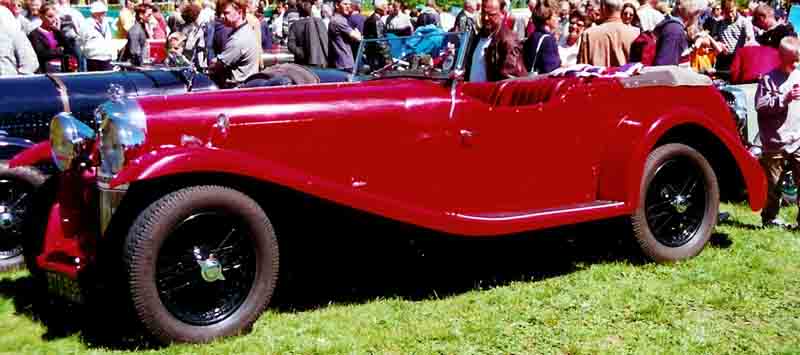
One thing about that car did stick in her mind, even more than 60 years later, was a non-standard feature that perhaps helps explain how my father, so recently shipwrecked, could afford such a luxury car.
It had two bullet holes in the body.
The story is that the car had belonged to a London underworld figure who "no longer had any use for it."
Do you You Tube?
I was amazed to find a short historic video on You Tube of fishing boats leaving the harbour at Great Yarmouth, less than a mile from where I first lived. It's just three clips, only 33 seconds in total, and dates from 1896 -- some while before I lived there.
Is there anything on You Tube for your home town, other locations and events in your family history?


