
Want more? Come early, at 9 am, to hear Lesley Anderson, BIFHSGO's Director (Education) present on the use of directories and gazetteers. As usual the morning admittance is free to all.
In case you don't know them, the picture is of Pat, taken by new Society photographer Ken Wood. We don't have a picture of Lesley; Google "Vanna White" instead.
10 May 2007
Only in Ottawa, Eh!
09 May 2007
Genealogy Tip: Map your surnames

Folks are often at a loss for leads when they find a record of their immigrant ancestor and all it says is they were from England, Scotland, Ireland, or occasionally Wales. If the name isn't too common you can start localizing the possible origin with a surname distribution map. At the left, from the Surname Profiler facility at the spatial-literacy web site, is the distributions for the surname Northwood, for the year 1998. I wrote a bit about the Northwood search last summer in a posting Update your searches.
The name has become more widespread in a century, but still has two areas of concentration. You can confirm this my doing the search and displaying a map for 1881. Focussing the search on Bedfordshire and the West Midlands are indicated. My lot are from Staffordshire and can be traced back many generations in the village of Pattingham.
I frequently use surname distribution as a way to interest beginners in family history. Many folks have a name they know little about. In a beginner group you can usually find some who have a suspicion about the region the family came from, and are delighted to see that confirmed with a surname distribution map.
08 May 2007
Is digitization killing genealogy tourism?
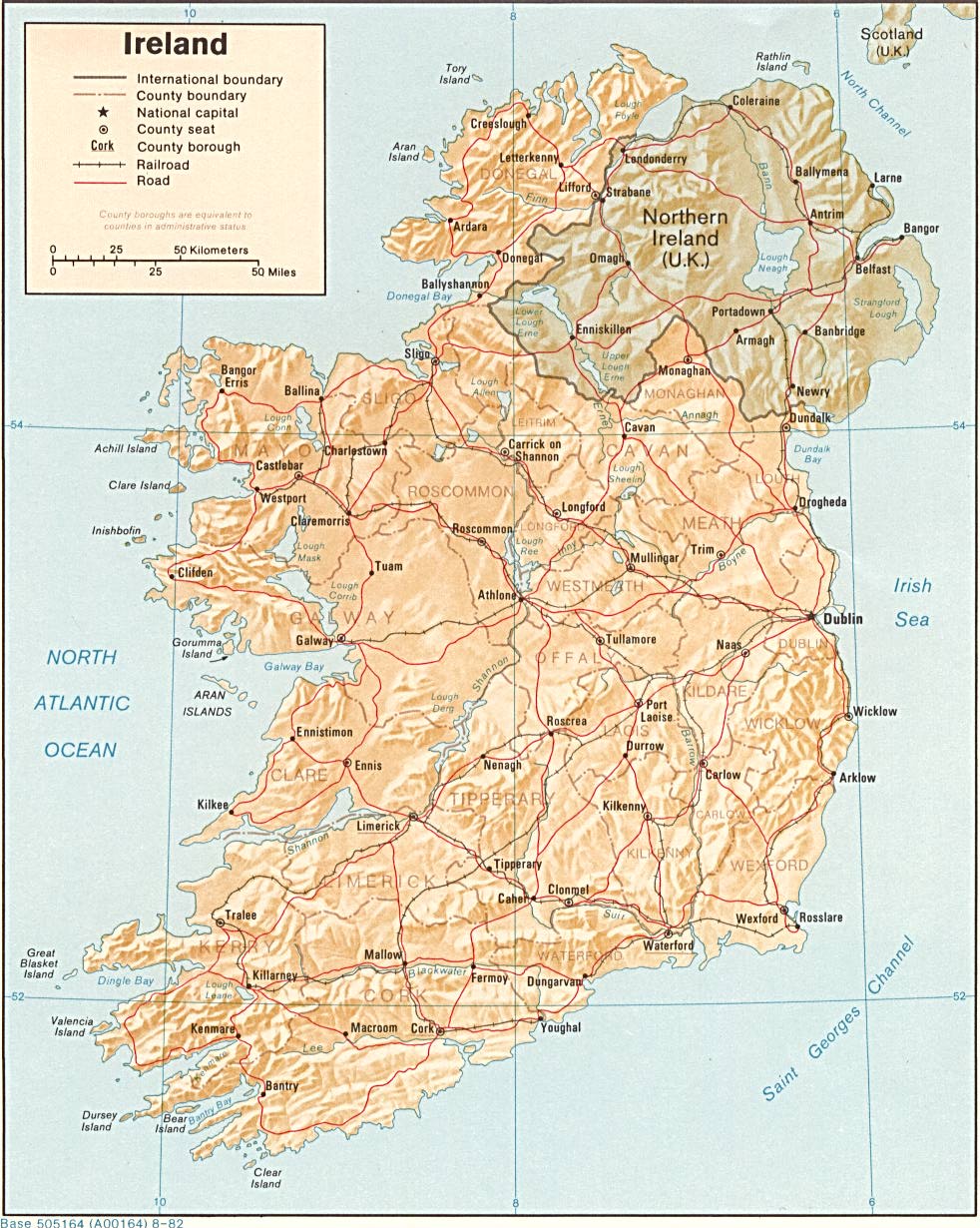
Others argue that it shifts the focus of tourist visits away from the confines of such offices. Being able to complete the basic research at home means the family historian becomes more, not less motivated to visit, but opts for a richer tourist experience in local museums, walks the roads and byways, visits the homesteads, churches and graveyards of their ancestors.
There has been a discussion on this in the electronic journal First Monday. In volume 12, number 1 (January 2007), Emily Heinlen published "Genealogy and the economic drain on Ireland: Unintended consequences." She points out that while the increase in popularity of digitized genealogical documents has been an economic boost for online companies that specialize in genealogy, it has had the unintended consequence on Ireland of decreasing the incoming revenue of the genealogy tourism industry. The basic data table referred to is reproduced below.
| Table 1: Genealogy tourism visitors — 1999-2004. Source: Bord Fáilte (Irish Tourist Board). | ||||||
| Overseas Visitors (000’s) | 1999 | 2000 | 2001 | 2002 | 2003 | 2004 |
| Britain | 32 | 26 | 20 | 11 | 11 | 9 |
| M Europe | 2 | 2 | 1 | 1 | 2 | 0 |
| North America. USA | 61 | 74 | 49 | 20 | 37 | 26 |
| Australia/New Zealand | 11 | 14 | 18 | 4 | 3 | 10 |
| Total | 106 | 116 | 88 | 35 | 63 | 45 |
In a letter to the editor in the March issue Fiona Fitzsimons and Cathy McCartney of Eneclann, a company linked to Trinity College, Dublin, involved with digitization projects, comment on the article's "limited and selective use of statistics on Irish visitor numbers." They point out that total visitor numbers increased by 1,262,000, or over 18%, from 1999 to 2005. That's despite worldwide tourist reductions that occurred in the aftermath of 9/11 and the SARS outbreak. While comparable figures for 1999 are not available, a very healthy 39% of visitors in 2005 engaged in cultural and historical activities.
07 May 2007
Should you take a free DNA genealogy test?

It sounds good, and they deliver as you can see from the data presented on their web site. The Y-Chromosome database includes more than 17,645 men with more than 7 markers; the mitrochrondrial database has 19,543 sequences.
According to the site's FAQ "Sorenson Molecular Genealogy Foundation is a non-profit foundation that is creating the world's leading collection of DNA results and corresponding genealogies. We are making the collection available on-line to the public to help in finding new family connections and extending one's genealogy. SMGF is not affiliated with any other commercial organizations, religious institutions, or other DNA testing projects."
The Foundation is State of Utah Business Entity number 4898157-0140, registered on 12 March 2001 as a non-profit corporation currently in good standing, officially described as in the business of information services. An expired registration for a company by the same name, at the same address, listed it as a religious organization.
SMGF is shown under the umbrella of the Sorenson Companies, along with Relative Genetics, a commercial DNA testing company. People who provide a sample to SMGF are eligible to receive a coupon for a test with Relative Genetics at a discount rate. Lab testing for both SMGF and Relative Genetics is conducted by another Sorenson Company, Sorenson Genomics. In my view these relationships call into question the FAQ statement that "SMGF is not affiliated with any other commercial organizations, religious institutions, or other DNA testing projects."
Folks wanting to take advantage of the test should be aware of the following:
The requirement to provide a four generation pedigree, including the donor providing the DNA sample, leaves one open to release of personal information which could be highly sensitive. The tests undertaken include not only those for the Y-chromosome and mitrochrondrial DNA but also autosomal DNA. Analysis of autosomal DNA can reveal the values for the CODIS markers used for forensic and criminal investigation purposes, and also information related to health vulnerabilities that could potentially impact on the ability of the donor, or relatives, to obtain medical insurance coverage.
According to the SMGF Privacy Policy:
"we make all reasonable efforts to protect the privacy of contributors"
"we will never share your genetic information with any outside companies. Your name will never be listed in our on-line pedigree charts. We will never list the names and genealogical information of any of your ancestors born after 1906 in our on-line pedigree charts."
Nevertheless, we are all aware that mistakes happen. Computers with personal data are occasionally lost or stolen and network security breached. The consent form you MUST sign in agreeing to participate in the SMGF project includes amongst the warnings under the heading "Risks, Inconvenience, and Discomfort":
"It is possible that the confidentiality of your records could be compromised. There are risks associated with a loss of confidentiality of your genealogical information and genetic testing results. Information about genetic test results may affect your employment, insurance, or family relationships. The sponsor cannot be certain that your genetic test results could never be linked to you."
In the State of Utah there is a process to convert from a non-profit to profit motivated corporation. Without any requirement to consult the donor, the information supplied could be used for private profit if such conversion was made. Furthermore, in the unlikely event that SMGF should run into financial difficulty, assets could be sold and it is unclear whether that might lead to the undertakings of confidentiality being compromised.
While there is no indication that SMGF and its sponsors have intentions that are anything other than honourable, potential donors would be wise to weight the risks and benefits in advance -- before having to do so while at the company booth at the OGS conference.
04 May 2007
Canada's Federal Genealogy Strategy

CGC have a lot to offer. I'm a booster, but don't hesitate to express what I hope is constructive criticism. For example, look at the main page of the web site and you'll see statements of mission, vision and policy. That's content that only a policy wonk could love. It's not what a typical user comes to the site to learn. I'm told a new front page presentation is coming soon.
What are the organization's plans for development? There is a Genealogy Strategy in the works. In the meantime the official word is in the LAC Report on Plans and Priorities 2007-2008. It's full of bureaucratize and non-specific commitments.
Whatever the Strategy eventually says, the fact is that when it comes to what most genealogists would like, more digitized content online, especially major records like the census, city directories and newspapers, LAC and the Department of Canadian Heritage mostly choose not to fund it. That's despite genealogy being the largest user group. CGC/LAC struggles to find external funding sources for digitization projects that usually have other agendas.
03 May 2007
DNA Podcast
The Naked Scientist, a popular BBC radio science show, had two interviews in its most recent edition on DNA studies of interest to genealogists.
The first was about a DNA sampling study from Oxford University, concentrating on people with all four grandparents from the same locality in the UK. It appears that the thrust is the analysis of autosomal DNA, although the example used was from a Y-chromosome study. There is a project web site here.
The second interview was with a PhD candidate from Leicester University who spoke of her Y-DNA study, and particularly finding a man whose ancestors were from Yorkshire, but whose DNA showed a rare African origin.
The interviews are available as a podcast, starting about a third of the way through the program, from here.
02 May 2007
Genealogy Tip: Recheck for digitized books
New digitizations of out of copyright books are appearing all the time. It's worth periodically checking the main digitization sites for people, events and locations in your family history.
Back last August I blogged about Google Books, and how they had digitized, and then extended copyright protection to a book published in the 1880s, only allowing a snippet view. The book was about my old home town of Great Yarmouth in Norfolk, England. Not showing the full text of a book published that far back was a mistake, an example of being overzealous or simply careless in copyright protection.
Apparently Microsoft agree with me as I found the complete text of The silvery hosts of the North Sea : with a sketch of "quaint old Yarmouth" appearing in the texts section of the Internet Archive with MSN credited as the digitizing sponsor. Against possible copyright status is printed NOT_IN_COPYRIGHT. It's also on Microsoft's Live Search Books. Live Search adds a capability to search inside the book, not just the title as with the Internet Archive.
01 May 2007
Trend-setting genealogy
Family Tree DNA, the largest commercial DNA testing company for genealogy, shows annual growth in the number of records over 60%. Ever more people are getting tested as they search for genetic cousins and explore their deep roots.
FTDNA is also seeing growth in the number of distinct surnames in their database, up about 30% in 12 months. As of 1 May there are 62581 unique surnames in the database. If you test through one of their 4010 surname projects you benefit from a discount rate for tests and enhance your chances of finding genetic cousins. The graph shows the trends in number of haplogroups found for different numbers of markers tested. Haplogroups are the genetic equivalent of surnames, defined by a string of digits representing the number of short tandem repeats at specific locations on the Y-chromosome. As of 1 May FTDNA has found 23,449 distinct 12-marker haplogroups. That's not very many if you consider that theoretically only three possibilities for the number of repeats at each of 12-marker would mean 531,441 12- marker haplogroups. This implies many people share the same 12-marker haplogroup; 360 people tested share mine which is included in the R1b1c group.
People with many 12-marker genetic cousins need more markers tested to reduce the number of matches. There are now more 25- than 12-marker haplogroups. 37-marker haplogroups are increasing more rapidly and slowly converging on the number of 25-marker haplogroups.
30 April 2007
Marian's Links for Ontario Genealogy
Marian Press is one person I always try and find time to listen to when at a conference. Marian, a librarian and lecturer on information literacy at the Ontario Institute for Studies in Education at the University of Toronto, teaches courses on website creation and using the internet as a genealogical information source.
On Saturday Marian gave a lecture for a conference organized by the Ontario Genealogical Society Region V. The handout, with links to web sites of particular interest to folks searching Ontario genealogy, is online here.
Likely you'll find most of these Canadian and Ontario resources on Cyndi's List, which I always suggest as a starting point when venturing into unfamiliar genealogical territory. But you won't find them as easily accessible as on Marian's Links categorized under the topics:
Getting Started; Getting Here; Hatch,Match and Despatch; Death; Census Records; Directories; Where Did They Live Exactly? Going to War; Were They in the News? Finding Your Canadian Ancestors in Books; Keeping Up With What’s New.
29 April 2007
Unusual names in family history - update
One of the delights of an Ancestry.com subscription is exploring newly available databases. This week "English Settlers in Barbados, 1637-1800" came online. I took the opportunity to search some of the less common surnames in my family, without success, and then remembered the one previous occasion I'd had to explore Barbados' records.
One of the two men from the Ottawa Company of Sharpshooters who died at the Battle of Cut Knife Hill on 2 May1885 was John Rogers, a native of Barbados. While researching for the book "The Ottawa Sharpshooters" I found his mother was baptized Mary Licorish Kidney, one of the most unusual names I've ever found. It rivals a Norfolk man I stumbled on baptized February Backlog.
Previous information was that Mary had been born in Barbados in 1818, too late for this dataset. There were lots of Kidney and Licorish family members, and John's paternal line was tentatively extended back to a g-g-grandfather named Andrew. That's a nice bonus benefit on this useful subscription.
Update
Ancestry.com have also added a new database, Slave Registers of former British Colonial Dependencies, 1812-1834, which includes information on Barbados slave owners as well as slaves. I probably should not have been surprised to kind that James T(homas) Rogers, father of John Rogers who died at the Battle of Cut Knife Hill, owned more than 100 slaves in 1834. the Kidney family owned 21 and the Licorish family 116 slaves.
28 April 2007
Archive CD Books Canada to provide FREE look-up service at OGS Seminar, 1 - 3 June 2007.
The following is a news release from Archive CD Books Canada about a unique opportunity to search a wide range of offerings from the Archive CD Books partners.
Archive CD books Canada are pleased to announced that, as their contribution to the success of this year's OGS Seminar, to be held at Algonquin College in Ottawa between 1st and 3rd of June 2007, they will be providing free access to their entire inventory of CANADIAN, USA, IRISH and AUSTRALIAN books on CD. You can preview the inventory at: www.ArchiveCDBooks.ca/
27 April 2007
Find that lost genealogy website

It may just be the site is temporarily down, perhaps owing to a power cut or maintenance. If so just wait until it returns, possibly only a few seconds, sometimes overnight.
It may be the site is, like the Python's Norwegian Blue Parrot "no more, ceased to be, expired and gone to meet it's maker, bereft of life it rests in peace. " It's an ex-website.
Fortunately there's a place to retrieve some websites bereft of life. It's called the Internet Archive, also known as the Wayback Machine. You can browse through 85 billion web pages archived from 1996 to a few months ago.
You enter the web address of a site or page where you would like to start, and press enter. Then select from the archived dates available. The resulting pages point to other archived pages at as close a date as possible. You may find some of the formatting, and sometimes images, are lost, but the basic content should remain. What you will not find is material from the hidden web, pages not accessible by a web spider, especially searcheable databases and the like.
Unfortunately keyword searching isn't supported. You need to know the web address, perhaps from a bookmark, published reference or dead link on an existing page.
If it looks like your goose is cooked the Internet Archive's Wayback Machine may just save your bacon!
24 April 2007
Did your mother come from Ireland? So what?
How about your grandmother, or her grandmother? Wherever you live there's a good chance many folks celebrate their Irish roots on St Patrick's Day, and throughout the year. In the Ottawa area that's reflected in a very active Irish research group that meets monthly under the sponsorship of the Ottawa Branch of the Ontario Genealogical Society.
The Irish population of 4.5 million in 1901 had dropped from 8.2 million in 1841 with the decline continuing decade after decade as emigration continued.
 One oft quoted statistic is that in 1891, 39 per cent of all Irish-born persons in the world were living outside Ireland. Where did they go? The pie chart shows about 25% were in the US, 6% in England and Wales, over 3% in Australia, 2.5% in Scotland and 2% in Canada.
 Canada's Irish-born population peaked earlier, likely around 1861 as did that in England. In the US and Australia the migration continued longer. Their Irish-born population peaked in the 1890s.
Can you relate these trends to your family history? The migration was so extensive that if your "mother" came from Ireland the chances are you have cousins to discover in one or more of the other countries.

Randy's Musings
A tip of the hat, and more practically a link on my blogroll, to Randy Seaver who mentioned my post on the top ten genealogy words. It has created a spike in visits here. Randy is a driving force behind the Chula Vista Genealogical Society. I frequently visit his blog for ideas and inspiration.
Randy also does most of the postings on the new Chula Vista Genealogy Cafe blog. which already contains some useful postings on genealogy basics, with a San Diego area emphasis. My southern California genealogy is a bit hazy but apparently San Diego is a suburb of Chula Vista.
22 April 2007
St George's and other fraternal societies
April 23rd is St George's Day, set aside for the patron saint of England who in legend killed a dragon.  There was an active St George's Society in Ottawa from 1844 to 1956. Its objectives were uniting English people and their descendants for social and patriotic purposes and affording its members advice and pecuniary assistance in case of need. The announcement shown was placed in the Ottawa Journal in February 1895 on the funeral of William Mills, mentioned here recently. It shows the logo of St George killing the dragon.
Ottawa in 1923 boasted many similar societies: the Ancient Order of Hibernians of America; Ladies' Auxilliaries of Carleton County; Ancient Order of United Workmen; Catholic Mutual Benefit Association; Foresters - Ancient Order; Foresters - Canadian Order; Foresters - Independent Order; Free Masons; Order of the Eastern Star; Royal Arcanum; Knights of the Maccabees; Knights of the Pythias; Loyal Orange Association; Loyal True Blue Association; Oddfellowes - Canadian Order; Oddfellows - Independent Order; Rebekahs; St Andrew's Society; St George's Society; St Vincent de Paul Society; Sons of England Benefit Society; Sons of Scotland; Ladies' Auxilliary of St George's Society; Daughters and Maids of England; Women's Christian Temperance Union.
St George's societies existed in Toronto and Montreal and likely many other communities. Their records may be an unexploited resource for family history. Ottawa's St George's Society records are with Library and Archives Canada.
21 April 2007
Ken Aitken Passes
I'm saddened to receive news of the passing of noted Canadian genealogical speaker, librarian and blogger, Ken Aitken.
He was predeceased by his mother Winifred Margaret Hambrook and father George Neil Aitken. He will be greatly missed by his loving wife Christine Mei-Chiang; his son Neil Aitken; his daughter Emele (Adam) Dykes; his grandson Thomas Dykes; and his siblings: Janet Taggart; M. Neil Aitken (Ruth); Peigi Sakota (Jay); and numerous nephews and nieces.About Ken’s Life:Ken held a BA in Linguistics, and a Master of Library Science degree from the University of British Columbia. He had also undertaken course work in local and family history with Brigham Young University and with the University of British Columbia.Ken was a member of the Genealogical Speakers Guild and the Association of Professional Genealogists. Ken had been a professional genealogist for over 25 years, a genealogy librarian for over 20 years and an adult educator for more than 40 years. He was currently focusing on genealogical education and was working on a book on evidence analysis. Active in genealogical organizations for many years Ken was charter president of the Hambrook Family History Society and served for 15 years as editor of the journal of that society. With the Saskatchewan Genealogical Society he served as a branch chairman, a director and as second vice-president of the Society.
Articles by Kenneth Aitken appeared in genealogical and family history journals and other scholarly journals in Canada, Australia, the U.S. and England.
As a lecturer, Ken spoke at conferences, seminars and workshops of the National Genealogical Society, BrighamYoung University, Saskatchewan History and Folklore Society, Saskatchewan Genealogical Society, Alberta Family Histories Society, Alberta Genealogical Society, Manitoba Genealogical Society, Ontario Genealogical Society, British Columbia Genealogical society, Kamloops Family History Society, and the Kelowna & District Genealogical Society as well as to local genealogical groups in Saskatchewan, Manitoba, British Columbia, Washington State and England.Over the past two decades he had been involved in family and local history. Ken had taught classes for libraries, community colleges, church and community groups. For many years he regularly taught local and family history classes at the Regina Public Library.A memorial service and celebration of his life will be held at the Church of Jesus Christ of Latter-day Saints, 2946 South Main St., Penticton, B.C., Saturday, April 28th, 2007 at 2:00 pm. "
20 April 2007
Improve your genealogy research skills

Archive CD Books Canada have just added to their catalogue "A Rideau Jaunt in 1872". It's timely as 2007 is the 175th anniversary of the Rideau Canal, the development that made Ottawa. The CD contains the first hand description of an adventure on a steam paddle-wheeler from Ottawa to Kingston down the Rideau Canal made in 1872. The story has never before been published, this is a reproduction of the originally handsomely hand-written document. There's a sample for download from this page.
How is this useful to improve your research skills? The author was Ottawa public servant William Mills. According to additional information on the download page, draw from other Archives CD Books Canada publications, he was born on 17 July, 1824, and first became a Civil Servant on 10th August 1858 (at the age of 34). Some Ottawa addresses where he lived were also given.
This was an opportunity to hone my research skills by finding out more about him. In genealogy research the three ways to improve are: practice, practice, practice. You make a few mistake and learn, Attaching that practice to an event can be a challenge .. fun .. snap, the jobs' a game. It can even provide material for a presentation, article -- or a blog.
How did I research William Mills? From the 1881 census, he was English-born, his wife was Mary Ann and daughter Nellie. There is a tempting IGI entry for the birth of William Peter Mills on the same exact date, 17 July, 1824, son of William Mills and Sarah , with baptism the following year in Stepney, London.
There is an Ontario registration for a death of a William Mills in Ottawa on 25 February 1895.
Checking the Ottawa Journal for the next few days reveals notices that he was long time Treasurer of the St George Society, and a Mason.
He is listed amongst burials at Beechwood cemetery, with his wife buried in 1913 in the same plot.
She is in the 1901 census living in the home of a son-in-law. The entry gives her birth date, 21 Apr 1834, and year of immigration, 1858. Note, that's the year William started working for the government.
The 1901 census also helps link her to others buried in the plot at Beechwood Cemetery which takes the family forward four generations.
19 April 2007
A web site to be proud of
 As a long-time board member of the British Isles Family History Society of Greater Ottawa I've been delighted to see the Society grow over the years while continually improving. Monthly Saturday morning meetings in the auditorium of Library and Archives Canada are regularly attended by well over 100 members. There is research on home children, especially those brought to Canada by the organization founded by John T Middlemore. The quarterly chronicle, Anglo-Celtic Roots, is an award winner.
Webmaster Andy Coates has done a fine job in updating the look and content of the site in recent weeks. Admire his work and find out more about the Society at www.bifhsgo.ca
18 April 2007
DNA or house history?
There are two meeting choices in Ottawa this Saturday morning, April 21. Both start at 9:30
BIFHSGO is holding an interest group meeting on DNA and genealogy at Library and Archives Canada. Those who have had a DNA test for genealogy, and those thinking of having one done, are welcome.
Do you know the history of your Ottawa home? The Ottawa Public Library is running a session at their Main Branch on Metcalfe Street revealing resources and information to help your search. Registration is required: 613-580-2424 x32165.
17 April 2007
Microfilm or digital for genealogy?
Dick Eastman had a posting in his plus edition lamenting a decision to microfilm rather than digitize a dataset. It's "so 1980s" was his comment. There's still a lot of microfilm around. How 1980s is it? Here's what the Rootsweb archives mailing list search engine I've been using in recent posts has to show.
The bar graph shows percent of postings for the year that mention microfilm*, digit*, and for good measure, CD. Microfilm* was mentioned in 1.4% of postings in 1996, peaked at over 1.5% in 1999 and has declined slowly to about 1.1%.
Digit*, including "digitized", "digital", "digitization" and other forms with this root, has doubled from 0.4% in 1996 to 0.8% in 2006.
Microfilm* is still mentioned in more postings than digit*. For a dying technology it's making a healthy contribution.
The trend that surprised me most was for CD. 1996 was an especially successful year for CD at over 2%, dropped back to just over 1.5% and spiked in 2002 at 2.2%. A more substantial decline has followed. It looks like this is a technology on the way out. DVD technology, not shown on the graph, has seen a consistent increase. It still gets only a tenth the mentions of CD.
It's evident that with microfilm, CD and other physical media we are seeing legacy technologies. Does anyone really want a microfilm or CD sitting in storage in their home of office? What they want is the data on it, and a small part of the data at that? Physical media will still have a role as robust storage, secure against damage by a major electromagnetic pulse.
15 April 2007
Top ten genealogy words
Here it is, a definitive list of the top words used by the genealogical community, counted down from ten to one. I searched the contents of 31,127,950 messages in the Rootsweb mailing list database using their archives search engine. You may find a surprise or two.
TEN: Death
Appearing in 2,736,649 documents, death was slightly more popular than marriage, which may say more about marriage than death. Both were mentioned more than birth.
NINE: Daughter
Despite there being more women than men genealogists, males were mentioned more often than females. Daughters were mentioned more than mothers; every mother is a daughter but not every daughter a mother.
EIGHT: Genealogy
You expected Scrabble?
SEVEN: Father
That male preference again.
SIX: Date
Dates are fundamental. When did an event happened? Looking a bit deeper, here may be a good reason why May has four times more mentions than any other month. The next most frequently mentioned is June, also a woman's name. Is this where the gender balance gets restored? March – July all have significantly more mentions that the other months. December, closely followed by February, has fewest mentions.
FIVE: Son
More sons than fathers too.
FOUR: Census
The most popular documentary source. The word is found in 14% of Rootsweb mailing list messages.
THREE: Children
Where would we be without them? May they all grow up in good health ready to become happy taxpayers contributing to my pension.
TWO: Name
Genealogy is about names, dates and relationships. Finding a name is the most fundamental thing we do as genealogists. We rejoice when we identify another generation back, and fret about remembering colleague’s names.
ONE: Family
For genealogists it’s Family first. Many of us pursue our family history as a way to unite or reunite the bonds of family, or to see the ties that bind the larger family of mankind. Organizations recognize this with names like Family Tree DNA, Family Tree Maker, Your Family Tree and Familysearch.
Other words tested, in descending order of use were: History, Mother, Marriage, Search, Cemetery, Book, Research, Year, Birth, Living, Surname, Web, Index, Record, Child, Tree.
A few words were eliminated from the ranking. Stop words, like “the” and “a”, could not be searched. The most hits, over 12 million, came for the word “list”, next came “message”, both to be expected for messages posted to Rootsweb mailing lists, but not specific to genealogy.
13 April 2007
The rise and fall of the Rootsweb mailing list
 Genealogists love Rootsweb; just not quite as much as before. Using the new improved Rootsweb mailing list search capability the bar chart in red shows year by year the number of messages posted on all Rootsweb mailing lists. A steep rise to 2000 was followed by two years of slight increase. The peak in 2002 saw over 4.1 million messages posted. 2003 saw a drop which has continued as a gentle decline since.
What's happening? Is interest in genealogy declining? Is the mailing list moving out of favour as a technology as the blog and web 2.0 take over? Have all the questions been asked, with the answers available on the mailing list archive? Something else? Other searches show technology trends. Microfiche are mentioned half as frequently in postings in 2006 as 10 years earlier.
The chart in blue, postings with DNA in the message body, shows healthy growth as interest in this area continues to develop after commercial DNA tests for genealogy started in 2000. Lest we get too excited, that's still less than 3.3% of all postings in 2006.
Another emerging word is blog. There were nearly 5000 postings with the word in 2006, up from just nine in 2001 when the word first appears with its current popular meaning.
12 April 2007
Library Thing for genealogy
 Library Thing is an online service where you can enter the books in your collection. I've never thought there was much benefit in entering recipes, CDs, books and other collections into a computer database. Library Thing and the online world have changed my ideas a bit.
I gave this system a try with my books on genealogy and related topics. The first pleasant surprise was how easy it is to enter the data. Because everything is online all you have to do is enter, say, the title and a pick-list appears for you to select the appropriate book. If it doesn't you can switch to another major database, such as a major national library catalogue, amazon.ca, amazon.com, amazon.co.uk and many others. Select the appropriate title and all the other data, author, publisher, number of pages, ISBN, and more is ingested. If available you also link an image of the cover, or you can add it.
What you get in return is the ability to see your collection in context. Apparently 106 other Library Thing users own "Professional Genealogy: A Manual for Researchers, Writers, Editors, Lecturers, and Librarians", 44 have "Ancestral Trails: The Complete Guide to British Genealogy and Family History." "In Search of Your British & Irish Roots: A Complete Guide to Tracing Your English, Welsh, Scottish, & Irish Ancestors", by the late Angus Baxter, the first genealogy book I ever owned, is held in 38 collections.
You can also get suggestions for other books you might want based on those owned by Library Thing members who have similar holdings. The system even explains why it makes the suggestion. I was a bit disappointed that the recommendations were US-oriented, even though my collection is British and Canadian. It would be nice to have a way to indicates aspects of a topic that are not of interest.
You can enter up to 200 books for free, as many as you like for $10 (year) or $25 (life).
The image above shows my books most owned by others.
10 April 2007
Contemplating the Future of Genealogy
Dick Eastman recently published an article "A New Computer Revolution is rising around us?"
in his newsletter. It got more attention and reaction than most things he writes. The thrust was to draw attention to the emergence of web-based applications vying to replace stand alone genealogy software.
But what about longer term trends; accelerating technological change and the pace at which knowledge continues to be generated? Is there any danger that all the genealogy possible will one day soon be done, and if so when? There's a short video, Shift Happens, I can recommend viewing when you contemplate the global trends that will play into answering these question. I stumbled upon it courtesy of Stephen's Lighthouse.
09 April 2007
Genealogy Odds and Ends
Ancestry have now completed the transcriptions of the Scottish census from 1841 to 1901. Transcriptions for 1881 and 1901 were added on April 3.
Also new on Ancestry as of April 5, Oxford University Alumni, 1500-1886. It's based on the publications Alumni Oxonienses: The Members of the University of Oxford, 1715-1886 and Alumni Oxonienses: The Members of the University of Oxford, 1500-1714.
Ancestors on Board have added the third decade, 1909-1919 to their database of passenger lists from ships outbound from Britain.
There is a database of some British taken prisoner of war in 1914-1918 here. It's part of the Long, Long Trail web site on The British Army in the Great War.
The Canadian edition of "Who do you think you are?" exploring family history's of celebrities, is expected to debut on CBC on Sunday 7 October.
07 April 2007
Military history and family history: students and immigrants
The media are providing close to saturation coverage of the 90th anniversary of the Battle of Vimy Ridge, considered by many a defining event in Canada's development as a nation. The Ottawa Citizen has been running a series on Vimy and its significance with involvement of a panel of recent immigrants, and another panel of students. A larger group of students have travelled to Vimy for the unveiling of the restored memorial, after having researched a soldier involved in the battle.
Anyone can research a soldier. I chose, almost at random except for his last name, Ernest Howe Reid. He served with the 78th Battalion of the Canadian Infantry (Manitoba Regiment), died on 9 April 1917 at the Battle of Vimy Ridge, is commemorated at the Vimy Memorial and recorded in the Commonwealth War Graves Commission web site here. Like many of his soldier compatriots he was an immigrant to Canada. His attestation paper informs he was born in County Cavan, Ireland, on 27 January 1889.
I'm not sure it has come out but Vimy shows for me the importance of immigrants to Canada. Although seemingly not a popular things to point out, checking randomly in the CEF deaths at Vimy I estimate half were immigrants, born in Britain, including Ireland. Canada is a country where immigrants play a leading role. Unlike in the US, that can be and is up to and including the highest office in the land. The present and previous Governor General demonstrate the leadership role. Vimy shows the importance for Canada's development of more ordinary, yet exceptional, immigrants
What did I find in researching Ernest Howe Reid?
On the attestation paper his wife's name was Irene, living in North Battleford, Saskatchewan. Reid enlisted on 24 April 1915 giving his occupation as railway fireman. He is found with his wife and a son, James, born February 1910, in North Battleford in the 1911 census giving his month of birth as February 1890, emigration as the same year as his wife, 1907. She was born in India in July 1892.
The best fit for him on a passenger list departing the UK is Ernest Reid, single, age 18, who sailed third class on the Lake Erie from Belfast on the 26th of September 1907, arriving in Quebec on the 6th of October. He gave his occupation as farm labourer. This is found at Ancestors on Board, a commercial database.The corresponding passenger list deposited on arrival in Quebec, found at Library and Archives Canada, indicates he is bound for North Battleford.
There is a land grant in his name for 10th section in township 47, range 16, W3 meridian.
Going to the Irish civil registration index, not online, the birth of Ernest Reid is registered in the district of Cavan in the 1st quarter of 1889.
Apparently Irene and James moved to BC shortly after the war. She remarried. The son, James Howe Reid, was a fatality during WW2. An attachment to his file on the Canadian Virtual War Memorial, here, includes a mention of his father dying at Vimy.
05 April 2007
Create your own Google genealogy map
 It's free and easy. Google has just implemented a method of placing your significant landmarks on a map, labelling them, even linking in photos and videos, and sharing them with relatives, your family history society, or the world if you wish.
You need a free Google account, then click on My Maps and start creating your personalized map. I've done one of places relevant for family history in Ottawa, including address and links to web sites. It includes archives, libraries, major cemeteries and a few other sites from Gatineau to Vernon.
04 April 2007
John Green: whose father was he?
 This month BIFHSGO has an Easter treat for you -- a day before the chocolate Easter eggs appear. Alison Hare, a previous winner of BIFHSGO's best presentation of the year award, will speak on "John Green: whose father was he?"
Alison writes about the presentation "In 1836 John Green petitioned for land in the Ottawa Valley near an unnamed son he said had come to Canada at the time of the Peter Robinson settlers. Research eventually determined that none of the Peter Robinson settlers were viable candidates. When all the possibilities have been ruled out, what is a researcher to do? This case study will reveal the surprising answer to the mystery; and demonstrate how the Genealogical Proof Standard can help solve difficult problems."
Alison is a BCG certified genealogist, a former journalist and graduate of the Carleton School of Journalism and served for five years as editor of Ottawa (OGS) Branch News. I always learn something from her presentations, even on hearing them a second time.
That's this Saturday, April 7 at 10:00 am in the auditorium at Library and Archives Canada.
03 April 2007
Update on Welsh parish registers
Last July I posted on an agreement reached to film and digitize Welsh parish registers, long withheld from the LDS (GSU) microfilming program. An item posted on GENBBRIT-L reports on progress.
Filming started in Gwent last October and has been completed, namely: Baptisms, up to 1906; Marriages up to 1921; Burials up to 1958.
The Monmouthshire film is beginning to show in the Family History Library catalogue.
Glamorganshire filming should be finished by now but will be awaiting cataloguing in Salt Lake City
Reportedly the agreement was a contract included GSU indexing all the parish registers, and to be completed in two years. I wonder if these films will show up as projects within Family Search Indexing?
02 April 2007
Family Search Indexing

Before you can index you have to register and download the special application. It runs independent of your regular browser. Registration is online. You don't have to give personal information -- but you do have to provide an email address. When I registered it took a day for them to get back to me with the password, likely too long to be able to use one of those temporary email addresses.
The application download is 28.6MB, not something you want to try on dial-up. Installation went smoothly and, after changing the initial password, I was ready to download the first batch of images. You have a choice of projects to work on. See the list here.
First I tried a page of the 1900 US census from New York. The screen is divided into two, the original image on top, the transcription you are making below. They attempt to highlight the element you should be transcribing, and usually come close.
It's good to read the instructions first so you know what to do when anomalies arise, such as missing data or entries that don't match the default format. Failing that information is repeated for each element as you come to it in a small box to the lower right.
If you're reasonably computer literate it's reading the original document image that you'll find to be the greatest challenge. Even with a good capability to magnify it can be tough. No doubt that improves with practice, I didn't feel I'd anywhere near mastered the skill.
For the second batch I switched to transcribing Ontario death registrations and felt more comfortable as I have a better grasp on the geography. The data wasn't as compact as on the census and you got a second chance at the name as there was repetition.
It turns out the images I dealt with had already been transcribed by Ancestry, although not in as much detail. It was certainly tempting to check what I read against the Ancestry transcription. I tried it a couple of times and didn't feel I did any better a job. It's also tempting where you find something difficult to read to search for a complementary record, like a census, to resolve the problems. In most cases where I thought I found one it was hard to justify using the spelling from that other record. You might question whether that one is correct anyway.
I couldn't complete a batch transcription in 30 minutes, which seemed to be the promise. Maybe I'm slow and will get there with practice. You can always work for 30 minutes, save the result and come back later to continue the task.
At the end of the batch the program allows you to run through and review elements it finds unusual. I had quite a few in each batch, some for missing elements, some for names that were non-English. Apparently the same batch is served to two different people, then a third looks at items where those two differ.
Given that the data I was indexing was already on Ancestry, for which I have a subscription, I found my motivation flagging a bit. You can go in and see a list of the items you've completed but it would be nice to receive some additional feedback. Part of the problem was that there were no records on offer that I had a personal motivation to index. Presumably that will change as the project gets up to full steam.
My recommendation? Why not give it a try. We all benefit when more data becomes available. Even if it's already indexed the competition helps keep the commercial guys honest.
01 April 2007
Famous Relatives?

If you believe the genealogy behind the beta "Find Famous Relatives" tool in Ancestry's One World Tree they all have a documented common ancestor with my late sister-in-law. They vary from 5th cousin, several time removed in the case of Milton and Cassidy, to 9th cousin.
Given that the connection is made based on family trees submitted by patrons I'm not putting much stock in the information. It does attract family interest, but it may not pay to look too closely. There are people holding high elected public office in this world I would rather not be related to, April Fools Day or any other day.
29 March 2007
New Ancestry Border Crossing Database
Ancestry's title for this newly digitized database is "Canadian Border Crossings, 1895-1956". From where I sit it's more like US border crossings. It records mainly crossings into the US from Canada, although there are a few crossing in the other direction.
Confusingly this series has been known by the name of one of the crossing points, St Alban's, VT. The dates used by Ancestry, 1905-1956, are still those associated with the St Alban's data, even though there are crossings included prior to 1905. For example, at Calais, ME, some of the records date from as early as 1877. It's worth looking at the dates for the most likely crossing 
- Calais, Maine (ca. 1906-Dec. 24, 1952) (also includes a few arrivals from 1877 to 1905)
- Van Buren, Maine (ca. 1906-Dec. 24, 1952)
- Vanceboro, Maine (ca. 1906-Dec. 24, 1952) (also includes a few arrivals from 1888 to 1905 and a few arrivals at Halifax, Nova Scotia and St. John, New Brunswick)
- Fort Fairfield, Maine (ca. 1909-Apr. 1953) (also includes a few arrivals at Easton, ME, Houlton, ME, Boston, MA, and Buffalo, NY and a few alien departures)
- Eastport, Fort Kent, Lubec, and Madawaska, Maine (ca. 1906-Dec. 24, 1952) (also includes some departure records of U.S. citizens)
- International Falls, Baudette, Duluth, Mineral Center, Pigeon River, Pine Creek, Roseau, and Warroad, Minnesota (Jan. 1907-Dec. 1952) (also includes some departure records of U.S. citizens)
- Buffalo, Lewiston, Niagara Falls, and Rochester, New York (1902-1954)
- Hogansburg, Malone, Morristown, Nyando, Ogdensburg, Rooseveltown, and Waddington, New York (Jul. 1929-Apr. 1956)
- Newport, Vermont (ca. 1906-Jun. 30, 1924)
- St. Albans, Vermont (1895-1954)
- Babb, Montana (Jun. 1928-Oct. 1956)
28 March 2007
For or against the slave trade?
The UK Parliament has a web site where you can view images of original petitions for and against the Act for the Abolition of the Slave Trade, 1807, from people in Manchester. There is a searcheable transcription of the names. Was your ancestor on the side of the sinners or the saints?
27 March 2007
Your Genealogy Affects Your Health: Book Review
 When I found this title some months ago, self-published in 2006 at iuniverse by F. Clark Fraser
The main chapters are:
1. Genetics in a Nutshell;
2. Family Resemblances: Common Normal Traits;
3. Genetics of Common Physical Disorders;
4. Genetics of Behaviour: Normal and Abnormal.
Your Genealogy Affects Your Health can be purchased online, either for download as an Adobe eBook($6US) or in hardcopy ($12.95US) here. There's a copy in the Ottawa Public Library.
25 March 2007
Extra information in 20th century civil registration indexes.
Genealogists who work a lot with pre-20th century data for England and Wales sometimes forget that in the early 20th century extra information is included in the civil registration indexes of births, marriages and deaths. I did. Then I rediscovered it yesterday when trying to trace back a sister-in-law's family. I had her father's name, born in 1915, but nothing earlier and was getting nowhere. There is a family story that they are from the same family as a prominent academic, but I couldn't see any connection.
I was ready to order the birth certificate, but in looking up the reference number found the mother's previous surname. Knowing that made it easy to find the marriage in the marriage index, and so the parents first names. With that, and the indexed census on ancestry.co.uk, in only a few minutes I had the family back another century. There was no connection to the prominent academic, at least after 1800.
The indexes start in July 1837 and retain the same information until 1866 when age at death was added. The mother's previous surname was added for birth registrations starting in the third quarter of 1911. In 1912 the marriage indexes started recording the spouses last name. But it's not a total good news story. From the third quarter of 1910 the second and subsequent given names were dropped in favour of initials in all the indexes. The full name was reinstated in the indexes from 1966.
23 March 2007
Operant conditioning in genealogy
I've been researching a great uncle, one my grandmother had little contact with after he moved to Canada and she married. On Tuesday a copy of his will arrived in the mail. It was gratifying to read that he had not totally overlooked his sister making her beneficiary in the event that none of his descendants survived.
In the will he expressed his wish to be buried next to his wife. It named the cemetery where she was buried and I wondered if he was there. As he had died in Majorca I thought maybe not. I also wanted to know whether other family members were buried there. So I Googled. There is a web site for the cemetery, and I sent an email seeking information. The next day's inbox contained a courteous reply that he was indeed there beside his wife and giving the plot numbers, section and dates of burial. In addition the message noted that his daughter, son and daughter-in-law are all buried in the same cemetery. There was also an offer of a map to show the locations.
A similar request, to a cemetery on a different continent sent earlier in the week, seems to have been ignored. Previous experience is mixed with enough positive experiences to keep one hopeful.
Operant conditioning explains that a randomly administered reward is the most effective way to get a rat trained to press a lever. It seems to apply in genealogy too.
22 March 2007
Battle of Vimy Ridge Anniversary
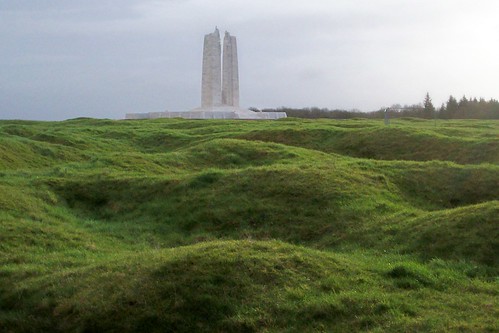
An increase in interest has been noticed at Library and Archives Canada (LAC) as relatives seek the service records of their era soldier relatives. LAC has an updated exhibition on Canada and the First World War. The Ottawa Citizen, and no doubt other papers, are giving in-depth coverage.
Ancestry.ca has a new database, Canadian Soldiers of World War I, 1914-1918, including images of original attestation papers from the LAC web site. In addition to name of enlistee, birth date, and regimental number indexed on the LAC site they have also digitized address, birthplace, age, and name and relationship of next of kin. It's a timely addition to Ancestry's Canadian portfolio.
21 March 2007
Canadian newspapers languish on microfilm
Searching in the online version of the Globe and Mail on the off-chance of finding reference to a man named Gregson, who married in Toronto in 1915, one of the hits appeared to be him. He was running for city council in Peterborough, which was his residence at time of marriage. It was yet another confirmation for me of the value of digitized historic newspapers for genealogy and family history.
A new US site with digitized newspapers came online in beta this week. Chronicling America allows you to search and read newspaper pages from 1900-1910 for papers from California, District of Columbia, Florida, Kentucky, New York, Utah, and Virginia. Each state had a target of 100,000 pages. These are the results of projects which started in May 2005. The initiative is sponsored jointly by the National Endowment for the Humanities and the Library of Congress.
There are other US collections. Two are mentioned in the most recent Rootsweb Review. From the Northern New York State Library Network come 550,000 pages from twenty-two newspapers. The other, www.fultonhistory.com
Meanwhile the British Library are continuing with their newspaper digitization project for a virtual library of nationally, regionally and locally important papers from 1800-1900, up to two million pages. It's scheduled to appear in mid-year. This builds on a pilot project with Olive Software.
In Canada we have Paper of Record of which I wrote recently, but where is Canada's national strategy for historic newspaper digitization, especially for local papers? It seems to fall under the mandate of the Alouette Canada project. There are good people involved, although not many clients. In these days of social networking you'd think the web site would have some capability for input from a broader community.
20 March 2007
Nova Scotia Historical Vital Statistics
 If you're looking for Nova Scotia birth registrations from 1864-1877, marriages from 1864 - 1930, or deaths from 1864-1877 and 1 October 1908-1955, they're here and free to view. The long promised web site went live on Monday here.
Nova Scotia's policy is to restricts availability of births registrations to 100 years, marriages to 75 years and deaths 50 years after the end of the year in which the event was registered.
Unusually the province decided to discontinue birth and death registrations between 1878 and September 1908 inclusive.
An initial quick search allows you to specify last and given names and the event type(s). Agree to the conditions of service and see the number of hits for each type of event. Click on the births, marriages or deaths tab to see the first page of ten results. You can flip to the the next set of ten easily, or click the icon to see an image of the original record or order a better quality copy.
I tried it out on the death of one of the Ottawa Company of Sharpshooters, Ernest Arthur Nash. My Nash search would have been much easier if I'd had this database when we did the Sharpshooter research. Although the first names were reversed, maybe the importance of being Ernest isn't so pervasive, the parents names and his birth date were the same as I had previously.
There is an advanced search allowing you to specify a year or year range for the event, and a county.
You see the original image using the Viewpoint reader. It should load automatically, but if not follow the instructions to download. I found the image was often too small to view comfortably, even after having zoomed, and resorted to doing a screen capture and pasting the image into a graphics program so I could zoom in further.
This is a nice addition to the suite of Canadian databases online.
18 March 2007
UK to Canada Immigration History
I've been looking for statistical data on immigration from the UK to Canada for a presentation in June to the annual OGS Seminar in Ottawa, and finally found a source at Library and Archives Canada. The copy was so fragile they only let me read it in the special collections consultation room, and I had to transcribe the data as they wouldn't allow copying.
As the authors make clear, this 1950s HMSO publication data is derived from a very mixed bag of sources. The earliest years are based on returns to local customs officers designed to ensure that departing ships had adequate provisions to see them through the voyage. Persons travelling on business or for pleasure, as well as immigrants, were likely counted. That's why the term outward movement rather then immigration is used. Having no Irish roots I had overlooked that the Irish were the major component in the early years, about until Canadian Confederation in 1867. According to the LAC online exhibit The Shamrock and the Maple Leaf "Approximately one million Irish landed in Canada in the century before the First World War." As expected there's a huge increase at the time of the Irish Potato Famine, with the English and Scots increase likely being Irish coming through their ports. The Irish immigration to the US at the time was much larger. An earlier increase, in the 1830s, is likely associated with the immigration stimulated by the Poor Law amendments in 1834.
After Confederation the English are the major component, including in the large pre-WW1 spike, which will be the topic of my OGS presentation. The drop during WW1, and following restrictive immigration policies to protect jobs during the depression of the 1930s, is clear.
The reference is: External migration; a study of the available statistics, 1815-1950 / by N.H. Carrier and J.R. Jeffery -- London : H.M. Stationery Office, 1953. -- 163 p. ill. -- AMICUS No. 12298747.
13 March 2007
First Anniversary
This blog is celebrating its first anniversary, and after 245 posts this blogger is taking a few days off.
What's the best web site for genealogy?
It may not be the first that comes to mind, but practically every genealogist has used it. Sure, Google would qualify for that honour too. I determined the best site as the first unsponsored hit, using the ubiquitous google.com, searching on "genealogy".
And the winner is ... familysearch.org
It's FREE. It's brimming with advice on getting started, advice on searching genealogy records and preserving and sharing your family history. There's access to FREE index transcriptions of parish records and census data (1881 for England, Wales and Canada, 1880 for the US). And there's the Family History Library Catalog where you can find out about non-digitized sources you can order into your local Family History Centre.
This LDS site isn't in the media buzz game. The most recent news item on the site is from 2005, but the first ranking reflects the continuing value of the resources.
Familysearch was also the winner amongst the unsponsored links at google.co.uk and ask.com.
Another winning site was genealogy.com. It came first at google.ca, yahoo.com, and yahoo.co.uk.
In case you're curious about genealogy blogs, for "genealogy blog" searched at google.com the winner is ... genealogyblog.com
Given the url this shouldn't have surprised me, but it did as I rarely visit. It's heavily US oriented.
I was also surprised at the number of death notices of prominent genealogists. Genealogy doesn't come to mind as a high risk occupation. Genealogy as an extreme sport maybe?
12 March 2007
Bicentennial of the Slave Trade Act
Perhaps fortunately for some of us, there are no British records of merchant seaman involved in the slave trade from Africa to America, officially ended when the UK Parliament passing the Slave Trade Act on 25 March 1807.
The Act didn't end slavery but prohibited trading in slaves from Africa. Colonies of the then British North America were bound by the legislation. It came into effect on 1 May, and a similar provision followed in the USA the next year. Nelson's victory at Trafalgar made enforcement practicable. Information on records for commissioned naval officers for the period may be found at TNA.
William Wilberforce, the best known advocate for abolition is the subject of a new film, Amazing Grace. See the trailer here. He lived just long enough to see a bill to abolish slavery in Britain pass through the British Parliament in 1833.
Wilberforce's great-great-grandson, a 48-year-old accountant, is commemorating the event by walking from the Wilberforce home in Hull, Yorkshire, to London and using the occasion to publicize present day sex and other slavery, said to subjugate more people today than the total number transported from Africa to America. There are numerous other commemorative and awareness raising events in Britain this year.
In Canada the Ontario government is "investing up to $1 million to support commemorative projects that tell the history of slavery, commemorate the struggle of African-Canadians, and honour the spirit of those who fought for freedom, justice and equality." The Governor General has mentioned the Slave Trade Act in a speech, but Stephen Harper's "new" government is silent.
09 March 2007
Did Google gobble Paper of Record?
Rumour has it that Ottawa-based newspaper digitization company Cold North Wind's stable of digitized newspapers has been recently acquired by the mighty Google. It would explain why the company's web site Paper of Record, which has been for sale for some while, can now offer free subscriptions.
Google already offers a news archive search, now in beta. The Paper of Record historical newspaper inventory does not presently appear to be part of that database, although other 19th century papers are, including some small runs of a few Canadian papers.
Google getting more heavily into newspaper morgues is exciting for genealogy. If you've found information of interest in your family history search in digitized versions of rare books in Google Books, or Microsoft's Live Search Books you'll appreciate the potential. Local papers are the paper of record for tens of thousands of communities. In them you find not only births, marriages and deaths recorded but a host of community happenings, scholarships, school graduations, sporting events, business openings and closings, military matters, club meetings, social notes and the whole minutiae of daily life which can help bring an ancestor to life, if only you can find the item on him or her.
08 March 2007
Ottawa Sharpshooters Presentation

07 March 2007
Who do you think you are? - Canada
According to two usually reliable sources the CBC has in production a Canadian version on this popular hour long BBC TV program in which celebrity family histories are explored. Scheduled to start airing in September. For a glimpse of the latest, third, series of the British program click here.
05 March 2007
Improving Family Tree Maker

Some folks get quite passionate about the virtues of their chosen software. Others, while seeing things they like elsewhere, have a lot invested in the product they use and don't want to have to climb the learning curve that comes with a new product, or lose some of the data and attachments in their existing files. The concern, along with that of privacy, is equally valid for folks thinking of moving to the online environment with services such as My Ancestry.
If Family Tree Maker wants to maintain leadership here are my recommendations for improvements, some of which likely apply to the competitor products.
First, improve mapping capability. For the last several versions FTM has had a pathetic mapping capability. The company should look at Family Atlas, a product of RootsMagic. I'm a happy user. Dick Eastman has recently done a thorough review.
Second, improve the way of entering source citations. Early versions of FTM had no citation capability, and although recent versions have, I find the format impenetrable. What is needed is built in fill-in-the-box type citation formats for common genealogy sources, especially the censuses and civil registration records for the jurisdictions most FTM users are likely to encounter.
Third, capture the growing field of genetic genealogy by incorporating provision for DNA information. At present Legacy does, but with FTM the only option is to enter such data is in the free format notes section under the edit tab. It would be simple to include another element to record the various types of DNA data under the facts tab or in the medical section. Even better would be a provision to show "derived" DNA information for maternal ancestors and their descendants for mitrochrondrial DNA, and Y-DNA through paternal line ancestors and their male line descendants.
FTM usually releases a new version or update in the summer, in time of the BIFHSGO September conference, although I doubt that's their driving force! It will be interesting to see whether the company has a commitment to keeping their product up to date.
03 March 2007
More on digitized and OCRd newspapers
I was pleased to see a comment posted by Bob Huggins, a pioneer in OCRd newspapers online, who found my blog entry on Paper of Record a few days ago.
Every so often I find myself using quotes like "half a loaf is better than none" and "seeing the glass as half full" when people complain about OCR inaccuracy, or errors in census transcriptions. You don't hear folks singing the praises after success nearly as loudly as they grumble after failing to find something.
Two of my best genealogy finds came thanks to Paper of Record where I located a wedding in PEI where a professional had hit a brick wall, and found a long report of a robbery committed by a person I was researching in Perth, Ontario.
OCR problems are a reality for old newspaper. Experienced searchers know of alternative approaches that may find the item sought when a straightforward search, which should be tried first, fails.
Assuming you've selected the most appropriate paper, it's always good practice to limit the period searched to as narrow a range as reasonable.
Think of alternate ways in which the entry might be unique. Search for the bride's name if you can't find the groom, or the name of the place where one of the fathers live, or any other aspect, such as the name of his regiment.
It can help to understand the format typically used in that paper for the period. For example, does a newspaper report of a marriage give the last names of the groom and bride as a header in a larger typeface? If so a search for adjacent names (Smith Jones) stands a better chance of success that one for John Smith or Cathy Jones.
Wildcard and proximity searches can be helpful if available. With Paper of Record you can search for a word, phrase or Boolean combination. The lack of segmentation of the page into separate stories means that you may get hits because words occur in different unrelated articles on the page.
02 March 2007
Ancestry adds 1871 and 1891 Scottish census
Yet another major contribution of UK census transcriptions to Ancestry's stable appeared on 1 March. The 1871 Census for Scotland was taken on the night of 2/3 April, the 1891 census on the night of 5/6 April. Images of the originals are not available, likely for copyright reasons.
01 March 2007
Fact or Fiction?: Living People Outnumber the Dead
Scientific American has an article referencing, Carl Haub, a US demographer on this FAQ. In 2002 he estimated that over 106 billion people have lived since 50,000 B.C. With about 6.5 billion alive today there are far more dead than alive. How many of the 106 billion would be your direct ancestor?
Genealogy in Wales
March 1st is St David's Day. The patron saint of Wales gets scant attention, and the Welsh get little notice in genealogy as many of the records are part of the English system. Wales being relatively small, fewer people emigrated to form a sizable diaspora. Welsh expats are none the less proud of their heritage, especially when it comes to music.
For those searching for Welsh records beyond the English system a good web resource is the National Library of Wales. The site is bilingual Welsh and English. Check out:
The Crime and Punishment database comprises data about crimes, criminals and punishments included in the gaol files of the Court of Great Sessions in Wales from 1730 until its abolition in 1830.
The Digital Mirror which gives access to collections of Welsh Biography, Pictures, Manuscripts, Exhibitions, Archives, Maps, Printed Material, and Photographs. Go to Sound and Video to download an mp3 of the first recording of the Welsh national anthem made 11 March 1899. It's scratchy, a very different rendition from the more familiar versions by mass choirs or rugby crowds.


