National Records of Scotland released the annual provisional names list (pdf) on 19 December
Jack remained the most popular first forename for baby boys, for a tenth consecutive year, the first forename for 1.8 per cent of the boys. Oliver rose from third to second place, James was down from second to third, and Lewis remained in fourth place.
The rest of the boys’ Top Ten were Noah and Logan (who remained fifth and sixth, respectively), Harris (up six places to seventh), Alexander and Leo (who remained eighth and ninth, respectively), and Harry (down three places to tenth). Harris was the only entrant to the boys’ Top Ten; Charlie (down four places to fourteenth) dropped out of it.
The fastest climbers within the boys’ Top Twenty were Harris, Alfie (up four places to eleventh) and Aaron (up four places to fifteenth). There were three entrants to the boys’ Top Twenty: Thomas (up six places to joint seventeenth), Archie (up two places to nineteenth), and Rory (up five places to twentieth).
Olivia was the top girls’ name for a second year, the first forename of 2.0 per cent of the girls. Emily remained second, Isla rose one place to third, and Sophie fell from third to fourth.
The rest of the girls’ Top Ten were Jessica (up two places to fifth), Amelia (remained sixth), Ava (down two places to seventh), Ella (remained eighth), Charlotte (up one place to ninth) and Aria (up two places to tenth). Aria was the only entrant to the girls’ Top Ten; Lucy (down two places to joint eleventh) dropped out of it.
No name climbed more than two places within the girls’ Top Twenty. There were two entrants to the girls’ Top Twenty: Harper (up twelve places to eighteenth) and Hannah (up five places to nineteenth).
Other big climbers within the 2017 baby name Top Fifty charts included (for boys) Theo (up 18 places to joint 27th), Muhammad (up 11 places to 36th) and Jude (up 12 places to 37th), and (for girls) Poppy (up 13 places to 30th). Particularly fast rising entrants to the Top Fifties were (for boys) Freddie (up 26 places to 46th), and (for girls) Sienna (up 36 places to joint 32nd), Willow (up 17 places to 45th) and Mila (up 20 places to joint 50th).
National Records of Scotland registered the births of 25,384 boys and 23,935 girls in the period covered by these figures. In total, 3,314 different boys’ first forenames and 4,221 different girls’ first forenames were registered; 2,063 boys and 2,767 girls were given names that were unique (within the period). The numbers of different names, and of unique names, were well above the levels of 10, 20 and 40 years ago. For example, the number of boys with unique first forenames was greater this year (2,063 in the period covered by these figures) than in the whole of 2007 (1,797), 1997 (1,126) or 1977 (761).
The top 50 boys’ names accounted for 39 per cent of all boys’ first forenames registered, and the top 50 girls' names accounted for 38 per cent of the girls' registrations.
21 December 2017
Scotland's Baby First Names 2017

Yuletide R&R: The Tragical Death Of An Apple Pie

A recent post from the Spitalfield's Life blog http://spitalfieldslife.com/2017/12/09/the-tragical-death-of-an-apple-pie-x/
20 December 2017
Presentations Online for BIFHSGO Members

- Another Bloody Englishman! Britannia in Red Serge, 1873-1920, by Glenn Wright
- Beyond All Reasonable Doubt, by Celia Heritage
- Buried Treasures: What's in the English Parish Chest?, by Paul Milner
- Working with Sources, by Gillian Leitch
- Researching in English and Welsh Archives, by Celia Heritage
- Copyright for Family History, by Marnie McCall
- Occupational, Guild and Freedman Records, by Paul Milner
- Genealogy and the Age of Shakespeare, by James F.S. Thomson
- British Military: Finding Your Pre-WWI Soldier, by Paul Milner
- Using Death Records in Family History, by Celia Heritage
- Tips and Tools for Navigating the English Probate System, by Paul Milner
- Historical Newspapers, by James F.S. Thomson
- I've Lost My Ancestor Before 1837: How Can I Find Him?, by Celia Heritage
- My God, Nobody Told Me!, by Paul Milner.
Revisit the 1939 Register
Although it has been online for a while now it's easy to overlook all the capabilities of the 1939 Register at Findmypast.
Has someone's information been opened up since you last looked? As people die or pass 100 years of age their information is added.
You can search by address as well as person.
There's supplemental contextual information about the community you only see by scrolling down from the transcript.
19 December 2017
Last minute: Judy G. Russell webinar

It's one of a series hosted and sponsored by the Board for Certification of Genealogists.
There's a difference between searching and researching, and understanding how the law impacts records and research is critical to the reasonably exhaustive research needed to meet the Genealogical Proof Standard. Learn how the law impacts records -- and how finding the right law for the right place and time is critical to genealogy.Register here.
Advance Notice: Find Your Ancestors in Church Records

Find Your Ancestors in Church Records
Church records of all denominations can be a treasure trove for genealogists. Gloria Tubman will discuss these valuable records and their place in family history research. Discover the information that is available from the record of a church rite, regardless of location, and learn some further clues to get the most from church records.
Gloria tells me there will be coverage of selected Canadian, British and Irish records.
Register at https://biblioottawalibrary.ca/en/event/find-your-ancestors-church-records
The Future for LAC?
"I also believe that the coming years will bring legislative changes that enable LAC to develop its own revenue streams.While maintaining quality services and offering them free of charge to our users, we could emulate many of our sister institutions—museums, and even national libraries and archives, such as the Bibliothèque nationale de France, the Library of Congress and The National Archives in the UK—in developing complementary revenue sources, such as sponsorship and philanthropy."This is an extract from a speech by Dr. Guy Berthiaume, Librarian and Archivist of Canada on 21 October, 2017 at the Faculty of Information and Media Studies, University of Western Ontario.
While the whole speech is worth reading, and should be read for context of the initiatives already taken, the quote gives hope that LAC may aim to increase the resources available to it while fully respecting its public service mandate.
I hope LAC will look at opportunities beyond sponsorship and philanthropy. Canada's National museums and galleries, and those in the UK all generate revenue from special exhibitions, shops and restaurants that can contribute to enhanced public service -- except LAC.
https://www.canada.ca/en/library-archives/news/2017/12/the_future_lastsforevermemoryinstitutionsnotathingofthepast.html
18 December 2017
Visiting the Archives of Ontario just got easier
 |
| TTC Subway Map |
December. The Archives of Ontario is just steps (100 metres) from the York University station.
If arriving in Toronto by train the trip from Union Station is direct, no changes required. The same Presto card you use elsewhere in Ontario works on the TTC. The journey takes about 40 minutes so you'll have time to go over your to do list while you ride.
Could researching the AO resources be even easier? Yes, if they weren't mired in the dark ages and embraced digitization.
Genealogy Courses in Toronto

Enquiries about these courses and other educational events should be sent by e-mail to courses@torontofamilyhistory.org. For course and workshop details, and for registration information, go to: https://torontofamilyhistory.org/learn
17 December 2017
Ottawa Branch donations

Arnprior and McNab/Braeside Archives will receive $9,800 for a newspaper digitization project. This builds on the development made possible by a project funded in the first round of the LAC Documentary Heritage Communities Program.
The Upper Ottawa Valley Genealogy Group will receive $650 for outreach and publicity.
The Ontario Name Index project (TONI) will receive $5,000 to support indexing Carleton County Township Papers. TONI recently surpassed five million entries.
Canadian Headstones is planned to receive $5,000 for website upgrade.
Agreement on another digitization project is pending which will exhaust the funds available.
SCGS Free Webinars 2018

Many of these presentations are applicable to everyone, not only those in California or the USA.
Find the schedule here.
Want a free preview? On 20 December 2017 Tammy A. Hepps, technologist, storyteller and life-long genealogist, will present 100 Days to a Better Family History. She promises it will help you prioritize research activities, pace work, and set deadlines. Register here.
16 December 2017
Findmypast weekly update
60,000 new records in the 1939 Register for England and Wales have been opened up and are now available to search and explore. They become available as people die, reach the age of 100, or entries erroneously closed are corrected.
The new Jersey Wills 1564-2000 database contains 14,342 entries giving name, place, date, and original text which is a cryptic one line transcript.
The remaining additions this week are four databases for Portsmouth, New Hampshire and about 10,000 additions of US marriages.
Music and Meyhem from Fife
Two recent Ancestry databases are from the Scottish county, or Kingdom, of Fife.
Dunfermline, Fife, Scotland, Carnegie Music Institution Registers, 1910-1920 has 13,699 entries from the Fife Archives. For each individual found within the collection, you may be able to find name, year and term of attendance, residence, subject, teacher, fee and occasional remarks. Follow someone through their study at the School of Music.
Fife, Scotland, Asylum Registers, 1866-1937 has 9,523 entries. Each entry includes name, birth year, admission date, discharge date and a link to the original record image. That gives more details including occupation, medical details, and often under Observations information on relatives.
15 December 2017
CEF Service Files December Update

The latest box digitized is 9059 (8803) and last name Smith (Sharp).
If my calculations are correct at last month's rate, which is the same as the previous month, the project will be finished by July 2018.
A tip of the hat and season's greetings to the folks in the digitization team who have made such good progress this year.
YouTube: Strangers in a Strange Land? Challenges of Adjustment in the Experiences of Scottish Emigrants and Immigrants in the Twentieth Century.
A lecture by Professor Marjory Harper explores issues raised by migration for those moving from and to Scotland. She mentions early on that the Scottish experience is not vastly different from that of others except in details.
The first section is based on records of the Scots in an asylum in British Columbia. What wasn't explored was how factors used to explain why they came to be institutionalized were different for who adjusted well, and those of a similar cohort who remained in Scotland.
This YouTube version was placed online on December 13.
DNA testing companies and fabricated African ancestry
How reliable are DNA test results?
Snopes investigated whether DNA testing companies deliberately fabricated African ancestry to "screw with" racist customers as claimed by "a number of less than reputable web sites" pointing to DNA testing companies such as Ancestry.com and 23AndMe.
It found the claim was "mostly false" and that "DNA testing companies strongly denied any such practice. The claim was traced to "one anonymous worker and published on a humor site; even the worker indicated purported meddling was unusual."
Suspicion of results is understandable. My AncestryDNA shows 19% Great Britain which is a best estimate with a range of 0%—47%. One of my brothers might have 0%, another 45% and all would be entirely consistent.
14 December 2017
Hunting for lost cousins
AncestryDNA identities that I have 87 fourth cousin matches, none closer. Presumably some of those are removes, others from further back as many of the names are Jewish.
Back in June 2015 an Ancestry study in the UK, reported in the Mirror, was that a typical Brit had five first cousins, 28 second, 78 third, 1,570 fourth, 17,300 fifth and 174,000 sixth cousins. I'm nowhere near that. I had two first cousins, only one is living.
Yesterday morning checking my database I found six second cousins, one third cousin, five fourth cousins, two fifth cousins and no sixth cousins. So I decided to go cousin hunting on Ancestry, Findmypast, FamilySearch and a few others concentrating on closer cousins likely to be a DNA match. After several hours work I now list four additional second cousins and three more third cousins.
A more conventional way than DNA matching of making contact with cousins is through Peter Calver's LostCousins website. In his latest newsletter Peter mentions that while searching for cousins is always free to initiate contact with a new cousin normally requires a LostCousins subscription. He is relaxing the need for a subscription between Christmas Day and New Year's Eve and suggests completing or updating your My Ancestors page on the site in advance.
Ottawa Branch OGS December Meeting
This Saturday, 16 December 2017
At 10:30 Genealogy: Back to Basics - DNA Analysis Tools
Jason Porteus will discuss some DNA analysis tools including those available at DNA testing sites like Family Tree DNA. Many people do the tests and can't make heads or tails of their results. He will provide a short refresher DNA presentation then a demo on some of the different DNA test platforms (FTDNA and Ancestry), then demo on how to work with specific analysis tools.
13:00 Networking
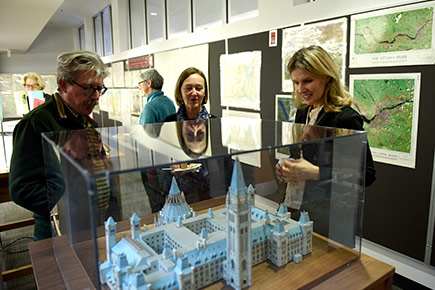
Monica Ferguson & Maureen Leslie will present on researching the history of a specific location in this city which can present unique challenges. The Carleton Library’s Ottawa Resource Collection bundles a variety of materials including government documents, historical maps, GIS support, rare books, archival collections and ephemera, helping to bring the puzzle pieces a little closer together.
15:00 Computer Special Interest Group
The venue is the City of Ottawa Archives, 100 Tallwood Drive. Free parking.
13 December 2017
Storify is closing

It's a reminder yet again of the risk of investing time and effort in cloud-based facilities which are liable to fail. Small start-ups are especially vulnerable but even big companies like Yahoo close unprofitable lines -- remember Geocities.
Genetic Genealogy Ireland 2018 Belfast

My first trip will be to Ireland. Having enjoyed Genetic Genealogy Ireland 2016 in Dublin the Belfast version looks like a good bet, especially as I can pair it with a few days stay in the Republic beforehand.
Maurice Gleeson has posted the program and other details of the event, 16-17 February 2018 at the Titanic Centre here.


