In May 2014 the wills of 26,000 Scottish soldiers who died in the Great War are to be made available by the National Records of Scotland via ScotlandsPeople. The project is part of Scotland's commemorations to mark the centenary of the outbreak of World War One.
via http://www.nrscotland.gov.uk/news/2014/scottish-soldiers-wills-to-go-online and a tip from Gail Dever.
03 March 2014
WW1 Scottish soldiers wills

Elitism and the paramount role of archival documents
Yesterday in the post about the four waves of genealogical interest I mentioned it was prompted by Friday's talk by Dr Scout Calvert, of UCLA Irvine, Technologies of Kinship: Genetic Genealogists and Origin Stories, at Carleton University.
Dr Calvert quoted sources which see genealogy as a pastime loaded with pedigree meanings, which relies on records from centuries past with overtones of race and class (prestige). "The assemblage of skills and activities involved in genealogy and supported by genealogical organizations encourage ideologically loaded images of our ancestors which in turn reflect on interpretations of history and social consensus."
Seen through the lens of lineage society activity genealogy can seem to be aiding and abetting "elitism." It is the basis for acceptance of some to membership and exclusion of others.
.
In her blog post about this talk Elizabeth Kipp wrote:
I queried whether DNA, as the "new kid on the block" or traditional paper trail genealogy would ultimately be the "decider" on family genealogy. I sort of knew her answer would be, as is mine, that the archival documents will always be more important that the genetic genealogy of a family. It really comes down to what determines family - is it the genetic composition that passes from father and mother to child or is it the logical flow of events that precede and follow that event where they can be documented. You can not change wills that have named children or the baptismal registers that have named parents. In the long run, family is determined by these paper documents and not by the DNA that runs through our veins.I didn't hear Dr Calvert coming down conclusively on side with Elizabeth's point of view.
According to my Oxford Dictionary genealogy is:
Account of descent from ancestor by enumeration of intermediate persons, pedigree; investigation of pedigrees.The definition of pedigree uses the term "pure breeding". Genealogy is a narrowly defined term about biological descent and relationships.
The first of several definitions of family is:
Members of household, parents, children, servants, etc.So what is "family genealogy"? How does it differ from genealogy?
DNA, paper records and oral history all provide evidence which needs to be evaluated. You can use these sources to probe your blood relationships (genealogy) or other aspects of your family history.
The way I see it we're free to be our own "decider" based on our own idea of what's more important. But your credibility will suffer if the standards of reasonable people, of which increasingly DNA evidence is becoming part, don't agree with your standards.
The genealogical rat!
Lab experiments demonstrate random reinforcement is a powerful motivator. Rats will push a lever more times if you reward randomly rather than regularly. Hope springs eternal.
There's also the genealogical rat. We optimistically buy magazines, read blog and mailing list posts, listen to webinars and attend meetings and conferences in the hope of latching on to something we can use to further our search.
These thoughts came to me as I was contemplating the four conferences that I will be going to in the next few months including the one I, with colleagues, am organizing in September for the British Isles Family History Society of Greater Ottawa.
The first conference is Gene-O-Rama, the usually-annual conference organized by the Ottawa Branch of the Ontario Genealogical Society, this year held on 21-22 March. It's a local event so the speakers are local. The exception is Jane MacNamara. Jane's depth of knowledge and clear presentation style placed her in the top 10 Canadian Rockstar Genealogists of 2013 as voted by Canadians. Even though she will be speaking on Ontario topics, of limited interest to me, I will want to hear at least one of her three presentations. Also ranked in the top ten Canadian Rockstar Genealogists are Gene-O-Rama speakers Lesley Anderson and Glenn Wright.
The family history search journey is different for each of us. What may be old hat to me could be new to you as you find yourself researching a branch of your tree from an area, geographic, religious or occupational, you have not looked at previously. And pay attention for something new, even if its outside your normal ambit. You may just be there to witness the emergence of something innovative.
If you find yourself having to choose between presentations consider the Rockstars first, they appear regularly on conference programs and in print for a reason. Or use the time at a conference to scurry around browsing the marketplace, making new connections and renewing friendships.
02 March 2014
March backup nag
You know the routine, and as the weather is not conductive to outdoor activity its a good time to get on with backing up your hard disk(s) if you missed doing so on St David's Day.
The four waves of genealogical interest

Against the backdrop of powerful, networked ICTs, affordable genetic tests, and discourses of human difference that inhabit genealogy and genetics research, this paper investigates the production of genetic knowledge and subjectivities within genealogical communities of practice. Based on interviews and participant-observer work in genealogical communities, this paper explores how genetic genealogists use and engage with genetic tests and databases, with ramifications for the construction of race and identity in the US context.Dr Calvert is interested in how genealogists, and genetic genealogists engage with the racial legacies of US history and population genetics, especially origin stories. Her study is a work in progress so she laid the framework and provided examples rather being able to draw firm conclusions.
Part of the framework she mentioned was "four waves of genealogical interest" in the US:
- 1876: the US centennial
- 1930s: the Depression
- 1976: Alex Haley`s Roots
- 2000: genetic genealogy
In discussion following the presentation I asked about these waves, commenting that there's surely more to the last than genetic genealogy, and asking about the Depression wave. Scout quoted a source which I didn't catch. At http://www.common-place.org/vol-02/no-03/ohare/ there's reference to peaks of interest in the 1890s, 1930s and 1970s as reflected in publications. That publication is too early to have captured the last peak.
What's the evidence from Google Ngram? Here's the frequency of the terms genealogy, ancestry and, pedigree in the American English corpus, with 5 year smoothing.
I'm hard pressed to see the four waves. Can you? What I see is an increase in the term ancestry through the 19th century, then a decline through the 1980s followed by an increase in parallel with an increase for the term genealogy which started around 1950. The term pedigree had no similar dramatic moves.
So what about the widely believed influence of Alex Haley's book Roots? An Ngram for the terms race and racial do show bumps in the mid-1970s, but Haley published Roots in 1976. It's more in line with the influence by the civil rights movement which preceded it.
What this evidence from Ngram suggests to me is that in terms of influence on genealogical interest the book Roots had precious little.
I'll have more to say on this lecture soon, including some comment on Elizabeth Kipp's post on her English Research from Canada blog.
International Genetic Genealogy Conference
I blogged about this conference last Tuesday and now have reservations to attend.
It took a bit longer than I'd hoped. When I went to register I noticed the credit card payment was not being processed through a secure site, it had neither the locked symbol nor an https: address. An email was sent - no response but the next day the site had the lock and the https: but with a red line through each! This time I phoned, got voice mail, left a message. No response.
I was ready to write a pointed blog post, but a more patient colleague suggesting cooling it for a few days.
On Saturday a secure page came up. Reservation completed. I'm now planning and looking forward to a trip to the Washington area., August 15, 16 and 17, 2014 at the National 4-H Youth Conference Center in Chevy Chase, Maryland.
Further conference information is at http://i4gg.org/
01 March 2014
Benchmarks update for February
Cold was the word of the month for February, and while change seemed glacial in genealogy online there were a few surprise moves.
Familysearch.org has added or updated record collections for a total of 1,726 (1,711). Census & lists account for 155 (152); birth, marriage, & death 1.025 (1,025); probate & court 163 (161); military 121 (119); migration & naturalization 110 (104); other 152 (150). Familysearch.org has Alexa rank 4,907 (5,064).
Ancestry saw little change in rank on the .com site 664 (663); the .co.uk continuing to advance 9,003 (9,239) while .ca slipped back below it's position two months ago 24,742 (21,991). Despite the continued addition of databases from FamilySearch the number of datasets in the collection remained the same, 31,665; 1,972 (1,968) for Canada, 1,766 (1,769) for the UK, 133 (133) for Australia and, 25,204 (25,213) for the USA.
MyHeritage.com's Alexa rank jumped to 6,195 (6,454)
Findmypast had a good month with .co.uk jumping in Alexa rank to 27,107 (29,485), while .com leaped up to 97,432 (107,032).
Family Tree DNA slid again in rank to 27,417 (26,261) while claiming a total of 670,716 records. 23andMe ranks 10,555 (9,908) continuing the decline with the FDA halt to its personal genetics health business.
GenealogyinTime.com at 35,695 (34,475) continue a drift down the rankings; Mocavo.com gained 41,125 (49,104), while eogn.com gained back some of the previous month loss, rank 22,913 (23,739).
Britishnewspaperarchive.co.uk contains 7,463,301 (7,343,941) digitized pages, an average addition of 4,263 (3,377) pages per day; Alexa rank 130,047 (126,932).
Newspapers.com contains 2,372 (2,142) newspapers including 667,873 (667,310) pages for England and 1,221,573 (1,213,349) pages for Canada. The Alexa rank continued a rapid advanced to 28,254 (35,659).
Cyndislist.com claims 329,681 (329,573) total links in 204 (204) categories, with 1,773 (1,773) uncategorized; Alexa rank continued to advance 62,773 (65,043).
FreeBMD.org.uk has 236,152,668 (235,362,957) distinct records, Alexa rank 77,855 (80,951).
CanadianHeadstones.com has 810,000 (794,000) gravestone photo records from across Canada. Alexa rank is rapidly improving 488,144 (513,183).
Deceasedonline.com which just started offering subscriptions, climbed to 695,270 (697,098).
The Canadian Gravemarker Gallery (gravemarkers.ca), has over 820,000 (815,000) photographs from across Canada and fell back to 8,203,598 (5,669,563) on Alexa.
Amongst Canadian family history societies bifhsgo.ca slipped to rank 2,274,173 (2,130,064), qfhs.ca climbed to rank 5,589,346 (6,655,816), and ogs.on.ca continued to decline to rank 337,640 (327,202).
And in case you're curious, Canada's Anglo-Celtic Connections has 5,418 (5,356) posts; on Alexa the .ca site tanked to 365,252 (236,710).
Did I miss something significant? If so please post a comment with statistics if applicable.
28 February 2014
WDYTYA? Live presentation on identifying human remains of soldiers who fell during the Great War
Another post on YouTube of a first class presentation from the DNA Lectures at Who Do You Think You Are 2014. This one, given by media savvy Andrew Robertshaw, somewhat ironically, emphasizes that DNA (mitochondrial), when used at all, is often only supplementary evidence. The presentation with questions runs for just over one hour, with a long tail of extraneous material. See it at http://youtu.be/MPupX-d4s74
Last call for OGS conferences advance registration
A final reminder: today, 28 February 2014, is the final day to obtain the advance purchase discount for registration for the OGS conference in St Catharines, and for GENE-O-RAMA at the Confederation Education Centre 1645 Woodroffe Avenue, Ottawa . Full information on the St Catherines conference is here (pdf), for GENE-O-RAMA here.
27 February 2014
A quick tour of British accents
A very short item demonstrating the regional variation of British accents from BBC Radio 4, via CBC As It Happens and a FB post by Kathie Orr
http://www.bbc.co.uk/programmes/p01slnp5
Streets of London now... and then
Thanks for the tip to Gail of Genealogy à la carte.
26 February 2014
Heir Hunters and the value of genealogical qualifications
A friend called to say she had been contacted by Finders, a London based heir hunting company, about a recently deceased relative. That's not a situation I ever expect to find myself in, but then neither did she.
The company, which has an informative web site, were very interested to sign her up, and seemed to be in considerable hurry to do so. Their cut would be an industry standard 20% of the inheritance. She asked my advice and, naturally, I was interested so did a little Googling.
A blog post on the Your Family Tree website recounts one person's quite favourable experience with the company.
The Society of Genealogists has a useful brochure, also available online, at What Should You do if Approached by Heir Hunters?
The Finders website provide information on their staff. What struck me as odd is that not one of them have a genealogical accreditation. One is an APG and SOG member, but neither of those require passing any kind of a test. Yet many of the others have had years of experience and success in heir hunting, which means they've proved their expertise to the satisfaction of the legal system.
What's the value of the professional qualification given by AGRA in the UK, and similar organizations elsewhere, if one of the most lucrative jobs calling for genealogical skills has no need for the qualification?
OGS Ottawa Branch Library news
Grace Lewis, OGS Ottawa Branch Librarian, has written a post for the Branch blog giving a 2013 year end review and listing latest additions for 2014. See http://goo.gl/jsqi8i
Technologies of Kinship: Genetic Genealogists and Origin Stories
A colloquium talk organized by Carleton University's Department of Sociology and Anthropology may be of interest to blog readers in the Ottawa area.
Title: Technologies of Kinship: Genetic Genealogists and Origin Stories
Against the backdrop of powerful, networked ICTs, affordable genetic tests, and discourses of human difference that inhabit genealogy and genetics research, this paper investigates the production of genetic knowledge and subjectivities within genealogical communities of practice. Based on interviews and participant-observer work in genealogical communities, this paper explores how genetic genealogists use and engage with genetic tests and databases, with ramifications for the construction of race and identity in the US context.
Speaker:
Scout Calvert serves as Assistant Project Scientist at University of California, Irvine. Her recent research projects have been about the “social lives of data,” primarily information infrastructures in cattle pure-breeding and genetic genealogy. Dr. Calvert also investigates how genealogists work with genetic data to create new knowledge about both recent family groups and ³deep² genealogical migrations of populations. She is a co-investigator at the California Institute of Telecommunications and Information Technology (CalIT2), on the Health Data Exploration project. She is affiliated with the Animal Studies Graduate Specialization and the Center for the Study of Standards in Society, both at Michigan State University.
The presentation is on Friday, February 28th, at 2:30 in room A720 in the Loeb building at Carleton.
Thanks to Leighann Neilson for the tip
25 February 2014
2014 International Genetic Genealogy Conference
The 2014 International Genetic Genealogy Conference is to be held August 15, 16 and 17, 2014 at the National 4-H Youth Conference Center in Chevy Chase, Maryland. The advertised speakers include many of the most knowledgeable genetic genealogists and population geneticists from around the world.
The organizer, the Institute for Genetic Genealogy, is a new independent, non-profit organization founded in 2014 with the express purposes of organizing educational conferences focused on the genetic genealogy field and funding genealogical and anthropological genetic testing and research, founded by Dr. Tim Janzen and CeCe Moore.
As Washington is much closer than Southern California and the SCGS event in June with its associated genetic genealogy event, I'm now looking at this August event as my preferred option for a US conference this year.
Further information is at http://i4gg.org/
WDYTYA Live DNA Seminars via YouTube
Recordings of five live presentations given at the Family Tree DNA Theatre at last week's Who Do You Think You Are? Live event in London have been posted on YouTube by Maurice Gleeson.
Overview presentations given are:
The Basics of DNA Testing (Katherine Borges)
DNA for Beginners - the three tests (Debbie Kennett)
Autosomal DNA - a step-by-step approach to analysing your atDNA matches (Maurice Gleeson)
Regionally specific presentations available are:
Scottish DNA - Clans, Families, and Surnames (Alasdair Macdonald)
Wales, DNA & Surnames (Brian Swann)
As these were recorded at the live event with lots of background noise the audio quality leaves much to be desired.
Depending on your familiarity with accents you may have additional difficulty, I found the presentation by Alistair Macdonald combined with the background noise a real challenge.
Brian Swann's presentation, which dealt with Y-DNA and complementary Welsh documentary resources, was especially well done although marred by running into loudspeaker announcements of the end of the event toward the presentation's end.
Sir John Tenniel (1820-1914)
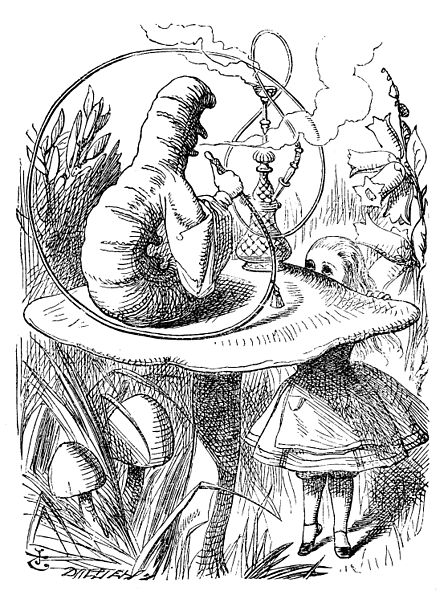
Today marks the centenary of the death of the illustrator for those classics, John Tenniel, described as "one of Victorian England’s most published illustrators, but as a Punch cartoonist he became one of the “supreme social observers” of British society, and an integral component of a powerful journalistic force."
Read an comprehensive article on Tenniel in Wikipedia.
He died in London leaving an estate of over 10,000 pounds and is buried at London's Kensal Green cemetery, with burial records available at deceasedonline.com.
24 February 2014
Gail Dever suggests the Knowledge Café for FHSs
Gail Dever posts a suggestion on her Genealogy à la carte blog of a "great way for a genealogy society to encourage its experts, who may be reluctant to make a formal presentation, to share their knowledge in an informal setting."
Many societies agonize about getting volunteers. This is a way to get people involved in a relatively painless way. Once involved their foot is on a slippery slope, there's a chance the commitment of at least some will grow to the point where they will become serial volunteers.
Read Gail's post at http://goo.gl/Y0cYan
WDYTYA? Live 2014 Speakers Handouts
The Society of Genealogists have posted a selection of handouts from presentations at the 2014 event just ended at http://www.sog.org.uk/learn/who-do-you-think-you-are-live-2014-speakers-handouts/
Presently available are:
Gill Blanchard (Thursday 20 Feb 2014) Our Ancestors' Homes. Where they lived and what their homes were like.
Else Churchill (Thursday 20 Feb 2014) What's been done before? Finding Pedigrees Online and at the Society of Genealogists
Else Churchill (Friday 21 Feb 2014) What Next? Pre 1837 Parish Registers in the Archives, Online and at the Society of Genealogists
Janet Few (Saturday 22 Feb 2014) Putting Your Ancestors in their Place - Sources for reconstructing nineteenth century communities
Janet Few (Friday 21 Feb 2014) A-Z of Family History. An alphabetical journey through some less well known sources
Mark E Gardner (Thursday 20 Feb 2014) How FamilySearch Can Help You Locate Your Ancestors
Mark E Gardner (Thursday 20 Feb 2014) Tips for Using British Records
Michael Tobias (Thursday 20 Feb 2014) Researching Your Jewish Ancestors
UPDATE
The following have been added
John Hanson (Friday 21 Feb 2014) Why Pay? The Top Free Alternative Websites for Family History
John Hanson (Saturday Feb 22 2014) Why Cant I Find Them in the Civil Registration Indexes?
Celia Heritage (Thursday 20 Feb 2014) Newspapers for Family History
Celia Heritage (Saturday 22 Feb 2014) Wills:Not Just a Source for Our Better Off Ancestors
Daniel Horowitz (Thursday 20 Feb 2014) How Can I Share and Preserve Memories in the the Digital Era
Roz McCutcheon (Friday 21 Feb 2014) The Poor Laws and the Irish Poor
Eileen M. Ó Dúill (Saturday 22 Feb 2014) Moving from Amateur to Professional Genealogist: Are You Ready?
Frank Pleszack (Thursday 20 Feb 2014) The Little Known Battle of Lake Narocz
23 February 2014
Ancestry adds Newfoundland BMDs
41,143 records now on Ancestry taken from "Births, Deaths and Marriages in Newfoundland Newspapers, 1810–1890. CD-ROM. St. John’s, Newfoundland, Canada: Maritime History Archive, Memorial University of Newfoundland."
Subscribe to:
Posts (Atom)


