09 December 2018
Genealogy Drop-in
Sunday Sundries
Miscellaneous items I found of interest during the week.
MyHeritage LIVE 2018 presentations free online
Recordings of all 24 classes from the MyHeritage event in Oslo are now available online for free. Delivered by MyHeritage staff and internationally renowned genealogists, the sessions covered genealogy, DNA, and the intersection between the two.
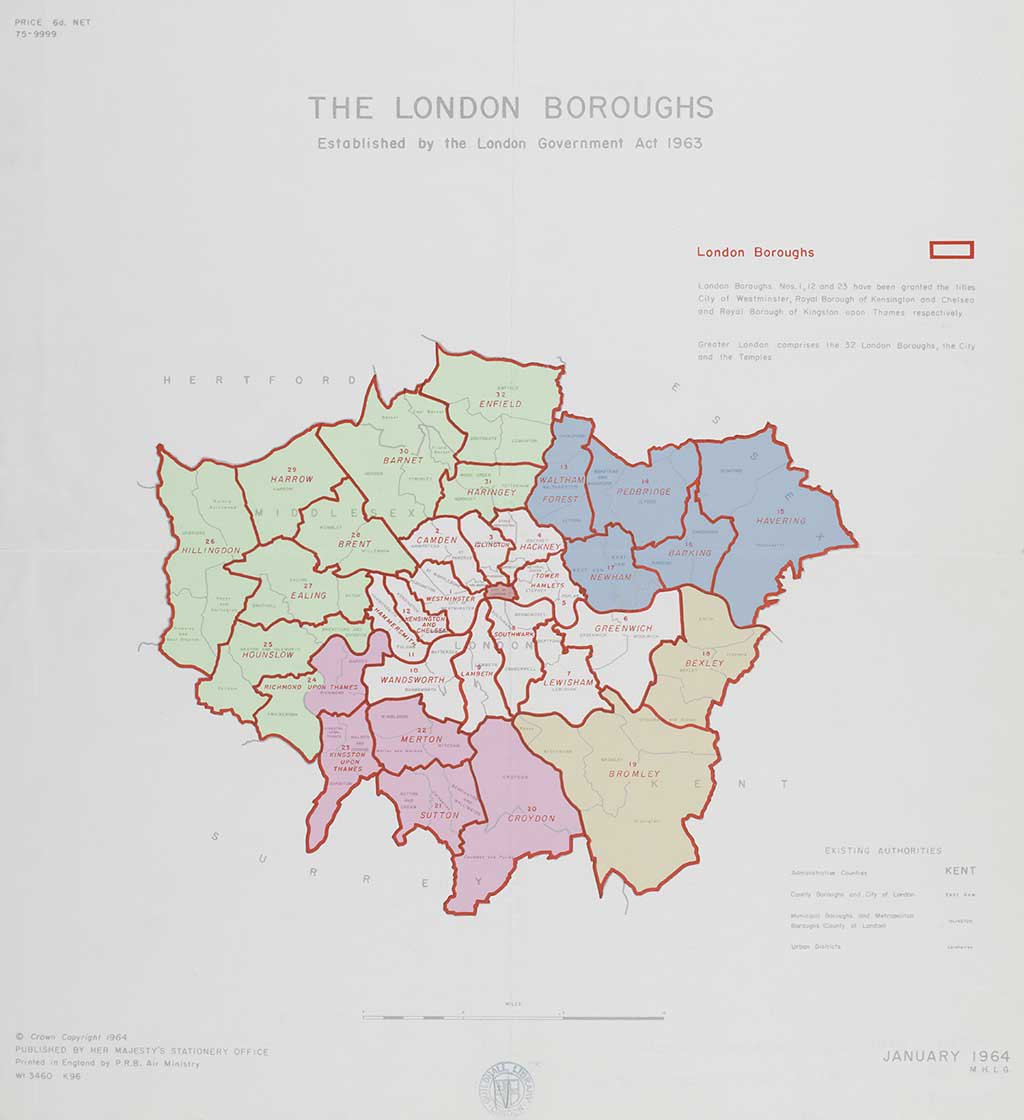
London Boroughs in 1964 (map)
Remains of Anglo-Saxon cemetery discovered in Lincolnshire
No mention in the article of DNA testing!
Retail decline, in maps: England and Wales lose 43m square metres of shop space
“Bricks to clicks” means more consumers are shopping online rather than in store meaning less tax revenue for local authorities.
Help the poor: Stop donating canned goods to food banks.
Last Saturday I walked past a parked bus and into the grocery store to be met by the offer of a paper bag for food donations. I ignored it. Such donations are a problem as they require sorting and may not be the items most in demand. Cash goes much further. Hand over $20, and the food bank will be able to buy $100 worth of most needed food, they’ll save on administrative costs and at income tax time you'll get back up to $6.
Nova Scotia Information and Privacy Commissioner - Naughty List
With gift suggestions.
And finally ...
08 December 2018
New from Findmypast
Cheshire Diocese of Chester Parish Baptisms 1538-1911
Over 35,000 new records covering the Widnes and Warrington areas have been added to the collection. These new additions cover the following parishes:
• Culcheth, New Church -1599 to 1928
• Hargrave, St Peter - 1883 to 1928
• Kelsall, St Philip - 1868 to 1928
• Warrington, All Saints - 1887 to 1896
• Warrington, St Barnabas - 1902 to 1923
• Warrington, St Paul - 1907 to 1920
• Widnes, St Mary - 1818 to 1917
• Widnes, St Paul - 1884 to 1928
Each record contains an image and a transcript of the original Church of England parish registers. The information listed will vary, but most records will list a combination of baptism date, birth date,place of birth, parish, parent's names and father's occupation.
Cheshire Diocese of Chester Parish Marriages 1538-1910
Over 14,000 new records covering 7 parishes have been added to the collection. These new additions cover:
• Culcheth, New Church – 1607 to 1928
• Hargrave, St Peter – 1841 to 1928
• Kelsall, St Philip – 1869 to 1928
• Warrington, St Barnabas – 1905 to 1928
• Warrington, St Paul – 1907 to 1928
• Widnes, St Mary – 1859 to 1907
• Widnes, St Paul – 1895 to 1925 Search these records
Each record contains an image and a transcript of the original Church of England parish registers. The information listed will vary, but most records will reveal the date of the marriage, the location of the marriage, the names of both the bride and groom, their occupations, father's name, father's occupation and witnesses.
Cheshire Diocese of Chester Parish Burials 1538-1911
Over 13,000 new records have been added to the collection covering:
• Culcheth, New Church - 1607 to 1928
• Kelsall, St Philip - 1868 to 1928
• Widnes, St Mary - 1858 to 1910
Each record contains an image and a transcript of the original Church of England parish registers. The information listed will vary, but most records will list a combination of age at death, death date, date of burial, place of burial, marital status and relative's names.
Also
British Army, Honourable Artillery Company
The collection includes 12 different sources:
• 1848-1914 Admission Registers
• 1908-1922 Membership Books, Honourable Artillery Company
• 1910-1915 Officers
• 1914-1919 1st Battalion Register
• 1914-1919 Record Cards
• 1914-1919 Regimental Number Registers
• 1914-1919 Papers & Photos
• 1915-1919 Membership Lists
• 1916-1919 2nd Battalion Rolls and Papers
• 1917-1918 Depot Register
• 1939-1945 Prisoners of War
• 1939-1945 Record Cards
Every record will include a digitised image of the original source and a transcript. The amount of information listed will vary depending on date and nature of the document.
Library and Archives Canada News
The total was spread over four or five years, $4-5 per year. Will that level of commitment be continued? The statement was made the LAC's future will be increasingly online and that data mining will be supported. So far I'm told that the digitization priority is indigenous peoples records which will cater to a small yet important minority in Canada. Will there be anything for the rest of us to look forward to, in addition to the much overdue 1926 census and free access to the sixty million pages originating at LAC of canadiana.ca starting 1 January 2019?
On the margins of the meeting I was told by a usually reliable source that FamilySearch has made progress in machine reading handwriting and to expect product to become available sometime next year.
07 December 2018
TheGenealogist adds Newgate Prison Records
The following is a company news release.
TheGenealogist is adding to its Court and Criminal Records collection with the release of almost 150,000 entries for prisoners locked up in Newgate prison along with any alias they were known by as well as the names of their victims. Sourced from the HO 26 Newgate Prison Registers held by The National Archives, these documents were created over the years 1791 to 1849.
The Newgate Prison Registers give family history researchers details of ancestors who were imprisoned in the fearsome building that once stood next to the Old Bailey in the City of London. The records reveal the names of prisoners, offences the prisoner had been convicted for, the date of their trial and where they were tried. The records also give the name of the victims and any alias that the criminals may have used before.
Use the Newgate Prison Registers records to:
● Find ancestors guilty of crimes ranging from theft, highway robbery, libel and murder
● Discover the victims of crime
● Uncover some of the aliases used by criminal ancestors
● See descriptions of offenders with details of their height, eye colour and complexion
● Research records covering the period 1791 - 1849
Human Mortality Explorer
Mortality rates decrease steadily, especially in the younger ages. Spikes or abrupt color changes might indicate war or disease.
Comparing the UK and Canada it was interesting to note that mortality was lower in the UK when I was born and is now lower in Canada at my age. Good move!
While the content id informative labelling on the axes is horribly small and the domain does not adjust to the range of years available leaving a large blank area for nations without early data.
via Flowing Data
06 December 2018
Steve Fulton director at large of FGS
A news release from the Ontario Genealogical Society announces that Steve Fulton, UE, the President of the Society, has been elected to a three year term as a director at large of the Federation of Genealogical Societies.
AncestryDNA Update
He gives the following explanation of how the process works.
if you can imagine every DNA test at Ancestry as a star in the night sky. Now imagine the distances between stars is based on shared DNA (the more DNA shared, the closer the stars). Now 'zoom out' to see all the 'stars' in the sky and you will notice there are actually constellations or clusters of stars. With some clever science & genealogy, Ancestry is able to determine these clusters are associated with different parts of the world. These form the AncestryDNA sub-regions. The final part, about how whether the region shows up in your test is basically how close your star is to the cluster.A friend wrote that while she is still 78% Irish/Scottish the genetic community is now Leinster matching her research.
There's no sub-division for my 34% Ireland and Scotland which comes with an error bar than goes as low as 2%! My Ireland and Scotland was 30% previously.
DNA from 10,000 year old chewing gums
Development of the ability to extract and analyse DNA from ancient materials continues to amaze. The preprint Ancient DNA from chewing gums connects material culture and genetics of Mesolithic hunter-gatherers in Scandinavia is another example. Note the article is not yet peer reviewed.
Human DNA was recovered from birch bark pitch mastics, chewing gums, from a site in western Sweden. Genome-wide data was from mastics representing three individuals, two females and one male. All were mitochondrial haplogroup U5a2d and two had a possible second degree relationship.
While chewing gum may lose its flavour on the bedpost over night it can conserve DNA for 10,000 years!
BIFHSGO December Meeting
Quakers in the Attic - Jamey Burr
A McKinlay in New Zealand - Ken McKinlay
And her name was . . . - Roberta (Bobby) Kay
Where were YOUR ancestors on December 2, 1854? - Duncan Monkhouse
Read more about the presentations and speakers here.
Instead of the normal 9 am educational session there will be the kick-off of a year of celebrations as BIFHSGO enters it's 25th year. Socialize with light refreshments and browse materials from Global Genealogy -- timely for Christmas gift-giving for the genealogist you're having a hard time thinking of something they might like (and maybe who won't give hints).
Saturday 8 December, 2018
The Chamber, Ben Franklin Place 101 Centrepointe Drive, Ottawa, Ontario
05 December 2018
Quebec Family History Society December Meeting and helpful resources
Kelley O’Rourke, QFHS Corporate & Recording Secretary, was a member of the St. Columban Irish, who was part of a team of volunteers who worked tirelessly to restore an Irish cemetery – containing many broken headstones - dating back to 1826.
The meeting is at 10:30 am at Briarwood Presbyterian Church Hall, 70 Beaconsfield Blvd, Beaconsfield.
QFHS President Gary Schroder tells me that their new Heritage Center at historic "Simon Fraser House" located at 153 Sainte Anne Street, Ste-Anne-de- Bellevue, Quebec is now fully operational. There was an open house for members two weeks ago and the official opening with dignitaries will be next spring which may coincide with the unveiling of a major new Montreal database Society volunteers are working on.
From the QFHS website I learned that the Heritage Centre is located within Pointe Claire which is also the location of the National Field of Honour Cemetery containing the remains of about 22,000 ex-service men and women who served in the Canadian or Allied Forces. Search from https://www.champdhonneurnational.ca/chn/veteranslocation/.
Not new, but helpful, is a 160 page list of settlements, hamlets, villages, towns, cities, etc. in Quebec that may have disappeared, changed names or have been amalgamated. Compiled by Jacques Gagné, one of the senior genealogists at QFHS, it is in PDF format and can be searched using Find from the Edit menu or with the short cut Ctrl + F.
Why those mystery DNA matches?
Many people have taken an AncestryDNA test to find out about their ethnic ancestry. It's easy to do and understand — and for some the results are surprising.
A couple of clicks away AncestryDNA gives a list of DNA cousins from those who also tested with the company. Unless you know a close relative was tested your best matches, like mine, will likely be 4th - 6th cousins. I have several, one at 53 cM with Confidence: Extremely High but no genealogical information and no response to emails. Six are in the same cousin range with Confidence: Very High but only two of those have information further back than parents and most have none.
That lack of supporting genealogical information shouldn't be surprising as now many more people have taken an AncestryDNA test than have explored their family history in any depth. Spitting in a tube is easier than doing the research in records even if those records are online.

Why are the DNA matches a mystery? Here's a scenario to explore in more detail.
Suppose you know all your 1st cousins their descendants and direct line ancestors. What you haven't done is research down from the 2nd and higher order great-grandparents — all you know in our traditional patrilineal naming system is their surnames which you can search for among your DNA matches. Because the number of people for any relationship down the direct line ancestors varies according to family size I explored three hypothetical scenarios in which all families had either two, three or four children who lived to have the same number of children.
Since you don't know the surname of a 2nd cousin unless the descent from the 2nd great grandparent is a direct male line, you can only recognize some of names of DNA matches, the percentage is in the table.
| IC | 1C1R | 1C2R | 2C | 2C1R | 2C2R | 3C | 3C1R | 3C2R | 4C | 5C | |
|---|---|---|---|---|---|---|---|---|---|---|---|
| Two Family | 100 | 63 | 63 | 13 | 9 | 8 | 6 | 5 | 4 | 3 | 2 |
| Three Family | 100 | 70 | 77 | 13 | 9 | 6 | 6 | 4 | 3 | 3 | 2 |
| Four Family | 100 | 75 | 85 | 13 | 8 | 5 | 6 | 4 | 3 | 3 | 2 |
Even at the 2nd cousin level, where DNA is fairly reliable in identifying the relationship, you'll only recognize 13 per cent of the surnames. That decreases to 6 per cent for 3rd cousins and 2 per cent for 5th cousins.
The lesson should be to manage your expectations. A person in the Two Family enjoys 1024 5th cousins so there's a one in 51 chance a match will have the common ancestor's name. It's many times longer odds for larger family sizes.
That may not be something AncestryDNA wants to shout about but the fact is that recognizing matches involves a lot of painstaking research in records.
And is it worth it? How much satisfaction do you get from identifying fifth cousins — unless maybe they're rich and famous!
04 December 2018
How many grandchildren?
With a few assumptions the number of grandchildren can be estimated. As the median number of children is about two, if we assumed that applied exactly at all generations the number of grandchildren would be four.
While the median may be two what is the impact of the distribution? Assuming there are no more than four children the extremes are zero, a woman who has no children can have no grandchildren, and 16 — four children having four children each.
The distribution of grandchildren for the Ireland, USA and England & Wales child distributions was calculated using a Monte Carlo simulation computed for over one million grandchild trials. As expected, with the exception of the women who have none, the peak of the distribution is four grandchildren although the distribution for Ireland has almost as many for six. Three and four plus child families in Ireland results in more grandchildren — ten grandchild families are twice as frequent in Ireland as in England & Wales or the USA.
The dips found at three and five grandchildren recur when the simulation is repeated.
It's unfortunate the published statistics do not break out the four+ category so the influence of infrequent large numbers of children in a family can be more clearly identified.
OGS December Webinar: Tina Beaird
Presentation: Scotland’s Resources: There is more to Scottish research than ScotlandsPeople!
There are dozens of sites available to help you in your Scottish research once you are ready to move beyond Scotlandspeople. Sites like GENUKI, ScotlandsPlaces, SCAN and the National Library of Scotland are just a few of the free websites available to you from ‘across the pond.’
Presenter: Tina Beaird
03 December 2018
Published collection temporarily unavailable in December - Library and Archives Canada
How would you feel if you'd planned a trip to LAC to consult a publication only to receive this at the last minute — or after you arrived? Posted on the day it came into effect. No advance notice!
Published collection temporarily unavailable in December - Library and Archives Canada
New GGI posts on YouTube
Since last Monday Maurice Gleeson has posted additional talks from the Genetic Genealogy Ireland session last October in Dublin.
Raising the Dead by Martin McDowell, about using the Lazarus tool on Gedmatch to paint ancestor's chromosomes, has received the most views. It's an advanced feature only useful for those who have test results for many identified relatives.
Next most popular is WATO - the latest tool for your atDNA by Andrew Millard. WATO is an abbreviation of What are the Odds and is designed to help refine when an unknown DNA match might lie in your family tree.
That presentation nicely complements Katherine Borges presentation Introducing DNA Painter mentioned in the previous post. It would be a good one to view beforehand if you could do with a gentler introduction.
DNA Cousins are more distant than they appear
When interpreting autosomal DNA statistics, one must be careful to distinguish between the distribution of shared DNA for a given relationship and; the distribution of relationships for given amounts of shared DNA.
Distribution of shared DNA for a known relationship

Data has been collected for the distribution of shared DNA by relationship by the Shared cM Project 3.0. These were crowdsourced by Blaine Bettinger. Most were likely from tests conducted on known relatives, others from a test that found a match which was subsequently identified. The figure is an example of the full distribution for first cousin once removed.
The table below summarizes the centimorgan (cM) results for a wider range of relationships. The more distant the relationship the less shared DNA, and also the fewer the data reported so there is greater sampling error. For relationships more distant than third cousin the Shared cM Project 3.0 obtained insufficient data for a full analysis. Perhaps there was a relationship but the amount shared was too small for it to be recognized. That also shows in the ratio of the average cM to the amount expected which increases for more distant relationships.
| Relatives | 1C | 1C1R | 1C2R | 2C | 2C1R | 2C2R | 3C | 3C1R | 4C | 4C1R |
|---|---|---|---|---|---|---|---|---|---|---|
| 1st percentile | 486 | 131 | 47 | 47 | 0 | 0 | 0 | 0 | 0 | 0 |
| Average (Expected) | 884 (850) | 440 (425) | 232 (213) | 232 (213) | 123 (106) | 75 (52) | 75 (53) | 49 (27) | 36 (13) | 29 (7) |
| 99th percentile | 1761 | 851 | 517 | 517 | 317 | 229 | 229 | 175 | 122 | 118 |
Distribution of relationships for given amounts of shared DNA
Extended families vary in size. In informal polls I've found anything from zero to over 80 first cousins. According to a study cited by ISOGG https://isogg.org/wiki/Cousin_statistics the average British person has an estimated 5 first cousins, 28 second cousins and 175 third cousins.
Simple Scenarios
Take the situation of 200 cM of shared DNA where the only relatives with tests are of the same, one or two generations younger. This would be the case for a senior where those in the older generations are deceased while there are no people in the great-grandchildren’s and subsequent generations yet born. Assume every family in the tree consists of the same number of children and there are no half relationships, endogamy or other complicating factors. Everyone survives and has that same number of children. The table shows the percent probabilities from the Shared cM Project and for families which uniformily have two and three children.
| Percent Probability | 1C | 1C1R | 1C2R | 2C | 2C1R | 2C2R | 3C | 3C1R |
|---|---|---|---|---|---|---|---|---|
| Shared cM Project | 0 | 2 | 34 | 37 | 19 | 4 | 4 | >0 |
| Two Family | 0 | 1 | 22 | 24 | 31 | 9 | 10 | 3 |
| Three Family | 0 | 1 | 19 | 18 | 34 | 12 | 12 | 5 |
The peak probability shifts from second cousin to second cousin once removed. Probabilities of closer relationships decrease and of more distant relationships increase. The trend is larger for larger family size — unsurprising as, for instance, there are 64 third cousins in the Two Family, 432 in the Three Family.
Conclusions
Simple population scenarios show that the distribution of relationships for given amounts of shared DNA differs from the distribution of shared DNA for a known relationship as found in the Shared cM Project. Taking into account the population distribution moves probabilities to more distant relationships, more so for larger family size.
It’s important to appreciate the limitations of the analysis. The statistics in the Shared cM Project are less reliable where there are fewer data reported, for more distant relationships and in the tails of the distribution. Further, given the variability of individual extended families the scenarios in the study will only be broadly representative for any individual's result.
While it would be interesting to have a similar analysis for lesser amounts of shared DNA the statistics at present are too noisy and do not extend to sufficiently distant relationships to yield reliable results.
02 December 2018
BIFHSGO’s new vision, mission and value statements
Sunday Sundries
Miscellaneous items I found of interest during the week.
MyHeritage extends deadline for DNA transfers
The deadline for transferring raw autosomal DNA test results is now 15 December, extended from 1 December. While at it consider adding the results to Gedmatch. The more you fish the more likely a catch.
The Trade Cards Of Old London
From Spitalfields Life, a selection of cards you might find, rummaging through a drawer in the eighteenth century.
Climate Solutions: Is It Feasible to Remove Enough CO2 from the Air?
Progress in the technical community in carbon capture technologies. U. S. emissions of means 61 million tons of CO2 are going into reservoirs this year. That's somewhat less than one per cent of US emissions, but growing. It could be an important part of the climate solution.
Economies of ale
Since 2008, nearly a quarter of pubs in the UK have closed – but the turnover of the pub industry is holding up and employment is on the rise. What’s happening?
Backup Nag
Did you do your monthly backup yet?
Percy Gordon Turner, CWGC Beechwood
Private Percy Gordon Turner (402201) of the 1st Battalion, Canadian Infantry (Western Ontario Regiment) was born on 2 August 1891 in East Grinsted, son of Edward Thomas and Minnie (nee Earl) Turner. He is found as a cabinet maker in the 1911 census living with his father and step-mother in South Ealing, Middlesex.
He emigrated to Canada in April 1914 arriving in Halifax on the Tutonic having already secured a job in Hespeler, Ontario.
Enlisting in January 1915 he suffered a gun shot wound to the left arm at Ypres in June 1916 which resulted in paralysis below the wound. Hospitalized in England he was returned to Canada in January 1917.
Death was at St Luke's Hospital in Ottawa of meningitis on an unseasonably cold 2 December 1918.