Yesterday I received an email from Family Tree DNA (FTDNA) informing me they had another client who exactly matches my mitochrondrial DNA (mtDNA) . For those not familiar with mtDNA, it's passed from generation to generation along the maternal line. I got mine for my mother, but as a male I won't ever pass it on to my children.
That makes three of us, clients of FTDNA, who share identical DNA in both Hypervariable regions 1 and 2 - that's a high resolution match. Because I've agreed to release of my name and email address to those who match I was able to see the new person's information.
A few hours later I received an email from that person giving his earliest know maternal line ancestor and asking about mine. From paper records I can trace my maternal line back seven generations, the earliest three of which were in one locality. That puts our earliest documented ancestors about a century and the North Atlantic Ocean apart.
mtDNA changes slowly which means that with present tests exact matches occur for people related quite distantly in time along their maternal lines. From the FTDNA web site, an exact high resolution mtDNA match has about a 50% chance of sharing a common ancestor within the last 28 generations (about 700 years). My new DNA cousin and I both have a lot of researching to do to get back that far!
FTDNA advertise they have about 31,000 clients who have taken mtDNA tests. I don't know if they all agreed to limited release of their results, but if so the three of us who share my mtDNA are about 1 in 10,000. With 300 million people in the USA, 60 million in the UK and 30 million in Canada, we could look for another 39,000 matches if everyone in those countries got a test. If they all descend from one woman 28 generations ago the intermediate generation daughters would have to have had daughters at a rate of 1.48 per generation. If the line started 54 generations ago the rate would be 1.22 per generation. That doesn't account for lines that don't produce daughters, so you'd expect the rate in surviving lines to be larger. What's the daughter production rate in your family history?
23 August 2006
Genealogy by mtDNA

22 August 2006
Battle of Jutland
There is a detailed article on the Battle of Jutland fought on May 31 - June 1, 1916, at Wikipedia. It was the largest naval battle of WW1.
More than 6,000 British officers and men were killed and those casualties are listed at a new web site that also includes transcripts of some contemporary reports. North East Medals, which also has good information on British medals, makes available this interesting source.
21 August 2006
Unorthodox Sources for Family History
The other day I came across a web site listing patents granted in Canada. That's not land patents but patents for inventions. It's here. You can access over 75 years of patent descriptions and images covering more than 1,500,000 patent documents. That isn't the kind of resource most people would go to when researching their family history although if your ancestor was an inventor it may be a good bet. Many of the patents were not granted to Canadians so try it even if your ancestor lived elsewhere. The same site gives access to trademarks and copyright databases which are more recent.
Anywhere names are given is fertile sleuthing ground for the family historian. Experienced genealogists know their way around a variety of records where life events are recorded. We're familiar with government records (civil registration of births, marriages and deaths; census; adoption; immigration and border crossings; military records; voters lists; land transactions; naturalization; wills), and church records (baptisms, confirmation, marriage banns and licences, marriages, burials, memorial inscriptions, older wills). Then there's war and other public memorials that may be either government, church or community sponsored. But where do we look after those? Think about what your ancestor did and what organization was involved that might have records back that far.
Top of my list would be newspapers. Checking death notices and obituaries for a few days, even a couple of weeks, after the event is likely to yield that most sought after genealogical resource, the names of relatives. You may learn the names of parents, siblings, offspring, greats, nieces and nephews, and where they were living. You may find mention of the year of death of a deceased spouse. On a happier note there are engagement announcements and reports of marriages.
Newspapers also hold plenty of other potential. Social notes, scholarships and awards, sports participation and much more. The problem for that type of mention is that until the past few years you had to plough through reels of microfilm on the off chance a family member would be mentioned. That's still the case with many newspapers, although digitization and OCR technology (however imperfect) are a reality for some, particularly the largest communities. Ottawa, unfortunately, has no newspaper digitized after the 19th century until the born-digital era.
City and telephone directories are widely used. We are fortunate in Ottawa to have a good collection of these at Library and Archives Canada (LAC) for all the country. LAC have placed quite a few late 19th century city directories online.
Did your ancestor go to school, or university? If so was there a year book? Perhaps there are still records existing. An article in the Summer 2006 Anglo-Celtic Roots, quarterly chronicle of the British Isles Family History Society of Greater Ottawa, relates the story of finding material in a university archives for a relative who died in WW1.
Did your ancestor ever author a book? You may not know it, but it could be worth checking library catalogues online, especially if the name is not so common. Many libraries incorporate their catalogue into a collective one, such as at here for Canada. However, if your ancestor wrote a book of purely local interest it may be held only in the local area library so check it's catalogue too. The same is true of publications of specialist interest. I found scientific books written by a person I was researching in the catalogue for Natural Resources Canada library.
On the topic of local books, you should not overlook the possibility of your family appearing in a local history. Canada has many of these digitized and searchable at the Our Roots web site. The Prairie Provinces seem particularly blessed with these publications thanks to the initiative of the pioneers, or sons and daughters of pioneers, who arrived in the late 19th and early 20th centuries, and wanted to record their history before it was forgotten.
Don't forget other local publications. Churches publish magazines. So do clubs of all kinds, and they acknowledge the contribution of volunteers. You may find your ancestor mentioned because he or she made coffee, served cakes, moved tables or collected tickets.
I blogged recently about finding photographs of people I was researching on the walls of local sports clubs. You may also want to investigate whether there are any records for local organizations such as the Women's Institute, Masonic Lodge or Knight's of Pythias. Names may be on the walls at their assembly hall or in newsletters. If you don't know where to start ask at the local family history of genealogical society, family history centre, public library or municipal archives. If there's a local university with a history department they may have a faculty member knowledgeable about local history.
There's at least one more type of unorthodox government record I didn't mention. Do you know what it is?
18 August 2006
Celebrate Your Anglo-Celtic Roots
It was good to hear yesterday that conference registrations for the BIFHSGO annual conference are on track for a record attendance. It's being held September 22-24 at Library and Archives Canada, in Ottawa.
Information about the conference, and a registration form, is available here.
The focus of the conference is Scotland. We are pleased to have David W. Webster BSc, FIChemE, FSA Scot as keynote speaker. David has built a substantial reputation over the last 18 years as a professional genealogical researcher in the Scottish and related records of Scottish emigrants to North America, Australia and New Zealand, as well as to England, Ireland, and Europe. A Fellow of the Society of Antiquaries of Scotland in 2001, David has written a number of books on genealogical research in Scotland, and is a regular contributor of articles to genealogy magazines in the UK and North America, and to Scottish family history societies.
In addition to delivering the Don Whiteside Memorial Lecture on Friday evening, David will be giving presentations on electronic and Web access to Scottish Genealogical Records, Scottish Statutory Birth Marriage and Death Records, Wildcards in Genealogical Research and using emigration records to bridge the gap to a Scottish ancestor and to search for present day relations in Scotland. David is also offering three demonstration sessions on Friday on using the
“scotlandspeople” website to research queries submitted in advance by registered attendees. These will be repeat sessions with attendance limited to 30 per session.
There's plenty more too. Will you have a difficult choice on Saturday morning between my talk and David's?
17 August 2006
Test for Scottishness
Newspapers around the world have picked up a story that a geneticist has developed a DNA test for “Scottishness”. "Dr Jim Wilson, of Edinburgh University’s public health sciences department, claims his test can tell whether people are descended from the Picts, who inhabited Scotland until the 10th century." You can read what the company, Ethnoancestry, has to say about the test here.
People would be wise to treat this type of test with some skepticism. Why would the Picts who settled in Scotland all have similar DNA? The test, which is based on 27 DYS markers, is proprietary means it has not been subject to open peer reviewed. What guarantee, beyond the company reputation, is there that the results represent a robust Pictish profile?
Here, as a free public service, I offer as an Anglo-Celtic Connections exclusive, a test for Scottishness. It too is guaranteed ... not to have been subject to peer review.
You're more Scottish if:
Your name start with Mc or Mac.
You can recognize your clan tartan.
You know its summer in Scotland 'cause the rain is warmer.
You like eating haggis while listening to the bagpipes.
You enjoy golf and curling, but play neither well.
You think of England as Lower Scotland, or if an American, Baja Scotland.
You're not so unsure of your Scottishness that you'd pay anyone £130 ($249) to test it?
16 August 2006
Home Children
Last week I blogged about a new memorial gravestone at Ottawa's Notre Dame Cemetery to 23 young people, Home Children who came to Canada from Britain, who died in their teens or twenties and were buried in numbered graves. In fact its two gravestones. I had the privilege of attending the memorial ceremony last Saturday and placing one of the flowers in remembrance of a child. Both these photos show Dave Lorente, son of a Home Children and pioneer researcher, who was MC. He couldn't have ordered better
  weather.
Also shown in the image on the left is a home child descendant, and on the right John Sayers, leader for a project to index Home Children in ships passenger lists. The project is the subject of an agreement between the British Isles Family History Society of Greater Ottawa and Library and Archives Canada. There is already a database with about 80,000 children indexed.
For those unfamiliar with the story of home children there are good web sites here, and here. The best book on the topic is here. For the genealogist there's a slim volume "Researching Canada's Home Children" available here by following Our Store, Heritage Books. Canadian Series, and clicking on the second page. Take a while to browse their other offerings too.
15 August 2006
Google Books extends copyright protection
Copyright holders have expressed concern about digitization initiatives such as Google Books fearing loss of revenue. A recent experience indicates they have nothing to fear as Google is taking a very conservative approach to copyright. In fact, to the extent that they are depriving people of access to books that have been in public domain for many years. Here's the story.
I don't always think of it, but every so often I visit Google Books looking for items related to my family history. Perhaps it was a news item about another source becoming available for their scanning that prompted me to visit his time.
My old home town was 
The publication was dated 1883, but only a snippet view was shown. It read "Of Yarmouth I can truly say there is little scenery, but there is plenty to see." I would like to have read more, but that's all that was available!
My initial thought was that the book should be out of copyright, but perhaps not. I'm no copyright expert. I seemed to recall there is a stipulation about copyright extending a certain number of years after the author's death. If the author was age 20 in 1883 and lived to be 100 he would have died in 1963, that's 43 years ago which perhaps could mean in some jurisdictions there would still be copyright protection.
Given today's genealogical resources can we find his death date. There was a little problem as he published the book under the name C Stacy-Watson, but nobody by that name could be found in the Ancestry database. In the FreeBMD death index there was a death entry for Christopher Stacy Watson in the 4th quarter of 1896. As the death was registered in Yarmouth, and he was the only man by that name in the 1891, 1881 and 1871 censuses, it was a pretty good bet it had to be him. That's 110 years ago, which should be long enough to clear copyright. So I emailed Google with that information and asked that the book be moved to the full view category.
Here is their reply:
The book you're referring (to) may be in public domain. However, as with all of our decisions related to the Google Book Search content, our goal is always to be conservative in our reading of both copyright law and the facts surrounding a particular book, and therefore we will continue to display the title in snippet view until we confirm that the book is in public domain.
14 August 2006
7,414 of the first families to arrive in New Brunswick
It'’s always good to find pre-digested data. Members of the New Brunswick Genealogical Society give an assist to family historians with a compilation of genealogical data from files, books, manuscripts, records and other resources of the Provincial Archives of New Brunswick in Fredericton. Start here and scroll down to the alphabetical listings.
Naturally you wi’ll want to verify the information for yourself. It is too easy for errors, and from some sources deliberate misinformation, to slip by. I checked out some of the families I have previously investigated, including Wiggins and Harper. The latter is the immigrant family of Christopher Harper, ancestor of Canada's Prime Minister Stephen Harper, "born c1735 near Hull in Yorkshire, England, died 17 Sep 1820, m. Elizabeth Leppington b. c1735, d. 14 Jul 1808: came to NB in 1774 and settled in Sackville Parish, Westmorland County." Both the Harper and Wiggins information seemed consistent with that I'd previously found, which I would expect from such a credible source.
This information was found in a recent weekly column in Ruby Cusack's extensive site on Genealogical Sources and Books of New Brunswick, Canada, at http://www.rubycusack.com
11 August 2006
Dick Eastman's Maiden Skypecast
I spent an interesting hour last evening sharing an online conference experiment with Dick Eastman, who needs no introduction from me, and 20 some others. It used the Skype system to link us all together. Several of the participants, including Dick, have already blogged about the experience.
Dick had done an admirable job up front in managing participant's expectations. He positioned it as a trial of the technology rather than an exchange of substantive information. That's exactly the way it turned out. I had a bit of trouble finding my way through the technological and administrative maze to get connected. Once I did the connection was solid.
Dick was able to turn individual microphones on and off, or mute everyone except himself. It was a blessing. Many people had background noise which was picked up and shared across the network, so muting their microphones meant much better quality sound.
Megan Smolenyak, who I thank for prodding me to blog this, raised the issue of where we go with this technology. She was too modest to offer a mini-lecture on DNA, although personally I'd welcome such an offer. I'd particularly like to know if she has any updates to her ideas in the What's Next chapter of her Trace Your Roots with DNA book. If that kind of mini-lecture is given it would be nice to also have some visual aids online to browse at the same time.
Another more democratic approach would be to ask participants to come with one or two "this may be news to you" items. There are developments all around the world which may or may not have content of direct relevance to others at the meeting, but which can spark ideas that can be adopted or adapted elsewhere. There was even a little bit of that with a brief exchange on the familysearch.org indexing projects, surely one of the most exciting initiatives in development. In Canada we have already benefited from a similar initiative in that we now have a freely accessible fully indexed census for 1901, and partial indexing for 1906 and 1911. Find these at the Automated Genealogy web site.
Thank you Dick for your initiative. There will be another trial next Thursday at 10pm EDT. See Dick's site for details.
Home Children Memorial

The man behind the initiative is Dave Lorente, a retired teacher who lives in Renfrew. He founded Home Children Canada and has worked tirelessly since the 1960s to keep alive the story and the memory of the more than 100,000 home children who cameto Canada from Britain and Ireland. His father was a home child, who came in 1929.
There is a story on the project, Gravestones will help ensure Canada's 'home children' are never forgotten, in today's Ottawa Citizen.
10 August 2006
Old English social life as told by the parish registers
You don't have to look far to find odd items in the Internet Archive. This book includes oddities relating to births, marriages, deaths and local customs, including a reference to "the parish bull", the responsibility of the parson but very different from a papal bull.
"Among the old entries in church books, reference is occasionally made to the parish bull, a charge having been levied upon the parson for keeping a bull for the use of his parishioners. As the Rector was entitled to the tithe of calves, it was to his interest to promote increase of tithable produce.
A correspondent of Notes and Queries (sth S., x. 334), says that, 'by custom of the parish of
Quarley, Hants, the parson was bound to keep a public boar and bull for the use of the parish
This he had neglected to do, whereupon his parishioners refused to give him the tithe of milk.' A memorandum dated April, I683, at St. Nicholas', Durham, affirms that ' it is ordered that Simors Lackenby is to keep in lieu of his Entercommon ground, one sufficient Bull for the use of the City and Borough kyne, for three years next ensuing ; and to give ten shillings towards a silver plate for a Course.'
From a copy of a Court Roll of the Manor of Isleworth Syon, dated September 29, 1675 it appears that Thomas Cole surrendered four acres and one rood of customary land lying in several places in the fields of Twickenham, called the Parish Land, anciently belonging to the inhabitants of Twickenham, for keeping a bull for the common use of the inhabitants in trust for the use of the said inhabitants, for keeping and maintaining a sufficient bull for the use aforesaid."
09 August 2006
British records coming to Ancestry
08 August 2006
Overlooked source for family history
 Here's a tip. If you know your ancestor was a sportsman it may be worth checking the walls and archives of any local clubhouse for that sport.
A few years ago I was researching a Ottawa eccentric, E Stone Wiggins. One day by chance visiting the Britannia Yacht Club, near his home, I found a photo of him on the wall. He had been president of the club in 1899.
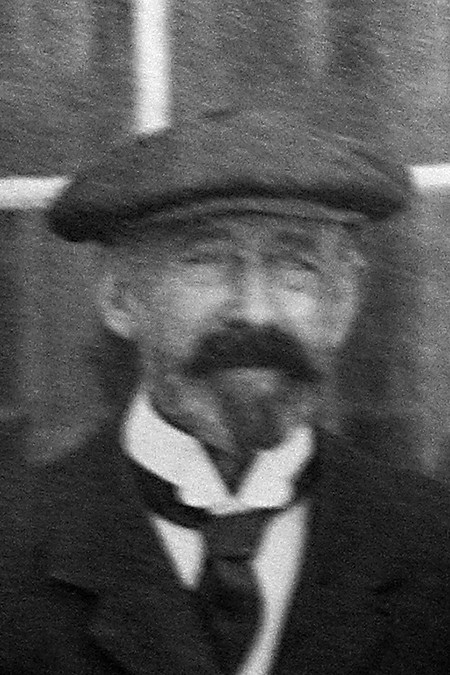
A couple of years later, while researching the Ottawa Company of Sharpshooters I spied a photo of Sharpshooter Lt. Henry H Grey, shown left, in a group at the Rideau Curling Club.
On Sunday I was checking out the photos on the wall at the cricket pavilion at the Rideau Hall and found a likeness of a relative of Rich Little, subject of a recent article in Families.
07 August 2006
Icons of England
The first Monday on August is Civic Holiday in Ontario, and known as Colonel By Day in Ottawa. By, of the Royal Engineers, was responsible for the construction of the Rideau Canal, which we hope will eventually be named a World Heritage Site. The Rideau Canal is an icon of Ottawa.
The Angel of the North
The Archers
Big Ben
Blackpool Tower
The Bobby
Bowler Hat
Brick Lane
Cricket
A Cup of Tea
The Domesday Book
Eden Project
The FA Cup
Fish and chips
Fox-hunting and the Ban
Globe Theatre
Hadrian's Wall
The Hay Wain
Many more are nominated. Which would your English ancestors have been familiar with? Would they have voted for Garden Gnomes or Sea Shanties?
05 August 2006
14 things beginning with S
Your family history, and life, might benefit from adopting the ideas in this list.
Support local heritage.
Subscribe to a family history magazine.
Store a backup copy of your family history file with a friend.
Speculate about creative ways around your brick wall.
Stop being a pack-rat.
Soak up the atmosphere at the earliest known location in your family history.
Smile more.
Sleep on it.
Sing a song you learned as a child.
Sit a while with the oldest person in your family circle.
Share your knowledge.
Send flowers to a cousin.
Scan the Rootsweb mail list for your surname.
Save time for family.
04 August 2006
Irish Collection
I ran across this large collection of free new resources for Irish family history at the web site for Library Ireland.
Until recently I had not appreciated how severely Irish immigration to Canada went into decline in the second half of the 19th century. "Unlike the experience of the United States the famine dispora heralded the closing phase of Irish Catholic migration to British North America. Between 1846 and 1850, only 230,000 Irish came to the Atlantic colonies and the Canadas." By 1901 the Irish born population of Ontario was only 3.2% and declined to 2.0% in 1911.
The collection seems like a mixed bag, and by the look of the dates a bit late to be of great interest to the folks with Irish ancestors who settled in Canada, unless perhaps to find ancestors who remained.
Cork County Directory 1862
Clare County Directory 1862
Cavan County Directory 1862
Ulster Towns Directory, 1910: Annalong, County Down
Ulster Towns Directory, 1910: Aghalee, County Antrim
Ulster Towns Directory, 1910: Antrim
The Scotch-Irish in Canada
Landing of the French at Killala
The Scotch-Irish of Pennsylvania
The Scotch-Irish of Ohio
Epilogue (1922-1930)
The Treaty
War and Conciliation
Sinn Fein and the Rising of Easter Week, 1916
John Redmond and Home Rule
Parnell and the Land League
Remedial Legislation
Young Ireland and the Fenians
The Famine
O'Connell and Emancipation
The Union
Revolution and Rebellion
Grattan's Parliament
The Struggle for Legislative Independence
Commercial Disabilities
03 August 2006
Families
 The August issue of the Ontario Genealogical Society quarterly, Families, arrived earlier in the week and includes my latest article "A Little Family History Research". Its based on an investigation of the ancestors of Ottawa-born impersonator Rich Little and highlights the use of a variety of Internet sources.
I enjoyed several of the other articles, especially those by Brenda Dougall Merriman, Patty McGregor and Alison Hare. Alison was also guest editor for this issue --- nice job.
02 August 2006
One for the record books
 Yesterday was a day to be grateful for airconditioning as the thermometer topped out at 36.3C (97F for the Celsius challenged), not quite 37.8C which is the highest ever recorded in Ottawa, nor anything like the record heat of Toronto in July 1936, but memorably warm. I got those figures on records quite easily from the National Climate Data and Information Archive, operated and maintained by Environment Canada. They provide free access to official climate and weather observations for many locations at the Climate Data Online. Daily data go back to the 1880s for several locations, and to 1840 for Toronto. When you want to add a bit of colour to your family history its worth checking out the weather at the time of significant family events. If you're not in Canada check a local newspaper archives, that's where I found the image of kids keeping cool in 1936..
01 August 2006
Toolbar Schmoolbar
One of the blogs I follow regularly is Stephen's Lighthouse. Stephen Abram impressed me as a speaker several years ago at a conference at Library and Archives Canada. He's now with SirsiDynix -- self proclaimed "global leader in strategic technology solutions for libraries".
A few days ago Stephen blogged on "Building Your Own Library Toolbar". The article even had a link to a toolbar developed for the Ottawa Public Library. It crossed my mind to develop one for BIFHSGO, but I had second thoughts. In promoting the idea Stephen wrote:
"This is a great way to gain 'shelfspace' on your users' monitors. You'll always be there as a presence and service reminding them about the books, but also your events, databases, virtual reference, story hours and more."
This strikes out for me. It's not looking at things from the user perspective where the library is a small part of their life. I already dedicate enough valuable desktop real estate to administrative overhead and don't need to lose even more when my existing desktop tools, which include a link to my library website, do what I need anyway.
31 July 2006
Update your searches

A lot of genealogical data is in databases not accessible by search engines like Google. You usually have to go to each database site and search it individually. One of the biggest sites is Rootsweb's Worldconnect which claims 459,857,161 names, 4,372,310 surnames and 400,262 contributed databases. It's a good idea to search it for those elusive ancestors, but set aside some time. When I search for Northwood I have to wade through multiple entries for 14th century family members. Some people seem to make it their hobby to resubmit the same thing. Although you can limit the search in several ways it would be good to also have a way to specify you want no hits earlier than a certain date.
28 July 2006
Very popular British records to come online
T
Buried in the newsletter is the sentence "Meanwhile we plan to make other records on microfilm, such as RG 4 and PROB 6, which are very popular at the FRC, available online within the next couple of years." New records online are always of interest, but what are RG 4 and PROB 6?
RG 4 is General Register Office: Registers of Births, Marriages and Deaths surrendered to the Non-parochial Registers Commissions of 1837 and 1857. Find details here.
PROB 6 is Prerogative Court of Canterbury and Related Probate Jurisdictions: Administration Act Books, 1559-1858. Details here.
Although I've not used them these look like useful records to have online.
Save some aggro

27 July 2006
Sahib, the British Soldier in India 1750-1914
I listened to a podcast by military historian Richard Holmes, who examines Indian soldiering in peace and war. He addresses the experience of ordinary soldiers, whether soldiers of fortune, East India Company or regular army, why they joined up, how they got to India and what they made of it when they arrived.
This is a recording of a lecture at The National Archives, and the content makes it well worth listening to. There's not much relevance to Canada and Britain, except that almost everyone has some connection to the British Raj. Some of the regiments who served in India also served in Canada before Confederation.
TNA will would be well advised to put a bit more effort into the technology. The sound is awful, it sounded as if the speaker was too close to the microphone. I would have liked to see the slides too.
26 July 2006
Your Family Tree Blog

You can link to it here. I took advantage of the RSS feed and added it to my Bloglines subscriptions.
On North American newsstands the magazine carries the cover title Your Family History.
Full disclosure - I have written for and am currently working on an article for YFT.
25 July 2006
Framing Canada
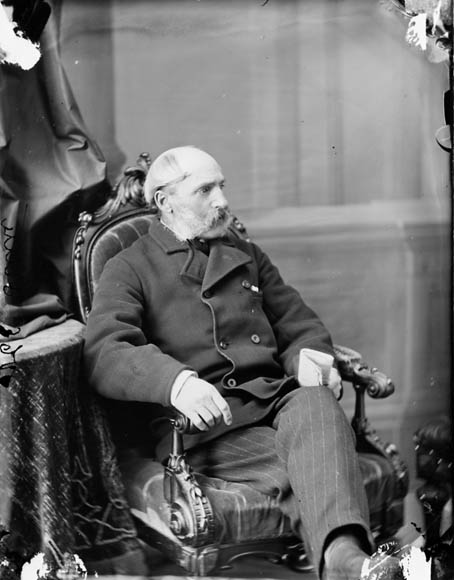
As the PR blurb says "these images tell the fascinating and ever-changing story of how Canadians see themselves and their world" although ts worth remembering its actually "how photographers depicted Canadians and their world." The online collection appears to have been augmented with many more digitized images, thematic presentations, and a flash introduction that I've bypassed in the link above.
This image from the collection is of William C Little from the William James Topley Collection. Little was a member of Parliament and immigrant to Canada from England in the 1850s. For more on Little, including his great-grandson, impersonator Rich Little, see my article coming soon in the August issue of the Ontario Genealogical Society publication Families. The article stresses use of a diverse range of online sources.
24 July 2006
The Genealogy Guys Podcast
George Morgan and Drew Smith, well known Florida-based genealogists, included an item on the upcoming BIFHSGO Annual Conference in a Canada-packed edition of their weekly Genealogy Guys Podcast. The program also included an informative interview with Louise St-Denis of the National Institute for Genealogical Studies and a short item on changes in Provincial boundaries.
Its well worth checking out what George and Drew are talking about each week, they both have interests that extend beyond the USA (which I'm told stands for Unexplored Southern Area). Find the Genealogy Guys Podcast here.
21 July 2006
Ups and Downs
Between 1869 and the 1930s more than 100,000 youngsters came to Canada from Britain through programs operated by various charitable organizations. These were kids who had been in some kind of distressed situation and came to Canada to be settled under the care of a host family. Collectively they are known as Home Children in Canada.
The best known agency, responsible for about a third of these young immigrants, was Barnardo's, founded by Thomas John Barnardo . His organization in Canada, with headquarters in Toronto, published an occasional newsletter for the children they brought over. The earliest edition was for 1895, the last for 1949. The most complete collection is likely at Library and Archives Canada, but unfortunately issues from about 1906 to 1919 are missing and cannot be located elsewhere. Likely 200 or so copies were printed, so it seems likely copies survive, perhaps in someone's attic. Please keep and eye open for copies and let me know if you come across any. They are part of Canada's history.
19 July 2006
Don't reshelve those books and magazines
A local librarian mentioned to me yesterday she was in the process of recommending cuts of $21,000 in periodical acquisitions. Asked how this is being done she told me that one of the inputs is based on scanning the codes on items left out on tables by visitors, which indicates interest in the item. So, if you want you local library to maintain its collection in your area of interest, DON'T RESHELVE ITEMS. Mum may have told you to always return things where they came from, but it doesn't apply in the library. You might want to pull out a few additional genealogy items and leave them out.
Manchester Burial Records
The burial registers of Manchester's Southern, Philips Park, and Gorton cemeteries can now be searched on-line at < www.burialrecords.manchester.gov.uk >. It's free to search the index of records and you can pay a small charge for more information including an image of the burial register. This information from a posting in the Rootswen GENBRIT list.
18 July 2006
Help find Megan's Little Orphan Annie
Regular readers will know that I have a great deal of respect for genealogist-author Megan Smolenyak Smolenyak. Yesterday she posted on her blog, Megan's Roots World, the story of Annie Moore, the first immigrant to land at New York's Ellis Island. Annie arrived from Ireland on 1 January 1892 with her brothers Anthony and Phillip. Read the article here. Megan is looking for the real story and is offering $1,000 to anyone who can discover what actually happened to Annie. Did she perhaps come to Canada?
17 July 2006
Mapping Human History
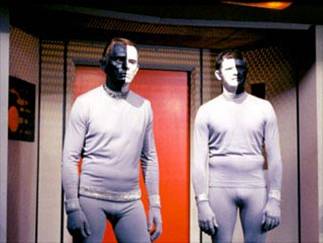 As background for my presentation on DNA and genealogy coming up in September at the BIFHSGO Annual Conference I borrowed a copy of Steve Olson's 2002 book Mapping Human History from the Library. I'm only a little way into the book but the end of the first chapter sets the tone ".... human's haven't changed much over the past 150,000 years. And that's exactly the conclusion geneticists have been drawing from our DNA." It a repudiation of race, in much the same way that Gene Roddenberry did in the episode of the original Star Trek series depicted in the image. Olson's argument seems to be that race is a social construct without physical basis, and that there is as much variation within racial groups as between them. This is debated in the reviews posted at amazon.com . I'll reserve comment on how Olson develops his case until I've read further, and then perhaps looked at a book with a counter view like Race: The Reality of Human Differences by Vincent Sarich and Frank Miele.
14 July 2006
Countries in Your Family History
 One of the blogs I visit regularly is Matthew Stibble's Bad Language, where the content puts a lie to the name. One of the links posted today is to a site here where by checking boxes you can produce a map - they suggest colouring in the countries you have visited - mine is shown here. You might also want to use it to illustrate the countries in your ancestry. Its a simple application, but free.
13 July 2006
Genealogical Libraries
These days more and more organizations are putting their library catalogues online for all to browse. These can help track down that elusive resource, especially in planning for a research trip. Here are a few of my favourites.
The British Isles Family History Society recently updated the online catalogue for their Brian O'Regan Memorial Library, found here. I see it is up to 1909 items with particular strength in Irish resources. Our partner organization, the Ottawa Branch of the Ontario Genealogical Society, has an online catalogue here for a library with more than double the holdings focusing on Ottawa-area resources.
Although not specifically a genealogical library, in Ottawa Library and Archives Canada is THE place to go for Canadian materials. Find their new amalgamated search here.
Outside Canada the Family History Library of the LDS Church, and their online catalogue, should be one of every serious genealogists' favourite links - start here. In the UK I go first to the Society of Genealogists' Library catalogue, here.
Don't overlook published family histories. Some never get to the large libraries, so look for the catalogue of the local public library, genealogical or local historical society for the area where they lived.
12 July 2006
The Digital Revolution – and Service Delivery in National Institutions
"(When you find a record in our new catalogue) we'll scan and digitize it for you on demand and email it to your home desktop in 24 hours for eight pounds 50."
"We've set ourselves the ambitious target that 90% of what people want to see we'll let them see online within the next five years."
These are quotes from a presentation in May by Natalie Ceeney, Chief Executive of The National Archives in Britain. Food for thought. Access the sound recording and slides from her presentation here.
11 July 2006
Family Secrets Revealed by DNA Analysis
 Earlier today I was asked to provide a short summary for the presentation I'll be making at the annual "Celebrate Your Anglo-Celtic Roots" conference of the British Isles Family History Society of Greater Ottawa. Read more about the conference, being held 22-24 September at Library and Archives Canada, Ottawa, here. My presentation, Family Secrets Revealed by DNA Analysis, is on Saturday the 23rd. I don't like giving away the whole story so wrote a teaser
The record of your ancestry is written in your DNA. Its far from a complete record, but does contain information to be found in none of the conventional genealogical sources. Until recently we have been illiterate when it comes to reading that DNA record. Thanks to advances in science and technology, and the availability of commercial services for genealogists since 2000, DNA is starting to contribute to extending family histories and resolving uncertainties. The presentation is based on my own experience.
10 July 2006
London's Magnificent Seven Cemeteries
 If you're into digging up relatives, and they happen to be in one of London's larger cemeteries, take a look at web pages the BBC have for the magnificent Seven Victorian Cemeteries. Kensal Green, opened in 1832, was followed by West Norwood (1837), Highgate (1839), Nunhead (1840), Brompton (1840), Abney Park (1840) and Tower Hamlets (1841). You won't find much of direct help to the genealogist looking for ancestors who may be buried there, but there is a brief description for each mentioning some of the prominent people who found their final resting place. Some of the cemeteries are being rejuvenated for nature preservation, education and appropriate recreation. Start at the web page here.
09 July 2006
Records of Scots Immigration to Canada
Canadian ships passenger lists remain one of the most difficult records of the period with which to work. Now, if you have someone of Scottish ancestry who arrived at a Canadian port, there is help at hand. A local Ottawa researcher, Don McKenzie, has indexed the passenger lists for Eastern Canada arrivals of Scots from 1870 to 1883 and donated the index to Library and Archives Canada (LAC). Its a typescript. LAC hope eventually to OCR the text and make it into an online database. In the meantime you can always contact the Canadian Genealogy Centre and ask for a lookup. To find out how to contact them look here.
07 July 2006
Welsh Parish Registers`
 A note in the minutes of the most recent FFHS General Meeting states that the Genealogical Society of Utah has obtained permission to microfilm Welsh parish records which has been withheld for many years. Hopefully that will eventually mean much greater availability of these Welsh records. Another note from a usually reliable source is that filming is starting in Monmouthshire this month.
05 July 2006
Statistics from the 1901 and 1911 Census in Ontario
Now that Ancestry have made an index of the 1901 Canadian census available online, complementing 1911 which has been available for some months, there is an opportunity to look at statistics on changes that occurred. Before anyone howls, yes I realize there are significant problems with the census data and the indexing. The statistics derived will undoubtedly exhibit problems and must be treated with appropriate caution. [End of obligatory academic caution.]
As background for a presentation next year I've been scanning these Ancestry databases for Ontario population trends. Its never been so easy to examine these statistics before, thanks to the availability through Ancestry and the Exact Search specifying the total count.
This was a period of massive immigration, and despite the federal government encouraging settlement in the "Last Best West" many did make Ontario their home. The Province's population increased from 2.2 million to 2.5 million. An extra 108,000 are shown as born in England (searched as Eng*) in 1911 compared to 1901; 15,000 additional born in Scotland (Scot*); 1,500 in Wales; and there was a decrease of over 19,000 born in Ireland (Ire*). The latter likely reflects the death of many Irish immigrants who came well before Confederation. The trend for the Irish-born was especially noticeable for York, Peterborough and Carleton counties, less so for Middlesex or Essex.
The trend for the Scottish-born is less systematic. Scots-born continued to represent the same fraction of the population in all five counties within about one percent.
By contrast the English-born fraction of the population boomed, most noticeably in York where it increased by more than 10%. Carleton and Peterborough saw 4% population share increases for the English-born. There was a 1% increase in Essex and hardly any change in Middlesex.
04 July 2006
National Probate Index
There is an unsubstantiated report that images of indexes to wills for England and Wales to 1960 are to be made available to search online. If these are the calandars,starting in 1858, meaning a short summary of the will, this would be a significant addition to the repetoire of online genealogical resources -- if only that they usually include the date of death. Read about the existing system at Guide to obtaining probate records.
03 July 2006
Security at the National War Memorial
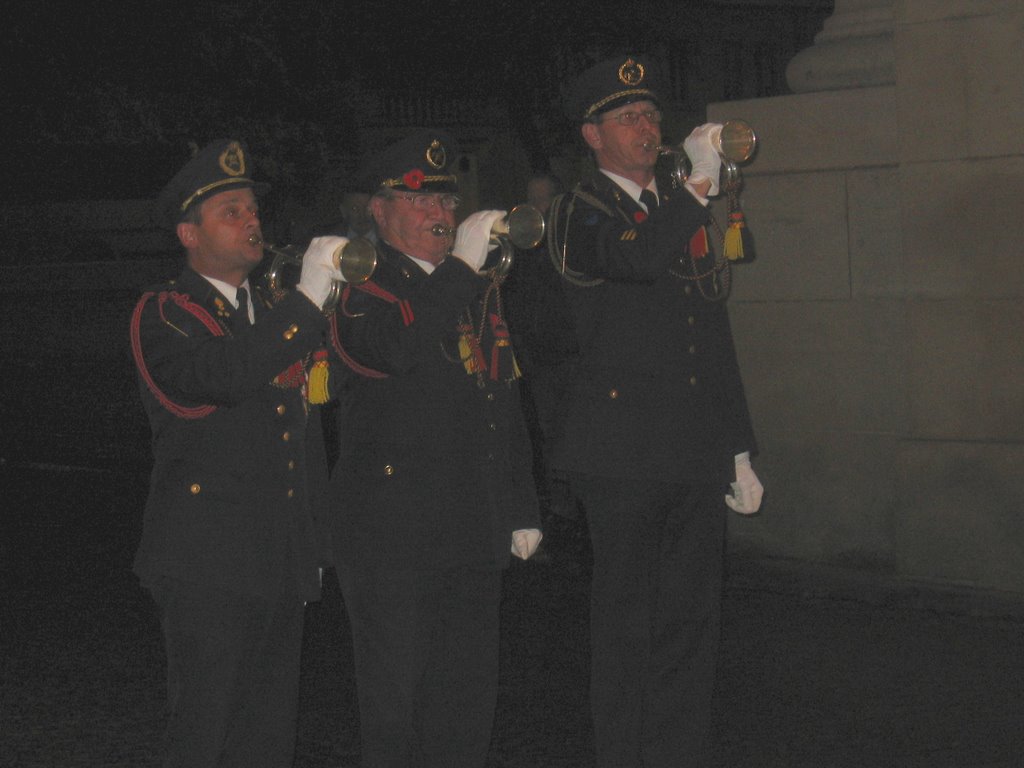 Last November I had the privilige of visiting Flanders and the Menin Gate. For all but ten minutes each day this memorial to more than 50,000 British Empire soldiers, including a great-uncle, who lost their lives in Flanders is a roadway entrance to Ipres (Ypres). At 8pm each day the traffic stops and a simple Last Post ceremony is held, often with a wreath laying by a visiting group. The memorial sees visits by tourists throughout the day as traffic passes under the archway of the gate. There is no security evident at any time. None is necessary as every school child knows that the memorial is something citizens takes seriously, evidenced by the ceremony as part of the community daily routine.
Today's Ottawa Citizen carries a photo of a young man urinating at the National War Memorial, and reports that "veterans" want increased security around the memorial. A fence is mentioned. We should learn a lesson from Ypres. Erecting a memorial is good. Holding an annual ceremony on November 11 is good. But how much better to ingrain the significance of the memorial, and what it stands for, into the minds of every citizen through a daily event, such as a Last Post ceremony.
01 July 2006
Ancestry 1901 and 1906 Canada Census
Just in time for Canada Day, Ancestry have added indexed versions of the 1901 and 1906 censuses to their Canadian offerings.
As with the 1911 census, which Ancestry added earlier this year, the index entries are linked to images of the enumerator's forms on the Library and Archives Canada (LAC) web site. Unfortunately there is no facility for zooming in on the image, if you want to do so you need to copy the image and paste into an image viewer. I use IrfanView.
We are fortunate to have a free index to the 1901 census completed by volunteers, and more than 90% complete index to 1906, which is only for the provinces of Manitoba, Saskatchewan and Alberta. Find these at Automated Genealogy.
30 June 2006
New Books on DNA in Announced
 Bryan Sykes, author of the best-selling Seven Daughters of Eve has been at work on a new book, or rather books. Saxons, Vikings and Celts appeared on the amazon.com web site and is scheduled for release in November. Blood of the Isles is found on the amazon.co.uk site for release in September. The descriptions of the books are similar, likely different versions for the two markets. From amazon.com ....
 From amazon.co.uk ... "Bryan Sykes, the world's first genetic archaeologist, takes us on a journey around the family tree of Britain and Ireland, to reveal how our tribal history still colours the country today. In 54BC, Julius Caesar launched the first Roman invasion of Britain. His was the first detailed account of the Celtic tribes that inhabited the Isles. But where had they come from and how long had they been there? When the Roman eventually left five hundred years later, they were succeeded by invasions of Anglo-Saxons, Vikings and Normans. Did these successive invasions obliterate the genetic legacy of the Celts, or have very little effect? After two decades tracing the genetic origins of peoples from all over the world, Bryan Sykes has now turned the spotlight on his own back yard. In a major research programme, the first of its kind, he and his team at Oxford University set out to test the DNA of over 10,000 volunteers from across Britain and Ireland with the specific aim of answering this very question: what is our modern genetic make-up and what does it tell us of our tribal past? Where are today's Celtic genes? Did Vikings only rape and pillage, or settle with their families? And what of the genetic legacy of the Saxons and the Normans? Are the modern people of the Isles a delicious genetic cocktail? Or did the invaders keep mostly to themselves forming separate genetic layers within the Isles? And where do you fit in? As his findings came in, Bryan Sykes discovered that the genetic evidence revealed often very different stories to the conventional accounts coming from history and archaeology. "Blood of the Isles" reveals the nature of our genetic make-up as never before and what this says about our attitudes to ourselves, each other, and to our past. It is a gripping story that will fascinate and surprise with its conclusions."
I'll certainly be looking at both, which are currently listed at substantial discount to cover price.
Update: A tip of the hat to Megan Smolenyak Smolenyak for referencing this item from her blog at Megasrootsworld
28 June 2006
The Penny Illustrated
Now online in searchable digitized format, the Penny Illustrated Paper was published in London between 1861 and 1913 providing "a valuable and entertaining source of detailed information on everyday life and historical events in Britain and across the Empire." This is the result of a project of the British Library and well worth exploring.
I tried searching
Search from: http://www.collectbritain.co.uk/system/paper/
27 June 2006
Librarians Helping Canadian Genealogists ...
I'm adding a new permanent link to this site. Its for a blog I visited when it first appeared; they even posted one of my suggestions in the early days. Then nothing much happenned with it for a while and I kind of forgot about it. Probably losing all my bookmarks in a crash had something to do with it too. I wonder what the other useful links were that I lost?
Librarians Helping Canadian Genealogists Climb Family Trees is the blog's name. It was recommended by Marion Press in a presentation at the recent Ontario Genealogical Society Seminar in Oshawa, and one of the contributing editors was another speaker at that event -- Ryan Taylor. Updating is a bit variable but if you check it once a week you'll likely find something new in the way of Canadian genealogy news and information.
Find it at: http://canadianlibgenie.blogspot.com/
25 June 2006
Rootsweb Mailing List Archives Search
Posting queries on a Rootsweb mailing list is one of the easier things you can do to try and find your way to the other side of a genealogical brick wall. I've done so many times, and every so often receive an email about a link, or possible link. Posting is like leaving a baited fishing hook hanging in the water. You never know when someone is going to search the archives find one of your old queries.
That search process just got a bit easier. Rootsweb have an improved search engine (still in the beta) for all the Rootsweb Mailing List archives. If you're familiar with the old search engine you'll know that you first had to select a mailing list, and then search its archives year by year. Now you can search all the lists at once and, seemingly, for all years. That's a big time saver, and also an encouragement to formulating your search terms more carefully so as not to become swamped by hits. There's an advanced search tab allowing you to put several convenient restrictions on the search including specifying a particular mailing list and the poster. I can think of a few more I'd like to see, especially limiting the period searched to the past few weeks or months.
Find the new search engine at: http://archiver.rootsweb.com
23 June 2006
Bytown Museum

Here's a tip for a gentle outing in the heart of Ottawa this summer . Park at the Mill Restaurant at the west side of the Portage Bridge, watch for the 2 hour parking limit, and stroll below Parliament Hill along the edge of the Ottawa River. The path is reopened, having been closed much of last year. Even on the hottest day, perhaps even especially on the hottest days, there is a cooling breeze from the river. The path climbs as you get to the Rideau Locks, but you can look forward to refreshments thanks to the new cafe at the Bytown Museum. There are colourful umbrellas to provide shade at three tables where you can linger, or buy an ice cream and eat it as you return along the same path -- the impression is different going in the other direction -- or climb to Wellington and go westward pass the Parliamentary Precinct, the Supreme Court and Library and Archives Canada. More on what's happening at the Bytown Museum here.
21 June 2006
The New world; or, The United States and Canada, illustrated and described
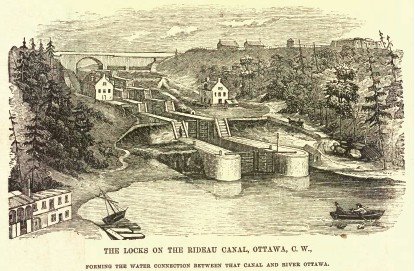
I try to keep an eye out for newly scanned books appearing on the Internet Archive. "The New world; or, The United States and Canada, illustrated and described" appeared recently. It includes a fair amount about Ottawa and vicinity, including mention that the city had been recently selected as Canada's capital by Queen Victoria -- meaning the book dates from 150 years ago. The engraving of the entrance to the Rideau Canal from the Ottawa River will be familiar to locals. Also of local interest are descriptions of travel by steamer and train from Montreal and Prescott to Ottawa.
What particularly attracted me were the "Notes connected with Emigration, Land and Agriculture", 70 pages of practical advice directed specifically at the person coming from the UK. For example, its helpful to know about administrative procedure, especially if travelling with a family. At the Castle Garden terminal in New York: "After leaving the ship, you proceed in a large barge, or steamer, to Castle Garden landing. On landing, you will be shown the way into the interior of the building. Entered it, you proceed to a desk, where the "Registrar" sits, with a book before him, in which he enters your name, where you are from, and to where you are going. You are then passed on to another clerk ..... "
Download the book in pdf from http://ia310112.us.archive.org/1/items/newworldus00londrich/newworldus00londrich.pdf
18 June 2006
Better English and Welsh Civil Registration Certificates
Most people purchase certificates for BMDs in England and Wales from the General Registry Office. There is a centralized system which started in mid-1837. You can look up events in the ever improving GRO index at FreeBMD, or search quarter by quarter on the index images at ancestry.co.uk. Once you find the reference you can order online from the GRO, and pay by credit card. The system works well -- I've used it often. Even if you don't know the reference you can ask them to do a search, for a price.
Another less used option is to order directly from the local record office covering the area in which the event was registered. You don't need the GRO index number, just the name and details as close as you can give them. Most of these offices don't have a system for ordering online -- so what's the advantage? In some cases, especially for marriages and for some locations, the certificate you receive will be a photocopy of the original which includes the original signatures. That's a more reliable record than a transcription which is what you get from the GRO. Find the addresses for the local offices here.
16 June 2006
1841 Census of Scotland
Ancestry.com recently added a transcription of this census to their UK offerring. As I blogged back in March, some of these records have been available through FreeCen, but it is good to have a more complete census and one that is integrated with their search engine.
A few words of caution:
1. In the notes Ancestry point out a number of parishes and census districts that are missing;
2. Unfortunatly these are only transcriptions, with no ability to view the original record;
3. As with the 1841 census of England and Wales, the information is not as extensive as in later years -- there is no indication of how people in a home relate to each other;
4. Birthplace information is sketchy.
14 June 2006
FreeBMD Updated
If you haven't visited FreeBMD lately to check the index for those elusive English and Welsh birth, marriage or death registrations -- now would be a good time. The FreeBMD database was updated on Friday 9 June 2006, and currently contains 117,432,059 distinct records (150,784,219 total records). The records that have been transcribed are not evenly distributed, but the vast majority of index entries are now available. Check the graphs for availability for Births and Marriages and Deaths showing which quarters are most complete.
12 June 2006
Is Interest in Genealogy Declining?
It never occurred to me to even ask the question until I checked out Google Trends, and tried it out with a search for 
As you can see above, the number of searches for the term on Google is in steady decline, although the number of news stories is if anything slightly increasing.
Then I tried limiting the search to queries from UK sites. The peak in late 2004 is, I think, associated with the first series of the popular BBC2 TV program "Who do you think you are?". The less pronounced peak in late 2005 and early 2006 is the second series of the program. Despite these peaks the overall trend is down. The system seems to give realistic results. Try searches for tsunami or Katrina to see the response to a sudden onset catastrophy, or to "
11 June 2006
Teachers Registrations in England and Wales
British Origins (www.britishorigins.com) announce that teacher registration information, for over 100,000 people who taught in England and Wales between 1870 and 1947 , have been added to their web site. More than half of these are women.
From 1914, many teachers in England and Wales (and elsewhere) registered with the Teachers Registration Council. The original registration records for the period up to 1947 (after which registration was abandoned) were deposited with the Society of Genealogists (www.sog.org.uk)
Registration started in 1914, but people who were already teaching registered so records cover teachers who started their careers from the 1870s on.
The records provide the following information:
o teachers name (and for married women teachers often their maiden name as well)
o Date of Registration
o Register Number
o (Professional) Address
o Attainments
o Training in Teaching
o Experience
Members of the Society of Genealogists will be able to use their free quarterly access to the origins database to access this information.
05 June 2006
Ottawa Events Next Weekend
June 10-11 will be busy days for genealogists in Ottawa.
On Saturday June 10 the British Isles Family History Society of Greater Ottawa has Lucille Campey as guest speaker at the last meeting of the season. Lucille will speak on The Pioneer Scots of Lower Canada: 1763-1855 which is the title of her new book which will be on sale, the fifth in a series on the Scots in Canada. Lucille will be introduced by Mike More, BIFHSGO member and Chair of the Ottawa Branch of OGS. The presentation starts at 10am in the auditorium of Library and Archives Canada.
That same afternoon the Family History Centre of the Church of Jesus Christ of Latter Day Saints will host a Family History Fair at 1017 Prince of Wales Drive. Presentations will be by: Sylvie Tremblay, Michel Béland, Olivier Bilodeau, Glenn Wright, Lesley Anderson, John Sayers, Brenda Bowman, Wayne Walker, Shirley-Ann Pyefinch and Ana Ghia-Pereira. To Register (free) Call: 613-224-2231 during business hours.
On Sunday, June 11 at 2PM Beechwood Cemetery holds their annual Historical Tour. This year's theme is "The Ottawa Sharpshooters and Ottawa’s Military Heritage". Many of those helping to animate the tour are Society BIFHSGO members. Even life-long Ottawa residents are sure to learn something to interest and surprise.
02 June 2006
ENCYCLOPEDIA OF CANADA'S PEOPLES
If you're looking for context for British and Irish immigration to Canada check out this publication, available as a more than 1300 page book, or online at < www.multiculturalcanada.ca/mcc/ecp/ >. The entries on the English and on Irish Protestants were written by Carleton University History Professor, abs BIFHSGO Hall of Fame member, Bruce Elliott. There are also chapters on Irish Catholics, Scots and Welsh.
30 May 2006
WILTSHIRE COMMUNITY HISTORIES
The web site at < www.wiltshire.gov.uk/community/ > contain information on 261 Wiltshire communities compiled by Wiltshire Libraries & Heritage. Every community page already has certain basic information, such as early maps, local administrative bodies, population from 1801, newspapers for its area, lists of local maps, the registration district, and links to other sites of interest. More is being added.
29 May 2006
GLASGOW DIGITAL LIBRARY
If you have Glasgow-area ancestors check out <> for Ebooks on Glasgow, including Who's Who in Glasgow in 1909, The old country houses of the old Glasgow gentry, Curiosities of Glasgow citizenship, Memoirs and portraits of one hundred Glasgow men, Glimpses of old Glasgow, The origin and history of Glasgow streets. There are also a few Ebooks on Scotland in general.
27 May 2006
Ontario Genealogical Society - Seminar 2006
Before heading off to the OGS banquet this evening a note that the best presentation I heard today was by Marian Press - "New Internet Technologies for Genealogy: Using Web Alerts, Intelligent Agents, Blogs and RSS Feeds, and Wikis. Find links to some of the resources she mentioned here.
24 May 2006
Lt Col John By RN
While in England I found time to stop at the churchyard in Frant to see the grave of Lt Col John By, RN, who was responsible for the building of the Rideau Canal. Ottawa was previously named Bytown in his honour.
The church at Frant is well situated away from the fumes and noise of the main road, a few minutes south of Tunbridge Wells. A lady doing maintence on the churchyard directed me to By's grave, and told me she had visited Ottawa some years ago. I was surprised that By takes second place on the stone on the plot, in the centre of the p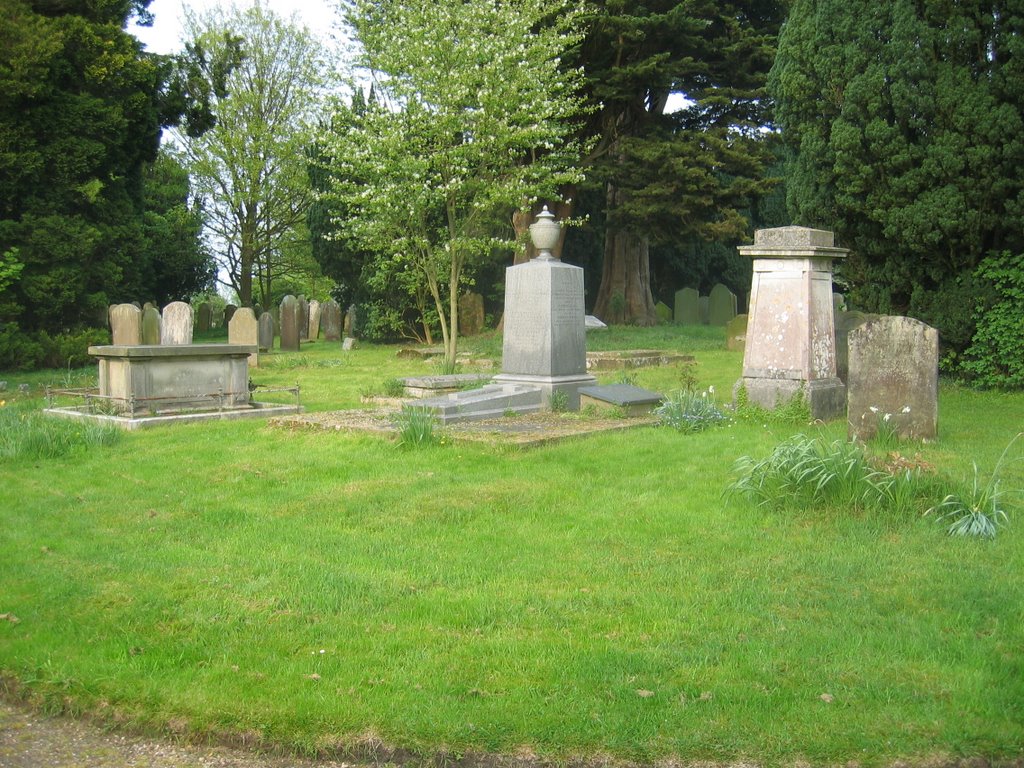 icture. You can see the plaque placed by the Ottawa Historical Society, now a little the worse for wear but still servicable, beneath his memorial inscription. I was told they believe By is buried in front of the monument -- the centre bump that shows as the mower shaved the grass more there. There is also a plaque to By in the church.
20 May 2006
Back ,,, and changed
This blog has served it's original purpose of allowing me to experiment with daily blogging. For the time being I will switch to less frequent updating with items to be included in the British Isles Family History Society's monthly eNewsletter.


