 Genealogists love Rootsweb; just not quite as much as before. Using the new improved Rootsweb mailing list search capability the bar chart in red shows year by year the number of messages posted on all Rootsweb mailing lists. A steep rise to 2000 was followed by two years of slight increase. The peak in 2002 saw over 4.1 million messages posted. 2003 saw a drop which has continued as a gentle decline since.
What's happening? Is interest in genealogy declining? Is the mailing list moving out of favour as a technology as the blog and web 2.0 take over? Have all the questions been asked, with the answers available on the mailing list archive? Something else? Other searches show technology trends. Microfiche are mentioned half as frequently in postings in 2006 as 10 years earlier.
The chart in blue, postings with DNA in the message body, shows healthy growth as interest in this area continues to develop after commercial DNA tests for genealogy started in 2000. Lest we get too excited, that's still less than 3.3% of all postings in 2006.
Another emerging word is blog. There were nearly 5000 postings with the word in 2006, up from just nine in 2001 when the word first appears with its current popular meaning.
13 April 2007
The rise and fall of the Rootsweb mailing list
12 April 2007
Library Thing for genealogy
 Library Thing is an online service where you can enter the books in your collection. I've never thought there was much benefit in entering recipes, CDs, books and other collections into a computer database. Library Thing and the online world have changed my ideas a bit.
I gave this system a try with my books on genealogy and related topics. The first pleasant surprise was how easy it is to enter the data. Because everything is online all you have to do is enter, say, the title and a pick-list appears for you to select the appropriate book. If it doesn't you can switch to another major database, such as a major national library catalogue, amazon.ca, amazon.com, amazon.co.uk and many others. Select the appropriate title and all the other data, author, publisher, number of pages, ISBN, and more is ingested. If available you also link an image of the cover, or you can add it.
What you get in return is the ability to see your collection in context. Apparently 106 other Library Thing users own "Professional Genealogy: A Manual for Researchers, Writers, Editors, Lecturers, and Librarians", 44 have "Ancestral Trails: The Complete Guide to British Genealogy and Family History." "In Search of Your British & Irish Roots: A Complete Guide to Tracing Your English, Welsh, Scottish, & Irish Ancestors", by the late Angus Baxter, the first genealogy book I ever owned, is held in 38 collections.
You can also get suggestions for other books you might want based on those owned by Library Thing members who have similar holdings. The system even explains why it makes the suggestion. I was a bit disappointed that the recommendations were US-oriented, even though my collection is British and Canadian. It would be nice to have a way to indicates aspects of a topic that are not of interest.
You can enter up to 200 books for free, as many as you like for $10 (year) or $25 (life).
The image above shows my books most owned by others.
10 April 2007
Contemplating the Future of Genealogy
Dick Eastman recently published an article "A New Computer Revolution is rising around us?"
in his newsletter. It got more attention and reaction than most things he writes. The thrust was to draw attention to the emergence of web-based applications vying to replace stand alone genealogy software.
But what about longer term trends; accelerating technological change and the pace at which knowledge continues to be generated? Is there any danger that all the genealogy possible will one day soon be done, and if so when? There's a short video, Shift Happens, I can recommend viewing when you contemplate the global trends that will play into answering these question. I stumbled upon it courtesy of Stephen's Lighthouse.
09 April 2007
Genealogy Odds and Ends
Ancestry have now completed the transcriptions of the Scottish census from 1841 to 1901. Transcriptions for 1881 and 1901 were added on April 3.
Also new on Ancestry as of April 5, Oxford University Alumni, 1500-1886. It's based on the publications Alumni Oxonienses: The Members of the University of Oxford, 1715-1886 and Alumni Oxonienses: The Members of the University of Oxford, 1500-1714.
Ancestors on Board have added the third decade, 1909-1919 to their database of passenger lists from ships outbound from Britain.
There is a database of some British taken prisoner of war in 1914-1918 here. It's part of the Long, Long Trail web site on The British Army in the Great War.
The Canadian edition of "Who do you think you are?" exploring family history's of celebrities, is expected to debut on CBC on Sunday 7 October.
07 April 2007
Military history and family history: students and immigrants
The media are providing close to saturation coverage of the 90th anniversary of the Battle of Vimy Ridge, considered by many a defining event in Canada's development as a nation. The Ottawa Citizen has been running a series on Vimy and its significance with involvement of a panel of recent immigrants, and another panel of students. A larger group of students have travelled to Vimy for the unveiling of the restored memorial, after having researched a soldier involved in the battle.
Anyone can research a soldier. I chose, almost at random except for his last name, Ernest Howe Reid. He served with the 78th Battalion of the Canadian Infantry (Manitoba Regiment), died on 9 April 1917 at the Battle of Vimy Ridge, is commemorated at the Vimy Memorial and recorded in the Commonwealth War Graves Commission web site here. Like many of his soldier compatriots he was an immigrant to Canada. His attestation paper informs he was born in County Cavan, Ireland, on 27 January 1889.
I'm not sure it has come out but Vimy shows for me the importance of immigrants to Canada. Although seemingly not a popular things to point out, checking randomly in the CEF deaths at Vimy I estimate half were immigrants, born in Britain, including Ireland. Canada is a country where immigrants play a leading role. Unlike in the US, that can be and is up to and including the highest office in the land. The present and previous Governor General demonstrate the leadership role. Vimy shows the importance for Canada's development of more ordinary, yet exceptional, immigrants
What did I find in researching Ernest Howe Reid?
On the attestation paper his wife's name was Irene, living in North Battleford, Saskatchewan. Reid enlisted on 24 April 1915 giving his occupation as railway fireman. He is found with his wife and a son, James, born February 1910, in North Battleford in the 1911 census giving his month of birth as February 1890, emigration as the same year as his wife, 1907. She was born in India in July 1892.
The best fit for him on a passenger list departing the UK is Ernest Reid, single, age 18, who sailed third class on the Lake Erie from Belfast on the 26th of September 1907, arriving in Quebec on the 6th of October. He gave his occupation as farm labourer. This is found at Ancestors on Board, a commercial database.The corresponding passenger list deposited on arrival in Quebec, found at Library and Archives Canada, indicates he is bound for North Battleford.
There is a land grant in his name for 10th section in township 47, range 16, W3 meridian.
Going to the Irish civil registration index, not online, the birth of Ernest Reid is registered in the district of Cavan in the 1st quarter of 1889.
Apparently Irene and James moved to BC shortly after the war. She remarried. The son, James Howe Reid, was a fatality during WW2. An attachment to his file on the Canadian Virtual War Memorial, here, includes a mention of his father dying at Vimy.

05 April 2007
Create your own Google genealogy map
 It's free and easy. Google has just implemented a method of placing your significant landmarks on a map, labelling them, even linking in photos and videos, and sharing them with relatives, your family history society, or the world if you wish.
You need a free Google account, then click on My Maps and start creating your personalized map. I've done one of places relevant for family history in Ottawa, including address and links to web sites. It includes archives, libraries, major cemeteries and a few other sites from Gatineau to Vernon.
04 April 2007
John Green: whose father was he?
 This month BIFHSGO has an Easter treat for you -- a day before the chocolate Easter eggs appear. Alison Hare, a previous winner of BIFHSGO's best presentation of the year award, will speak on "John Green: whose father was he?"
Alison writes about the presentation "In 1836 John Green petitioned for land in the Ottawa Valley near an unnamed son he said had come to Canada at the time of the Peter Robinson settlers. Research eventually determined that none of the Peter Robinson settlers were viable candidates. When all the possibilities have been ruled out, what is a researcher to do? This case study will reveal the surprising answer to the mystery; and demonstrate how the Genealogical Proof Standard can help solve difficult problems."
Alison is a BCG certified genealogist, a former journalist and graduate of the Carleton School of Journalism and served for five years as editor of Ottawa (OGS) Branch News. I always learn something from her presentations, even on hearing them a second time.
That's this Saturday, April 7 at 10:00 am in the auditorium at Library and Archives Canada.
03 April 2007
Update on Welsh parish registers
Last July I posted on an agreement reached to film and digitize Welsh parish registers, long withheld from the LDS (GSU) microfilming program. An item posted on GENBBRIT-L reports on progress.
Filming started in Gwent last October and has been completed, namely: Baptisms, up to 1906; Marriages up to 1921; Burials up to 1958.
The Monmouthshire film is beginning to show in the Family History Library catalogue.
Glamorganshire filming should be finished by now but will be awaiting cataloguing in Salt Lake City
Reportedly the agreement was a contract included GSU indexing all the parish registers, and to be completed in two years. I wonder if these films will show up as projects within Family Search Indexing?
02 April 2007
Family Search Indexing

Before you can index you have to register and download the special application. It runs independent of your regular browser. Registration is online. You don't have to give personal information -- but you do have to provide an email address. When I registered it took a day for them to get back to me with the password, likely too long to be able to use one of those temporary email addresses.
The application download is 28.6MB, not something you want to try on dial-up. Installation went smoothly and, after changing the initial password, I was ready to download the first batch of images. You have a choice of projects to work on. See the list here.
First I tried a page of the 1900 US census from New York. The screen is divided into two, the original image on top, the transcription you are making below. They attempt to highlight the element you should be transcribing, and usually come close.
It's good to read the instructions first so you know what to do when anomalies arise, such as missing data or entries that don't match the default format. Failing that information is repeated for each element as you come to it in a small box to the lower right.
If you're reasonably computer literate it's reading the original document image that you'll find to be the greatest challenge. Even with a good capability to magnify it can be tough. No doubt that improves with practice, I didn't feel I'd anywhere near mastered the skill.
For the second batch I switched to transcribing Ontario death registrations and felt more comfortable as I have a better grasp on the geography. The data wasn't as compact as on the census and you got a second chance at the name as there was repetition.
It turns out the images I dealt with had already been transcribed by Ancestry, although not in as much detail. It was certainly tempting to check what I read against the Ancestry transcription. I tried it a couple of times and didn't feel I did any better a job. It's also tempting where you find something difficult to read to search for a complementary record, like a census, to resolve the problems. In most cases where I thought I found one it was hard to justify using the spelling from that other record. You might question whether that one is correct anyway.
I couldn't complete a batch transcription in 30 minutes, which seemed to be the promise. Maybe I'm slow and will get there with practice. You can always work for 30 minutes, save the result and come back later to continue the task.
At the end of the batch the program allows you to run through and review elements it finds unusual. I had quite a few in each batch, some for missing elements, some for names that were non-English. Apparently the same batch is served to two different people, then a third looks at items where those two differ.
Given that the data I was indexing was already on Ancestry, for which I have a subscription, I found my motivation flagging a bit. You can go in and see a list of the items you've completed but it would be nice to receive some additional feedback. Part of the problem was that there were no records on offer that I had a personal motivation to index. Presumably that will change as the project gets up to full steam.
My recommendation? Why not give it a try. We all benefit when more data becomes available. Even if it's already indexed the competition helps keep the commercial guys honest.
01 April 2007
Famous Relatives?

If you believe the genealogy behind the beta "Find Famous Relatives" tool in Ancestry's One World Tree they all have a documented common ancestor with my late sister-in-law. They vary from 5th cousin, several time removed in the case of Milton and Cassidy, to 9th cousin.
Given that the connection is made based on family trees submitted by patrons I'm not putting much stock in the information. It does attract family interest, but it may not pay to look too closely. There are people holding high elected public office in this world I would rather not be related to, April Fools Day or any other day.
29 March 2007
New Ancestry Border Crossing Database
Ancestry's title for this newly digitized database is "Canadian Border Crossings, 1895-1956". From where I sit it's more like US border crossings. It records mainly crossings into the US from Canada, although there are a few crossing in the other direction.
Confusingly this series has been known by the name of one of the crossing points, St Alban's, VT. The dates used by Ancestry, 1905-1956, are still those associated with the St Alban's data, even though there are crossings included prior to 1905. For example, at Calais, ME, some of the records date from as early as 1877. It's worth looking at the dates for the most likely crossing 
- Calais, Maine (ca. 1906-Dec. 24, 1952) (also includes a few arrivals from 1877 to 1905)
- Van Buren, Maine (ca. 1906-Dec. 24, 1952)
- Vanceboro, Maine (ca. 1906-Dec. 24, 1952) (also includes a few arrivals from 1888 to 1905 and a few arrivals at Halifax, Nova Scotia and St. John, New Brunswick)
- Fort Fairfield, Maine (ca. 1909-Apr. 1953) (also includes a few arrivals at Easton, ME, Houlton, ME, Boston, MA, and Buffalo, NY and a few alien departures)
- Eastport, Fort Kent, Lubec, and Madawaska, Maine (ca. 1906-Dec. 24, 1952) (also includes some departure records of U.S. citizens)
- International Falls, Baudette, Duluth, Mineral Center, Pigeon River, Pine Creek, Roseau, and Warroad, Minnesota (Jan. 1907-Dec. 1952) (also includes some departure records of U.S. citizens)
- Buffalo, Lewiston, Niagara Falls, and Rochester, New York (1902-1954)
- Hogansburg, Malone, Morristown, Nyando, Ogdensburg, Rooseveltown, and Waddington, New York (Jul. 1929-Apr. 1956)
- Newport, Vermont (ca. 1906-Jun. 30, 1924)
- St. Albans, Vermont (1895-1954)
- Babb, Montana (Jun. 1928-Oct. 1956)
28 March 2007
For or against the slave trade?
The UK Parliament has a web site where you can view images of original petitions for and against the Act for the Abolition of the Slave Trade, 1807, from people in Manchester. There is a searcheable transcription of the names. Was your ancestor on the side of the sinners or the saints?
27 March 2007
Your Genealogy Affects Your Health: Book Review
 When I found this title some months ago, self-published in 2006 at iuniverse by F. Clark Fraser
The main chapters are:
1. Genetics in a Nutshell;
2. Family Resemblances: Common Normal Traits;
3. Genetics of Common Physical Disorders;
4. Genetics of Behaviour: Normal and Abnormal.
Your Genealogy Affects Your Health can be purchased online, either for download as an Adobe eBook($6US) or in hardcopy ($12.95US) here. There's a copy in the Ottawa Public Library.
25 March 2007
Extra information in 20th century civil registration indexes.
Genealogists who work a lot with pre-20th century data for England and Wales sometimes forget that in the early 20th century extra information is included in the civil registration indexes of births, marriages and deaths. I did. Then I rediscovered it yesterday when trying to trace back a sister-in-law's family. I had her father's name, born in 1915, but nothing earlier and was getting nowhere. There is a family story that they are from the same family as a prominent academic, but I couldn't see any connection.
I was ready to order the birth certificate, but in looking up the reference number found the mother's previous surname. Knowing that made it easy to find the marriage in the marriage index, and so the parents first names. With that, and the indexed census on ancestry.co.uk, in only a few minutes I had the family back another century. There was no connection to the prominent academic, at least after 1800.
The indexes start in July 1837 and retain the same information until 1866 when age at death was added. The mother's previous surname was added for birth registrations starting in the third quarter of 1911. In 1912 the marriage indexes started recording the spouses last name. But it's not a total good news story. From the third quarter of 1910 the second and subsequent given names were dropped in favour of initials in all the indexes. The full name was reinstated in the indexes from 1966.
23 March 2007
Operant conditioning in genealogy
I've been researching a great uncle, one my grandmother had little contact with after he moved to Canada and she married. On Tuesday a copy of his will arrived in the mail. It was gratifying to read that he had not totally overlooked his sister making her beneficiary in the event that none of his descendants survived.
In the will he expressed his wish to be buried next to his wife. It named the cemetery where she was buried and I wondered if he was there. As he had died in Majorca I thought maybe not. I also wanted to know whether other family members were buried there. So I Googled. There is a web site for the cemetery, and I sent an email seeking information. The next day's inbox contained a courteous reply that he was indeed there beside his wife and giving the plot numbers, section and dates of burial. In addition the message noted that his daughter, son and daughter-in-law are all buried in the same cemetery. There was also an offer of a map to show the locations.
A similar request, to a cemetery on a different continent sent earlier in the week, seems to have been ignored. Previous experience is mixed with enough positive experiences to keep one hopeful.
Operant conditioning explains that a randomly administered reward is the most effective way to get a rat trained to press a lever. It seems to apply in genealogy too.
22 March 2007
Battle of Vimy Ridge Anniversary
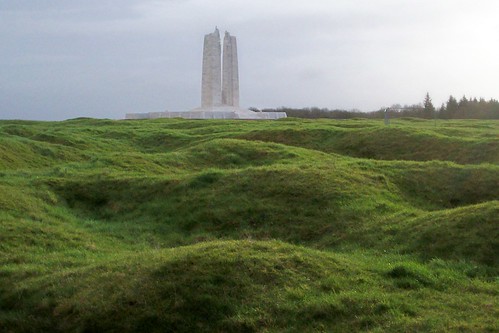
An increase in interest has been noticed at Library and Archives Canada (LAC) as relatives seek the service records of their era soldier relatives. LAC has an updated exhibition on Canada and the First World War. The Ottawa Citizen, and no doubt other papers, are giving in-depth coverage.
Ancestry.ca has a new database, Canadian Soldiers of World War I, 1914-1918, including images of original attestation papers from the LAC web site. In addition to name of enlistee, birth date, and regimental number indexed on the LAC site they have also digitized address, birthplace, age, and name and relationship of next of kin. It's a timely addition to Ancestry's Canadian portfolio.
21 March 2007
Canadian newspapers languish on microfilm
Searching in the online version of the Globe and Mail on the off-chance of finding reference to a man named Gregson, who married in Toronto in 1915, one of the hits appeared to be him. He was running for city council in Peterborough, which was his residence at time of marriage. It was yet another confirmation for me of the value of digitized historic newspapers for genealogy and family history.
A new US site with digitized newspapers came online in beta this week. Chronicling America allows you to search and read newspaper pages from 1900-1910 for papers from California, District of Columbia, Florida, Kentucky, New York, Utah, and Virginia. Each state had a target of 100,000 pages. These are the results of projects which started in May 2005. The initiative is sponsored jointly by the National Endowment for the Humanities and the Library of Congress.
There are other US collections. Two are mentioned in the most recent Rootsweb Review. From the Northern New York State Library Network come 550,000 pages from twenty-two newspapers. The other, www.fultonhistory.com
Meanwhile the British Library are continuing with their newspaper digitization project for a virtual library of nationally, regionally and locally important papers from 1800-1900, up to two million pages. It's scheduled to appear in mid-year. This builds on a pilot project with Olive Software.
In Canada we have Paper of Record of which I wrote recently, but where is Canada's national strategy for historic newspaper digitization, especially for local papers? It seems to fall under the mandate of the Alouette Canada project. There are good people involved, although not many clients. In these days of social networking you'd think the web site would have some capability for input from a broader community.
20 March 2007
Nova Scotia Historical Vital Statistics
 If you're looking for Nova Scotia birth registrations from 1864-1877, marriages from 1864 - 1930, or deaths from 1864-1877 and 1 October 1908-1955, they're here and free to view. The long promised web site went live on Monday here.
Nova Scotia's policy is to restricts availability of births registrations to 100 years, marriages to 75 years and deaths 50 years after the end of the year in which the event was registered.
Unusually the province decided to discontinue birth and death registrations between 1878 and September 1908 inclusive.
An initial quick search allows you to specify last and given names and the event type(s). Agree to the conditions of service and see the number of hits for each type of event. Click on the births, marriages or deaths tab to see the first page of ten results. You can flip to the the next set of ten easily, or click the icon to see an image of the original record or order a better quality copy.
I tried it out on the death of one of the Ottawa Company of Sharpshooters, Ernest Arthur Nash. My Nash search would have been much easier if I'd had this database when we did the Sharpshooter research. Although the first names were reversed, maybe the importance of being Ernest isn't so pervasive, the parents names and his birth date were the same as I had previously.
There is an advanced search allowing you to specify a year or year range for the event, and a county.
You see the original image using the Viewpoint reader. It should load automatically, but if not follow the instructions to download. I found the image was often too small to view comfortably, even after having zoomed, and resorted to doing a screen capture and pasting the image into a graphics program so I could zoom in further.
This is a nice addition to the suite of Canadian databases online.
18 March 2007
UK to Canada Immigration History
I've been looking for statistical data on immigration from the UK to Canada for a presentation in June to the annual OGS Seminar in Ottawa, and finally found a source at Library and Archives Canada. The copy was so fragile they only let me read it in the special collections consultation room, and I had to transcribe the data as they wouldn't allow copying.
As the authors make clear, this 1950s HMSO publication data is derived from a very mixed bag of sources. The earliest years are based on returns to local customs officers designed to ensure that departing ships had adequate provisions to see them through the voyage. Persons travelling on business or for pleasure, as well as immigrants, were likely counted. That's why the term outward movement rather then immigration is used. Having no Irish roots I had overlooked that the Irish were the major component in the early years, about until Canadian Confederation in 1867. According to the LAC online exhibit The Shamrock and the Maple Leaf "Approximately one million Irish landed in Canada in the century before the First World War." As expected there's a huge increase at the time of the Irish Potato Famine, with the English and Scots increase likely being Irish coming through their ports. The Irish immigration to the US at the time was much larger. An earlier increase, in the 1830s, is likely associated with the immigration stimulated by the Poor Law amendments in 1834.
After Confederation the English are the major component, including in the large pre-WW1 spike, which will be the topic of my OGS presentation. The drop during WW1, and following restrictive immigration policies to protect jobs during the depression of the 1930s, is clear.
The reference is: External migration; a study of the available statistics, 1815-1950 / by N.H. Carrier and J.R. Jeffery -- London : H.M. Stationery Office, 1953. -- 163 p. ill. -- AMICUS No. 12298747.
13 March 2007
First Anniversary
This blog is celebrating its first anniversary, and after 245 posts this blogger is taking a few days off.
What's the best web site for genealogy?
It may not be the first that comes to mind, but practically every genealogist has used it. Sure, Google would qualify for that honour too. I determined the best site as the first unsponsored hit, using the ubiquitous google.com, searching on "genealogy".
And the winner is ... familysearch.org
It's FREE. It's brimming with advice on getting started, advice on searching genealogy records and preserving and sharing your family history. There's access to FREE index transcriptions of parish records and census data (1881 for England, Wales and Canada, 1880 for the US). And there's the Family History Library Catalog where you can find out about non-digitized sources you can order into your local Family History Centre.
This LDS site isn't in the media buzz game. The most recent news item on the site is from 2005, but the first ranking reflects the continuing value of the resources.
Familysearch was also the winner amongst the unsponsored links at google.co.uk and ask.com.
Another winning site was genealogy.com. It came first at google.ca, yahoo.com, and yahoo.co.uk.
In case you're curious about genealogy blogs, for "genealogy blog" searched at google.com the winner is ... genealogyblog.com
Given the url this shouldn't have surprised me, but it did as I rarely visit. It's heavily US oriented.
I was also surprised at the number of death notices of prominent genealogists. Genealogy doesn't come to mind as a high risk occupation. Genealogy as an extreme sport maybe?
12 March 2007
Bicentennial of the Slave Trade Act
Perhaps fortunately for some of us, there are no British records of merchant seaman involved in the slave trade from Africa to America, officially ended when the UK Parliament passing the Slave Trade Act on 25 March 1807.
The Act didn't end slavery but prohibited trading in slaves from Africa. Colonies of the then British North America were bound by the legislation. It came into effect on 1 May, and a similar provision followed in the USA the next year. Nelson's victory at Trafalgar made enforcement practicable. Information on records for commissioned naval officers for the period may be found at TNA.
William Wilberforce, the best known advocate for abolition is the subject of a new film, Amazing Grace. See the trailer here. He lived just long enough to see a bill to abolish slavery in Britain pass through the British Parliament in 1833.
Wilberforce's great-great-grandson, a 48-year-old accountant, is commemorating the event by walking from the Wilberforce home in Hull, Yorkshire, to London and using the occasion to publicize present day sex and other slavery, said to subjugate more people today than the total number transported from Africa to America. There are numerous other commemorative and awareness raising events in Britain this year.
In Canada the Ontario government is "investing up to $1 million to support commemorative projects that tell the history of slavery, commemorate the struggle of African-Canadians, and honour the spirit of those who fought for freedom, justice and equality." The Governor General has mentioned the Slave Trade Act in a speech, but Stephen Harper's "new" government is silent.
09 March 2007
Did Google gobble Paper of Record?
Rumour has it that Ottawa-based newspaper digitization company Cold North Wind's stable of digitized newspapers has been recently acquired by the mighty Google. It would explain why the company's web site Paper of Record, which has been for sale for some while, can now offer free subscriptions.
Google already offers a news archive search, now in beta. The Paper of Record historical newspaper inventory does not presently appear to be part of that database, although other 19th century papers are, including some small runs of a few Canadian papers.
Google getting more heavily into newspaper morgues is exciting for genealogy. If you've found information of interest in your family history search in digitized versions of rare books in Google Books, or Microsoft's Live Search Books you'll appreciate the potential. Local papers are the paper of record for tens of thousands of communities. In them you find not only births, marriages and deaths recorded but a host of community happenings, scholarships, school graduations, sporting events, business openings and closings, military matters, club meetings, social notes and the whole minutiae of daily life which can help bring an ancestor to life, if only you can find the item on him or her.
08 March 2007
Ottawa Sharpshooters Presentation

07 March 2007
Who do you think you are? - Canada
According to two usually reliable sources the CBC has in production a Canadian version on this popular hour long BBC TV program in which celebrity family histories are explored. Scheduled to start airing in September. For a glimpse of the latest, third, series of the British program click here.
05 March 2007
Improving Family Tree Maker

Some folks get quite passionate about the virtues of their chosen software. Others, while seeing things they like elsewhere, have a lot invested in the product they use and don't want to have to climb the learning curve that comes with a new product, or lose some of the data and attachments in their existing files. The concern, along with that of privacy, is equally valid for folks thinking of moving to the online environment with services such as My Ancestry.
If Family Tree Maker wants to maintain leadership here are my recommendations for improvements, some of which likely apply to the competitor products.
First, improve mapping capability. For the last several versions FTM has had a pathetic mapping capability. The company should look at Family Atlas, a product of RootsMagic. I'm a happy user. Dick Eastman has recently done a thorough review.
Second, improve the way of entering source citations. Early versions of FTM had no citation capability, and although recent versions have, I find the format impenetrable. What is needed is built in fill-in-the-box type citation formats for common genealogy sources, especially the censuses and civil registration records for the jurisdictions most FTM users are likely to encounter.
Third, capture the growing field of genetic genealogy by incorporating provision for DNA information. At present Legacy does, but with FTM the only option is to enter such data is in the free format notes section under the edit tab. It would be simple to include another element to record the various types of DNA data under the facts tab or in the medical section. Even better would be a provision to show "derived" DNA information for maternal ancestors and their descendants for mitrochrondrial DNA, and Y-DNA through paternal line ancestors and their male line descendants.
FTM usually releases a new version or update in the summer, in time of the BIFHSGO September conference, although I doubt that's their driving force! It will be interesting to see whether the company has a commitment to keeping their product up to date.
03 March 2007
More on digitized and OCRd newspapers
I was pleased to see a comment posted by Bob Huggins, a pioneer in OCRd newspapers online, who found my blog entry on Paper of Record a few days ago.
Every so often I find myself using quotes like "half a loaf is better than none" and "seeing the glass as half full" when people complain about OCR inaccuracy, or errors in census transcriptions. You don't hear folks singing the praises after success nearly as loudly as they grumble after failing to find something.
Two of my best genealogy finds came thanks to Paper of Record where I located a wedding in PEI where a professional had hit a brick wall, and found a long report of a robbery committed by a person I was researching in Perth, Ontario.
OCR problems are a reality for old newspaper. Experienced searchers know of alternative approaches that may find the item sought when a straightforward search, which should be tried first, fails.
Assuming you've selected the most appropriate paper, it's always good practice to limit the period searched to as narrow a range as reasonable.
Think of alternate ways in which the entry might be unique. Search for the bride's name if you can't find the groom, or the name of the place where one of the fathers live, or any other aspect, such as the name of his regiment.
It can help to understand the format typically used in that paper for the period. For example, does a newspaper report of a marriage give the last names of the groom and bride as a header in a larger typeface? If so a search for adjacent names (Smith Jones) stands a better chance of success that one for John Smith or Cathy Jones.
Wildcard and proximity searches can be helpful if available. With Paper of Record you can search for a word, phrase or Boolean combination. The lack of segmentation of the page into separate stories means that you may get hits because words occur in different unrelated articles on the page.
02 March 2007
Ancestry adds 1871 and 1891 Scottish census
Yet another major contribution of UK census transcriptions to Ancestry's stable appeared on 1 March. The 1871 Census for Scotland was taken on the night of 2/3 April, the 1891 census on the night of 5/6 April. Images of the originals are not available, likely for copyright reasons.
01 March 2007
Fact or Fiction?: Living People Outnumber the Dead
Scientific American has an article referencing, Carl Haub, a US demographer on this FAQ. In 2002 he estimated that over 106 billion people have lived since 50,000 B.C. With about 6.5 billion alive today there are far more dead than alive. How many of the 106 billion would be your direct ancestor?
Genealogy in Wales
March 1st is St David's Day. The patron saint of Wales gets scant attention, and the Welsh get little notice in genealogy as many of the records are part of the English system. Wales being relatively small, fewer people emigrated to form a sizable diaspora. Welsh expats are none the less proud of their heritage, especially when it comes to music.
For those searching for Welsh records beyond the English system a good web resource is the National Library of Wales. The site is bilingual Welsh and English. Check out:
The Crime and Punishment database comprises data about crimes, criminals and punishments included in the gaol files of the Court of Great Sessions in Wales from 1730 until its abolition in 1830.
The Digital Mirror which gives access to collections of Welsh Biography, Pictures, Manuscripts, Exhibitions, Archives, Maps, Printed Material, and Photographs. Go to Sound and Video to download an mp3 of the first recording of the Welsh national anthem made 11 March 1899. It's scratchy, a very different rendition from the more familiar versions by mass choirs or rugby crowds.
28 February 2007
Your Family Tree Free Trial Issue

1 - Interview your relatives - beginner's advice on making the most of an afternoon with your great aunt
2 - My great-uncle's memory - how reader John Stephenson researched his great-uncle's WWI death, and got the man the commemoration he deserved
3 - Image from the past - expert Audrey Linkman analyses a photo of a man in a bowler hat, posing with a child and a racing dog
4 - Family history detective: Prison records - how to research ancestors on the other side of the law...
5 - Website guide - using Ancestry.co.uk's family tree building tools.
YFT, which appears with a cover name Your Family History in Canada, is one of the few magazines to which I subscribe. It's well worth browsing.
26 February 2007
Ancestors in the Attic - week 15
This episode, which appears to be the final one in the current series, was broadcast last Wednesday. I caught the repeat on Saturday evening and didn't notice any glaring errors.
Overall for the series, I liked:
- learning about aspects of Canadian history through the lens of individuals experiences;
- the web site which gave good insight into the episodes and challenges involved.
I would have liked:
- a teamwork approach with more time devoted to documenting the search, more like the PBS series History Detectives.
I disliked:
- the artificiality of cellphone calls and people appearing from behind bushes and around corners;
- the quick-cut editing;
- the frenetic approach of the host.
25 February 2007
Paper of Record - Free?
You may have tried Paper of Record, the web site of Ottawa-based Cold North Wind Inc. A breaking news item at the Global Gazette reports that this online collection of digitized newspaper pages, completely searchable by any word, can now be accessed free of charge. To access the database you have to register on the site so they can mail a password to you.
I like the service, particularly at the price. In fact I was happy to have it included as part of my subscription to the Godfrey Library. However, considering some of the limitations, most notably the way in which pages were OCRd, I didn't find it worth a stand alone subscription. How long will it will last as a freebee?
24 February 2007
DNA in genealogy
Imagine you walk into a family history conference and are handed a small strip of paper, asked to moisten it in your mouth and insert it in a slot in a machine about the size of a cellphone. At the end of the opening plenary session you receive an envelope directing you to one of the conference rooms. Arriving there you find yourself amongst family -- family you didn't know about but whose DNA is a close match to yours. For most people the common ancestor is too far back to be able to confirm it with traditional genealogical documentation, but many in the room find a common geographic region in their family past. A few, some who may have known each other for years, find an unsuspected link between their family trees.
Fact or fiction? It could be closer than you'd think if the Pocket DNA Barcoder being proposed for animal species identification ever comes to pass and is adapted for human DNA. As explained in this item at ScientificAmerican.com, although the basic technology is available--and the DNA testing has been shown to work--it requires a clean, sterile lab to ensure accuracy. According to the article the pocket-sized gadget remains a further-off goal. I've learned not to underestimate the rate of technological change. Maybe we'll be experiencing this sooner than they think.
22 February 2007
Kanata Seniors Centre Link
I enjoyed talking to a lively group at the Kanata Seniors Centre on Thursday. We discussed the seven golden roles of beginning genealogy, explored surname distributions in the UK and some of the best genealogy web sites.
In case participants didn't find it there is a free site for exploring surname distributions here. In the session we used Stephen Archer's Surname Distribution Atlas CD available here.
British Army WWI Pension Records 1914-1920
Ancestry.co.uk have placed online the first release, surnames A amd B, for soldiers service records of non-commissioned officers and other ranks who were discharged from the British Army and claimed disability pensions for service in WWI. These were also men who did not re-enlist in the Army prior to World War II.
In addition to Attestation forms completed on enlistment other items often found are: medical history forms, casualty forms, disability statements, regimental conduct sheets, awards. One file I looked at had a form recording a marriage.
These are some of the most used records at TNA (Kew), found in series WO364 known as the ‘Unburnt collection.’ More than half of the files were burned during WW2 air raids on London, so you have to be a bit lucky to find your ancestor's file surviving.
It's good to see these records becoming available through an Ancestry subscription I already have, and available without cost through many public libraries and Family History Centres, without the high pay per view cost favoured by TNA.
20 February 2007
Beginning Genealogy at Kanata
It's been busy. Yesterday was Heritage Day in Ottawa with an event at City Hall. In the afternoon I attended a meeting on street naming, one of the heritage initiatives I've been pushing.
This is also the time of year when Ottawa deals with its city budget. As usual, heritage related matters are at risk, despite being a miniscule part of the budget. I spoke to a tired looking Council at a public session on Tuesday evening.
On Thursday at 1 pm I'm speaking on Beginning Genealogy at the Kanata Seniors Centre. I understand 37 people are registered, but there's room for more. Find information about the Centre here.
18 February 2007
Saturday at Quinte Branch of OGS
I had a quick trip to Trenton, Ontario, on Saturday to give my Family Secrets Revealed by DNA Analysis talk to the Quinte Branch of the Ontario Genealogical Society. Beth and Bill Campbell, organized the meeting and had invited me -- Bill had previously heard the talk at last September's BIFHSGO annual conference.
The venue was a treat. A new building houses the municipal offices and library, situated on the lake shore of the Bay of Quinte with a magnificent vista of the Bay greeting you as you enter the library. You never saw such a contrast to cubicle land.
There were about 40 people at the meeting including several visitors and guests attracted by the topic. They had to bring in extra chairs. Amongst the pre-presentation announcements was a report from Nancy Trimble, the representative for that OGS region, read by a member. She mentioned the new format of Families including a colour cover, and that OGS was talking with Revenue Canada to examine the extent to which they can offer benefits only to members and still provide them a receipt for tax purposes. That deliberation will interest other Canadian genealogical, and likely other types of societies. BIFHSGO stopped issues tax receipts a few years ago when we determined that doing so was inconsistent with giving discounts to members for our events and publications.
Being a new facility the room came with a built in LCD projector, and was small enough that I didn't require a microphone. A few shorter people at the back did have to bob their heads up every now and again to see the bottom of the screen. I enjoyed the facility and felt the presentation went well. Others seemed to enjoy it -- there were lots of questions after the talk and one-on-one during the refreshments at the end.
I'd like to thank Bill and Beth, and the folks at Quinte Branch for inviting me to what is clearly an active OGS branch full of friendly folks. I'd happily speak there again -- hint intended!
15 February 2007
OGS Quinte Branch presentation
I shall be speaking on DNA in Trenton, Ontario, this Saturday. All welcome. More information here.
14 February 2007
How it's made: genealogy
Have you seen the TV program How it's made? You get the industrial strength truth behind the "home baked" and "family farm" images on the labels of the food we eat; the inside story on everyday consumer products.
Programs like Ancestors in the Attic, mostly portray a sanitized version of how a family genealogy or history is made. You don't see researchers spending hours, days or months searching original, or worse microfilmed, documents to uncover the elusive evidence. Although indexed census and civil registration records have made the search easier in many cases you also often find misindex or missing records. Many records remain preserved in out of the way repositories, unindexed and often unexamined for years, if ever, since they were created.
Another thing you don't see is people following promising but false leads. Genealogical research is like much other research where you, usually informally, formulate a hypothesis and then set out to test it. I've had an example recently in the context of a presentation I made to a beginning genealogy session when I spoke about the first golden rule of genealogical research - work backwards. I used the example of researching the ancestry of the new Mayor of Ottawa, Larry O'Brien. His father's grave marker shows a birth year 1908. The nearest I could come to establishing the next generation back was an entry for someone of the same name in the 1911 census, born in Montreal in late 1907. Was the grave marker birth year an error? I followed the Montreal family back two more generations into the Ottawa valley and was hopeful it might lead to some clues to establishing that as the correct family, but had to admit during the beginning genealogy presentation I didn't have evidence, it was a hypothesis.
On Monday I went to a public meeting where, to my surprise, Mayor O'Brien put in an appearance. It was an opportunity too good to miss so I asked him privately as he was leaving if his father was born in Montreal. He said no, in Manitoba, and mentioned the suburb of Ottawa where earlier generations had lived. Pretty good evidence against the Montreal hypothesis, and it was blown out of the water when I found his father, with a 1907 birth year, in the 1911 Manitoba census. Making the link back to that suburb is proving a challenge, but I do have a new hypothesis to work on. My presentation to a beginner session next week will have different story to tell and a new hypothesis to present.
13 February 2007
Historical Directories of England and Wales

Historical Directories is a digital library of local and trade directories for England and Wales, from 1750 to 1919. You can choose to see those published for a specific county, or a certain decade, select a particular directory and search. The hits are highlighted on an image of the original page.
Directories of this period are usually regarded as a supplemental genealogical source. They rarely contain information about anyone but the head of household, and then often only if the person paid for a listing. But they can yield surprises. A great-grandfather of mine is listed as locksmith, gunsmith or bellhanger on various certificates and censuses I've seen, so I was surprised to find him listed in one of these directories as an umbrella maker. Obviously a man of diverse talents.
This is a free resource -- at least until next October.
11 February 2007
How Does Your Society Help Beginning Genealogists?
Saturday was a big genealogy day in Ottawa. The morning featured the monthly BIFHSGO meeting. As usual, people gathered early in the auditorium lobby at Library and Archives Canada to chat with friends, have coffee or tea and biscuits, and browse tables with published resources. It's a time to get advice from the local experts, swap books, and share stories of triumphs and frustrations. A few years ago we started issuing name tags to everyone which saves considerable embarrassment for those of us, including me, with poor memories.
For the past few meetings there has been a short pre-main meeting presentation, known as pre-BIFHSGO, of a more basic nature organized by Lesley Anderson, the Society Director of Education. These have proved popular. This month Lesley had organized a whole session of five presentations for the afternoon so no pre-BIFHSGO session was held.
The main meeting was fairly typical; a series of announcements, appeals for volunteers and for support for a local initiative, this month it was to get approval for a new City of Ottawa Central Archives given by Friends of the Archives President, John Heney. The speaker of the day was Marguerite Evans on "Sarah Hersey's Diary: The Spirituality of a 19th Century Pioneer Woman." Marguerite is a former university lecturer and, despite speaking on a topic rather more academic than our normal fare, held the attention of the audience as she explored the evolution of Sarah's spirituality as expressed in her diary writings as the situation of her family changed.
The afternoon beginner session had about 30 people registered, many who had started researching their family history some while ago and now realized they wanted some guidance on how to do it right. The session is given semi-annually, sponsored jointly by BIFHSGO and the Ottawa Branch of the Ontario Genealogy Society, with the lead Society providing most of the speakers.
There were five 30 minute presentations using Powerpoint, supplemented by handouts. I started with a session appropriately titled "Getting Started" based on the Seven Golden Rules of Beginning Genealogy, as published in each issue by Your Family Tree. Alison Hare followed with a first rate presentation on using the census and civil registration records. Lesley Anderson covered organizing your information, Sharon Moor spoke on resources available in the Ottawa area, and Mike Moore on Internet Resources. The session ended with a question period, and many more questions informally after the close.
How does your Society help beginners, or those who want some elementary level instruction? I'd welcome information posted as a comment, or just a direction to your own blog entry or Society website information.
08 February 2007
Ancestors on Board - now to 1909
Way ahead of when I thought they might be, the second decade of these UK outbound ships passenger lists have been added.
See Stephen Rigden's blog entry here.
BIFHSGO February Meeting
Family history is much more than genealogy. Saturday morning's BIFHSGO meeting at Library and Archives Canada, featuring a presentation by Marguerite Evans RN, PhD(Ethics), certainly demonstrates that. A long-time member whose presentations I invariably find both substantive and enjoyable, Marguerite will speak on "Sarah Hersey's Diary: The Spirituality of a 19th Century Pioneer Woman."
Abstract
In 2004 Ron Newman of Brockville, Ontario, donated the handwritten diary of Sarah Hersey to the Ottawa Branch of the Ontario Genealogical Society. The entries in her diary cover the period from 1804 until her death in 1850. In addition to the usual recordings of births, marriages, and deaths, Sarah also described such life events as the destruction of her house by fire, cholera epidemics in Hawkesbury , Ontario, and in Massachusetts. More significantly, however, she documented aspects of her faith; in particular, of her spirituality which was a way of life for her and which sustained her and enabled her to cope with whatever befell her. This presentation will examine various aspects of the diary entries to ascertain the intensity of Sarah's spiritual life and to compare her spirituality to that of current Postmodern spirituality.
You don't have to be a BIFHSGO member to attend, all welcome. The meeting starts at 10am.
07 February 2007
BMD Index Update - England and Wales
The Federation of Family History Societies (FFHS) has informed members that the General Register Office (GRO) is developing a system to enable BMD indexes to the digitized records to be searched via the internet. These should be made available progressively from early 2008.
The FFHS has accepted the GRO's invitation to take part in user testing of this Multi Access to GRO Published Index of Events (MAGPIE) system. By early 2008, the historic birth indexes will have been loaded and the historic death records (those from 1837-1957) should also have been loaded. Those indexes will be accessible via the MAGPIE system on screen terminals at The National Archives at Kew, as well as via the internet, when the Family Records Centre at Islington closes. Loading of the historic death records will be followed by the modern birth and death records, then the historic marriage records (those from 1837-1945) and the modern marriage records.
That means that although the original vellum and paper indexes will be moved to Kew, they will eventually not be on open access. By April next year the experience of manhandling heavy index volumes around, and elbowing yourself some space in the search room at the FRC will be history. Better plan a trip soon if you want to relive that experience.
06 February 2007
Ancestors on Board - the blog

In case you missed the announcement of this major new database, the site covers long-distance voyages made from all British ports between 1890 and 1960. The data now available are from 1890 to 1899. Whether destined for Canada, Australia, New Zealand, Bermuda or anywhere else under the never setting sun over the British Empire, your travelling ancestors of the period should be there. That's also true of passengers destined for rebellious former colonies or to corners of the world so deprived that there residents never had the privilege of living as British Subjects.
I'm anticipating the next batch covering the second decade 1900-1909 "to be published shortly." Rigden mentions in a recent posting a relatives found in this period bound for Quebec. That Rigden family may be found in the 1911 Canadian census in Vancouver. People by that name still live in BC today as well as elsewhere in Canada.
04 February 2007
Ancestors in the Attic Video - a women Mason
As mentioned in the previous post, you can watch short videos on the Ancestors in the Attic website. They're likely items considered too insubstantial to make it to air, but still interesting. I stumbled on one telling the story of the only woman Mason, named Elizabeth St Leger. A second cousin of mine mentioned her as an ancestor but didn't have the details. The video motivated me to follow up. It appears she's his six times great-grandmother.
The story told on the video is of this young Irish lady hiding in a grandfather clock, overhearing a Masonic meeting, and then being discovered when her father investigates the muffled sound of the clock striking the hour. To keep the secrets of the Masonic order they decide to initiate her as a Mason. Read a more detailed version of the story from 1895, nearly 200 years after the incident happened in 1710, here. It's devoid of clock, and gives other examples of women Masons.
Elizabeth St Leger married Richard Aldworth; the families are both of the Irish nobility in Cork. To link my second cousin to them meant tracing his family back through English census records, and bringing in evidence from The Times Digital Archive, a subscription database of the newspaper back to the late 18th century. When those sources ran out the names, dates and places seemed to make a smooth transition to genealogies in A Genealogical and Heraldic Dictionary of the Landed Gentry of Great Britain and Ireland
01 February 2007
Ancestors in the Attic - Episode 13
There were only two segments this week. The first was a complex story of family members losing touch owing to separations and divorces, and descendants finding each other. It appears that although the program researcher (Paul) did dig up information on the family history the work that lead to a reconnection was done by family members. They used data submitted by subscribers to ancestry.com, or perhaps more accurately submitted to rootsweb.com and then appropriated by ancestry. Touching scenes of a reunited family vividly reinforced the value of secondary sources -- even though viewed with a certain scorn by professional genealogists -- can be useful, and adequate, when used in pursuing some family history objectives.
The second segment drew exclusively on a published family history, something the panel seemed to have no qualms about accepting as the truth, even though these can be suspect.
If you haven't found it on the Ancestors in the Attic web site, which is an essential complement to the program, there are a few videos not part of the televised programs. They are short, and one of them features the story of the only woman Mason, one that is also supposed to link to one of my obscure collateral lines.
31 January 2007
Nahanni and the British Library

In Canada we have National Parks that few will ever visit. But there is wide support for protecting them. The Nahanni National Park Reserve is one. They are part of Canada's heritage and define our national identity.
In the UK the British Library plays a similar part in helping defining the national identity, so it's sad to read reports of politicians so careless of the heritage entrusted to them that they are prepared to put a price on, and in some instances close, access to documentary heritage. This article from The Independent documents the proposals.
I have used the British Library once, quite a few years ago, looking for genealogical information on an East India Company soldier. It's an inspiring facility next to St Pancras Station. The Newspaper Library, which I've also used, is nondescript in its North London obscurity, but the contents include local newspapers which are the paper of record for ordinary folks. Pity the politicians don't seem to care about ordinary folks and their history, a sure sign they've been in power for too long.
30 January 2007
Ulster Town Directories - 1910
You won't often find mention of Irish resources here, I don't have any Irish ancestry, and most of those I know with Irish roots had ancestors who left during the famine, or earlier, a notoriously difficult period to research..
One of the better Irish resources is LibraryIreland. I've mentioned it before, " a free information resource on Irish antiquities, biography, genealogy, history (general, local and social), literature, and much more besides."
It's worth checking out, especially if you had family members who might appear in one of the 1910 directories for the towns below.
Incidentally, the theme of BIFHSGO's annual September conference this year is Ireland. Watch here or the BIFHSGO web site for an announcement of a speaker, maybe even speakers, directly from Ireland.
Aghalee,Annalong,Antrim,Ardara,Ardglass,Armagh,Armoy,Aughnacloy,Bailieborough, Ballinamallard,Ballintoy,Ballybay,Ballybofey, Ballycarry,Ballycastle,Ballyclare, Ballygawley, Ballygowan, Ballymena,Ballymoney,Ballynahinch,Ballyshannon,Ballywalter, Banbridge,Bangor,Bellaghy,Belleek,Belturbet,Benburb,Beragh,Bessbrook, Buncrana, Bushmills,Caledon,Carnlough,Carrickfergus,Carrickmacross,Carrickmore, Castleblayney, Castlecaulfield, Castledawson,Castlederg,Castlerock,Castlewellan,Cavan, Clones, Clogher,Clough(Antrim),Clough(Down), Cloughmills,Coleraine,Comber,Cookstown, Cootehill, Crossgar, Crossmaglen,Cushendall,Desertmartin, Doagh, Donaghadee, Donaghmore, Donegal, Downpatrick, Draperstown, Dromara, Dromore (Down), Dromore (Tyrone), Drumquin, Dundrum, Dunfanaghy, Dungannon, Dungiven, Enniskillen,
Falcarragh, Fintona, Fivemiletown, Galgorm, Garvagh Gilford (Down), Glenarm, Glenavy, Glenties, Gortin, Gracehill, Greyabbey, Groomsport, Hillsborough, Holywood, Irvinestown, Islandmagee, Keady, Kilkeel, Killinchy, Killough, Killybegs, Kilrea, Kirkcubbin, Larne, Laurencetown, Letterkenny, Limavady, Lisbellaw, Lisburn, Lisnaskea, Londonderry, Loughbrickland, Lurgan, Maghera, Magherafelt, Maguiresbridge, Markethill, Martinstown, Milford, Moira, Monaghan, Moneymore, Moorfields, Moville, Moy and District, Muckamore,
Newcastle, Newry (Down and Armagh), Newtownards, Newtowncrommelin, Newtownhamilton,
Newtownstewart, Omagh, Pettigo, Pomeroy, Portadown, Portaferry, Portballintrae, Portglenone, Portrush, Portstewart, Poyntzpass, Randalstown, Raphoe, Rasharkin, Rathfriland, Rathmullan, Richhill, Rostrevor, Saintfield, Scarva, Seaforde, Shercock, Sixmilecross, Stewartstown, Strabane, Swanlibar, Templepatrick, Toomebridge, Trillick, Waringstown, Warrenpoint, Whitehead.
28 January 2007
What good is genealogy?
A good way to keep seniors occupied so they don't riot on the streets in protest against Blair/Bush/Howard/Harper? A way to recycle senior's excess savings when they no longer have a mortgage? A good way to link generations? A job? A useful complement to local and public history?
Maybe all of the above!
How about as a useful contribution to your health care?
At least three members of the British Isles Family History Society of Greater Ottawa have been treated for prostate cancer in the past year. Fortunately the prognosis is good for prostate cancers detected in the local and regional stages, nearly 100 per cent of men diagnosed in these early stages will be disease-free after five years. Amongst the risk factors are age, more than 65 per cent of all prostate cancers are diagnosed in men over the age of 65. The chances of being diagnosed are doubled when a relative has been diagnosed with the disease, and the risk is highest for men who have had relatives diagnosed before the age of 65. Do you have Irish ancestry? A study by the Irish Cancer Society found that the incidence and death rates from prostate cancer are higher in Ireland than in England, Scotland and Wales.
Men, make sure you are checked regularly and tell your family doctor if there is a family history of the disease.
25 January 2007
Ancestors or Oprah?
The TV choice facing me at 8 pm last evening was Ancestors in the Attic on History Television Canada or Oprah's Roots: An African American Lives Special on PBS. I opted for Ancestors.
The first segment, finding information on Howard Dabbs, a Canadian bomber captain who died at the age of 20 during a WWII mission, and whether there was a Dabbs Lake named after him, should have been no more difficult than searching Google, a newspaper archive online or Canada Geonames. Just about all the family history research seemed to have already been done by a relative.
The second segment showed how to find coroner's reports. What was not said was that often you are better off checking local newspaper coverage than looking for a coroner's report.
The final segment was on the Rush family, father and children, who were inmates of Smallburgh Union Workhouse in Norfolk, England, in 1851. The panel relied on census records to infer that the mother had deserted the family. It would have been good to check the records of the workhouse for the period which are at the Norfolk Record Office in Norwich.
I switched to PBS after Ancestors. What a refreshing difference in presentation style!
24 January 2007
TNA Podcasts
For those of us who research family history in the UK and Ireland from North America it's frustrating to learn about expert presentations being given back there, and having no access. Now there is one channel opening up, and it's free. The National Archives at Kew has placed online a series of talks, some of which are relevant to family history, in the form of podcasts. "Tracing births and deaths on board British and colonial-registered merchant ships " was given last December by Chris Watts of TNA. The link for this and other TNA podcasts is here.
23 January 2007
The Genealogy Community
I try and keep an eye on visits to this blog and have noticed a slight surge in hits by new visitors today. I wasn't sure why, then had a look at my Bloglines search file. I have a standing search for "genealogy" combined with a few negative search terms to filter out some of the garbage. Anyway, I spotted that I've been tagged by Family Matters: tech support for the family historian.
I'm not entirely sure what's involved, but as I understand the game I'm supposed to reveal some little know facts about myself, and finish with some links (tags?) to other genealogy blogs I read. Here goes.
- Anglo-Celtic-Connections is a rip off of Anglo-Celtic Roots, the quarterly chronicle of the British Isles Family History Society of Greater Ottawa (BIFHSGO). I've been compiling a monthly email newsletter that goes to BIFHSGO members a week before each monthly meeting. Last March I decided to start previewing some of those items in this blog which is now passed 200 posts.
- My computer skills go back a long way but are pretty rusty. I first learned to program at the University of London (England) in the mid 1960s using the ATLAS computer and CHLF3 autocode. Anyone hear of them?
- In my teens I was once an extra in a movie, and have done TV interviews including as a subject expert on History Television Canada on the most deadly US hurricane, 1900 landfall at Galveston, as it continued north to Canada and then east to Newfoundland waters where more than 100 people were killed.
- I have been a resident of Ottawa for more than 20 years, but have also lived in Toronto, Fort Collins (CO), Winnipeg, Montreal, Halifax, and back in the UK in Leicestershire and Norfolk.
- I'm still lamenting the loss last year of genealogist Ryan Taylor, who, reflecting on the friendships generated, said "I enjoyed all the memories. That's the real truth about family history."
22 January 2007
Genealogists Support British Census Petition Online
The number of genealogists and others signing an online petition to reduce the classified (closed) period for British census data from 100 years to 70 years is mounting rapidly. As of this morning, Monday 22 January, there are more than 9,000 signatures. On Friday when I signed there were 5,000.
The petition calls for census information from 1911, 1921 and 1931 to be available for use by the general public researching their family history. Census data from the US 1930 census is available and there has been no sign of a problem.
If you are British, perhaps an expat like me, consider signing the online petition to the British Prime Minister . The deadline to sign up is 8 March 2007. See how many signatures there are now, and sign if you can, here.
21 January 2007
OGS Seminar Early Bird Registration Deadline
Don't miss saving on registration for the Ontario Genealogical Society's annual Seminar being held at Algonquin College in Ottawa from 1-3 June 2007. The deadline for Early Bird registration is 31 January. Details and registration forms are at http://ogsseminar.org/.
OGS Seminar is a highlight of the year for Ontario genealogists, and Ottawa is a popular venue as folks can combine the conference with a research trip to Library and Archives Canada. For those with Ottawa Valley roots it's an opportunity to visit other local archives, libraries and museums too.
If you're coming from a distance you might want to make a vacation of it and plan on attending the Quebec Family History Society Conference, Roots 2007, being held in Montreal at McGill University, June 15-17. Further information at www.qfhs.ca/program.html
18 January 2007
Ancestors in the Attic - week 11
It has been several weeks since I last saw an episode of this half hour program on History Television Canada. It ran at 8:00 pm on Wednesday, to be repeated twice out of prime time for the benefit of night owls and addicts.
Did absence make my heart grow fonder? Not regarding the host's performance. Is the line between irreverence and demeaning so fine?
BUT
The family history in this episode was encouraging. The first item, on coffin ship immigration in the Irish famine era has very nice supplemental material on the web site that vividly portrays the horrors of the voyage. The second item, supposedly seeking the grave of a women from the Ottawa Valley, showed the value of land records. But it seems that the grave location was previously known; the program web log says "she wanted to know why her g4-grandmother, “Granny” Martha Gardiner West is buried in Penatanguishene." The third, the expert panel segment, was the most problematic where it claimed that a picture found at the Toronto Archives was of the person in question. Perhaps so but the images shown didn't make the point.
Overall this material made for a better web site than TV. I won't be burning any late night oil to see this episode again.
17 January 2007
1911 England and Wales census search service
 According to Garrick Webster posting on the Your Family Tree magazine blog, the National Archives has made limited searches of the 1911 Census for England and Wales available via a paid-for research service available as of today. This is a costly "bespoke" service and you need to know the address where the person was living. Family historians can go to The National Archives 1911 census page and fill in the request form.
See the full posting here.
15 January 2007
Free Databases for Genealogical Searching
Here is a site mentioned to me when I was at the Society of Genealogists earlier in the month. It was new to me and contains genealogy databases from Britain, Canada, Australia, New Zealand, USA and a few more categorized under the headings:
A word of caution. Although the site is free there are pop-under windows that appear using IE7. The Firefox browser suppresses them, but I did notice a flickering of the cursor, possibly related to the suppression. I recommend ensuring you have solid virus and trojan protection in place before trying these links.
14 January 2007
Do you use the library for genealogy?
Ottawa is a knowledge-based city (government and high tech), one that started moving away from a natural resource base 150 years ago and has never been strongly manufacturing-dependant. So Ottawa has more reason than most to nurture the knowledge skills of its people as the base of its economy.
I'm sure the city's mayor and councillors understand that, but equally they are subject to the tyranny of the urgent trumping the important. In the current situation it's the urgent need for some of them to meet a promise during the recent municipal election to hold the line on property taxes. Those who use and value the public library system are, or at least feel, threatened.
In Ottawa we are fortunate to have a library system that is sensitive to the needs of family historians, I know that having spoken to the City Librarian, Barbara Clubb. However, the OPL is not well funded, even compared to other Ontario communities and family history resources share in this poverty.
Thanks to a posting on Resource Shelf it was interesting to discover a report, hot off the e-press, from the US Urban Institute. Making Cities Stronger: Public Library Contributions to Local Economic Development adds to the body of research pointing to a shift in the role of public libraries—from a passive, recreational reading and research institution to an active economic development agent, addressing such pressing urban issues as literacy, workforce training, small business vitality and community quality of life. The study was commissioned by the Urban Libraries Council (ULC) and funded by the Bill & Melinda Gates Foundation and Geraldine R. Dodge Foundation. I suspect the findings are equally applicable to Canada. It should be required reading for local politicians.
11 January 2007
Catch-up Items
Having now returned from four weeks in England it's time to catch up with items included in the last BIFHSGO monthly enews.
A COUNTRY FIT FOR HEROES?
www.aftermathww1.com recalls what happens when the boys came home after the Great War.
METROPOLITAN POLICE
Stories of crimes from the London Crime Museum at: www.met.police.uk/history
BRITISH RAILWAY MUSEUMS ONLINE
Darlington Railway Centre and Museum at: www.drcm.org.uk
National Railway Museum at: wwwnrm.org.uk
08 January 2007
Ancestorsonboard.com
In the next few days Find My Past (formerly 1837online), in conjunction with The National Archives in the UK will bring on line the first major segment of digitized and searchable passenger lists for ships leaving British ports on long overseas voyages. The records are those of the


