Have you been counting down the days. Today's the day, registration is now open.
"The Ontario Chapter of the Association of Professional Genealogists and the Canadiana Department, North York Central Library (Toronto Public Library) are pleased to present this opportunity to hear one of the foremost genealogical educators of our day. We promise a full day of stimulation for your personal or professional genealogical pursuits."
The event is in North York, 2 April 2011.
You can read about Elizabeth Shown Mills, CG, CGL, FAGS, FNGS, FUGA and the presentations she will be giving at: http://www.ocapg.org/shown_mills.html
You can also register from that page through a link to GenealogyStore.com. If you already have an account there don't try to create another one from the same email address, as I did having forgotten the existing one, or you'll be greeted with a cyber-babble exclamation.
Space is limited and I understand quite a few registrations from non-members of the Ontario Chapter of APG have already come in.
15 January 2011
Elizabeth Shown Mills comes to Toronto

More on OGS fee increase
=============
Erroneous Publication of an OGS Fee Increase
Just after the holidays, there was an erroneous statement published on a private blog that is causing concern. It was claimed that there is discussion within the Society of a further fee increase and that there was a notion to require OGS members to also be a member of their local branch.
On behalf of the Board and the Executive, I would like to inform our members that neither of these ideas has been discussed at this time.
As one of the Board's responsibilities, fees are discussed at least once a year. Any fee increase recommended must then be approved by the membership. The Board is not recommending a change to the fee structure for 2011. The fee will remain the same as in 2010.
As to requiring members to be a member of their local branch, this has not been recommended nor discussed.
I hope that this explanation clarifies all concerns. If there are any further questions regarding this matter, please feel free to contact me (president@ogs.on.ca) or the Executive Director (ed@ogs.on.ca).President, Ontario Genealogical Society.
I remain confident in the source used for the original post.
That post did not state that discussions on fee increases, or on requiring a branch membership, had taken place at a Board or Executive meeting. Such discussion between senior society members can and do take place outside such meetings, the case here. By the time the issue gets to the official meeting the conclusion may essentially be fait accompli.
The statement that "The Board is not recommending a change to the fee structure for 2011" is self-evident as collection of 2011 fees is well underway. The OGS statement makes no such undertaking for 2012 fees. Would OGS members prefer efficiencies be found in operations rather than a fee increase? Time will tell.
Ottawa Scottish Genealogy Group Meeting
The next Ottawa Scottish Genealogy Group meeting will be on Monday, January 17th 2011 at 7:00 PM in Room 154 at Library and Archives Canada.
Doug Gray will give a presentation about the various research facilities he used for family history on his recent trip to Scotland. He will show websites that were useful on this trip where he did research in the Boarders, Angus and Edinburgh including the ScotlandsPeople Centre.
From Joanne Payne comes notice of a website with information about the parishes of Dumfriesshire and the Johnstone Family: http://www.pbase.com/image/131514919
via Bob Lamoureux
14 January 2011
Over 22,000 new London docklands baptism records at findmypast.co.uk
The findmypast.co.uk flood of new parish records this week continues with an updated London docklands parish baptisms collection, all pre-1820, with 22,645 new records.
Here is a breakdown of these new records:
| Church and area | Date range | Number of records |
| St Matthew, Bethnal Green | 1799-1819 | 12,605 |
| St Dunstan, Stepney | 1608-1628 | 10,040 |
This brings the total London docklands baptisms on FMP to 503,711.
Good news from the Archives of Ontario
The following is a notice from the Archives of Ontario regarding extended hours of operation:
=============
We are pleased to announce that the Archives of Ontario will be extending its hours of operation. Effective February 8, 2011, we will offer extended hours of service to the public on Tuesdays and Thursdays to 8 p.m. and on Saturdays from 10 a.m. to 4 p.m.
Select services will be available during the extended hours, including: registration, reference services, microfilm viewing and printing, and viewing of previously ordered materials. Orders placed during extended hours will be processed on the next business day. The Exhibit Gallery will also be open.
We are extending our hours of operation to better meet your needs and enhance your experience at the Archives of Ontario. By extending our hours we also hope to attract new audiences and further showcase Ontario’s public and private archival records.
If you have questions about this initiative, please don’t hesitate to contact Ms. Keisha Banhan, Senior Manager Archives Services, at < keisha.banhan AT ontario.ca>.
Michael Geist: Ottawa awol but others busy digitizing Canada’s heritage
A Toronto Star article by University of Ottawa Law Professor Michael Geist commenting that "In the absence of national leadership, a loosely connected coalition of local and provincial digitization initiatives have begun to take shape."
Read the article at http://www.thestar.com/business/article/921290--ottawa-awol-but-others-busy-digitizing-canada-s-heritage
J Brian Gilchrist at Quinte Branch of OGS
Saturday 15 Jan 2011 sees the annual Crouse-Wanamaker Lecture presented at the Quinte West City Hall Library by noted Ontario genealogist J Brian Gilchrist.
More information is at www.rootsweb.ancestry.com/~canqbogs/meetings.htm
Even more parish records from Northern England
They've done it again. Yesterday I blogged about 126,000 new parish birth and marriage records (transcripts) from Cumberland, Durham, Northumberland, Westmorland and Yorkshire at findmypast.co.uk. Now FMP have added a massive 447,108 new parish baptism transcripts for the period 1600-1997 covering 324 parishes in total.
And this time you can view a list of these parishes (PDF). Keep up the good work FMP, I'm still looking for my Cumberland ancestors in this collection!
13 January 2011
Rick Roberts on DeceasedOnline.com
If you research burial records in England, and some in Scotland, you should know about DeceasedOnline.com
It's a site I've mentioned before as cemeteries get added. Now Rick Roberts of Global Genealogy has written a helpful free article on the site for the Global Gazette.
Spotlight on Northern England baptism and marriage records
Findmypast.co.uk continues to add parish records, the latest from Cumberland, Durham, Northumberland, Westmorland and Yorkshire. These are courtesy of the Northumberland & Durham Family History Society
16,383 Durham baptismal records have been added from the parishes of St Andrew, St Helen & St Peter. They span the period 1773-1959.
110,584 marriages from all five counties are added for the period 1521–1989.
While the FMP announcement gives the names of the churches it fails to give the name of the community. How many churches going by St Andrew are there in these counties?
Ancestry updates England, Alien Arrivals, 1810-1811, 1826-1869
Another update, this time to a data collection containing lists of aliens (non-British citizens) arriving in England between 1810 and 1869.
Unfortunately there's no indication of the magnitude of the update.
TNA sources are:
FO 83/21-22: Lists of aliens arriving at English ports, August 1810-May 1811; 2 volumes of original lists created under an act passed in 1793 “for establishing regulations respecting Aliens arriving at this Kingdom, or resident therein, in certain cases”
HO 2: Certificates of alien arrivals, 1836-1852; 236 volumes of original certificates arranged by port of arrival
HO 3: Returns of alien passengers, July 1836-December 1869 (with a gap from January 1861 to December 1866); returns made of alien passengers on ships arriving at British ports as required by the Aliens Act, beginning in 1836; formerly known as Lists of Immigrants; also includes some papers on the drafting of the Act, its administration, and proposals for its revision
CUST 102/393-396 Accounts of aliens arriving at London (July-November 1826) and Gravesend (October 1826-August 1837); arranged by certificate of arrival number
History Television CRTC licence renewal
(Warning - this post is of interest mainly to Canadians, and contains opinion)
Are you happy with Canada's History Television channel? If not, or if so, you have a rare chance to express your opinions to the CRTC at a time when it is especially open to viewers' comments.
Shaw Media, the company behind specialty cable channel History Television (previously History Television Canada) has submitted documentation for renewal of its licence. This is part of a broader process for licence renewal of many channels. A public comment period is now open, with submissions due before January 28, 2011 in advance of public hearings starting on April 4, 2011. The process is described at http://www.shawmedia.ca/about/licenceRenewal.asp where you can also find links to information from the company.
As part of the process the company is seeking a reduction of its Canadian programming expenditure (CPE) requirement from 40% to 29%.
In its submission the company addresses a comment from CRTC staff that "past complaints have been filed against the History Network in regards to the broadcasting of certain programs that did not meet its nature of service definition.”
The company responds that it invests heavily in original productions, commissioning approximately 100-120 new hours of Canadian programming each year and pointing to series such as Finding the Fallen, and Ancestors in the Attic, the two part miniseries Battlefield Quebec and specials such as The Last Soldier, Storming Juno and Death or Canada.
It also comments that in airing programs such as M*A*S*H and Ice Road Truckers it strives to offer programming that is both entertaining and provides some relevant historical significance.
I have reviewed the material in the company submission and its earlier reports, the History Television website, and considered my own viewing experience. Comments have to be based mainly on history as there is little in the document that reflects new initiatives, other than a promise of a History Project.
My views are the following:
1. History Television is a highly profitable business. In 2009 it had total income of $49,692,444, higher than in any of the previous four years. Total expenditures were $22,428,203, lower than in any of the previous four years. Advertising revenue alone more than covered the total expenditures. Operating margin exceeded 50%, up from 32% in 2005.
2. History Television relies largely on US produced and themed content. A one day sample, starting at 6am on Tuesday 11 January 2011, had 17 hours out of 24 with US themed programs. That fosters US hegemony. The programming offered contains little Canadian content and fails to reflect the diverse origins of Canadians and its conditions of licence which require "a special emphasis on documentary and dramatic programs related to Canada’s past."
Even if substantially enhanced Canadian content is unaffordable, which given the profitability is highly questionable, there is no lack of other international content to draw on, from Who Do You Think You Are? now produced in the UK, Ireland and Australia as well as the US, to numerous BBC productions, such as A History of the World drawing on 100 objects from British museums, which, with imagination, could be augmented with Canadian content.
3. History Television programming emphasizes military and action themes, and largely fails to reflect other aspects (political, literature, music, art, science, technology) of Canada's (and the world's) history.
4. History Television already has one of the lowest CPE requirements amongst channels in its category (termed Category A .) In proposing to invest even less on Canadian programming on the channel the company is falling further behind in nurturing and supporting Canadian historical research and media production. The proposal to require a group CPE, rather than individual station requirements, will be to the detriment of those interested in Canadian historical programming.
5. History Television's licence virtually precludes the development of any competitive channel. However, much of the programming now on History Television could also be shown on other channels. The Commission has an obligation to ensure Canadians with an interest in history, content creators and viewers, receive the maximum possible benefit from programming from the one licensee in the history niche.
In summary, History Television is a profitable speciality channel now well into its second decade of operation. It should be providing a higher level of benefits to Canada's historical interest community.
The above may become an intervention to the CRTC; comments appreciated.
12 January 2011
Literary Review of Canada criticism of LAC
The Jan/Feb issue of Literary Review of Canada contains an opinion piece National Archives Blues: Is a precious Canadian asset being digitized to death? by Susan Crean.
I had the opportunity to speak with Susan some months ago, and again after Christmas when she told me the article would be appearing.
She reflects on long experience using archives. The article is a worthwhile read and only 14 paragraphs. I won't attempt a summary except to say Amen to "the real treasures are the archivists, the clue givers."
Unfortunately, in focusing on digitization as an enemy the article goes astray. Is there any historical researcher, academic or family historian, who has not benefitted from digitized materials?
Not so long ago the digitized newspaper collection of Paper Of Record, which was purchased by Google, was taken offline. There was uproar. Graduate students instantly lost the online archive, an asset they could use with minimal expense, needed to complete their dissertation research. Arrangement were soon made to make the resource available again.
The article hits closer to the truth when it laments "LAC’s narrowing focus and the approach to digitization that seems to assume one size can be made to fit all."
The buck stops, as always, with the leadership, in this case the Librarian and Archivist of Canada who is seemingly disinterested in meeting and listening to the views of public clients, and focused on those of the Ottawa government elite. As Susan writes, LAC has "disappeared behind its website and into a fog of MBA speak." Just look at the pathfinder papers produced a year ago, in contention as a groundbreaking cure for insomnia, with a promise of consultation which has been desultory at best.
While digitization can benefit many it doesn't meet all needs. And some of those it doesn't, described in the article, are just those that bring out the sparkle in Canada's history and produce high quality research articles that lead to books and TV programs that can, or could, illuminate Canada to a much broader audience.
Unfortunately when it counts its clients LAC marginalizes that broader audience, the secondary users who receive services that are only possible because of the work of the specialist "elite" researcher community. If LAC did value those secondary clients it would surely show it, and its dedication to the oirganizational mission, by making appropriate provision for that small cadre of researchers, and a greater effort to nurture its in-house archivist and librarian expertise on whom those people rely.
New Ottawa City Archives Update: 11 Jan 2011

Work on the exterior of the new Ottawa City Archives and Library distribution centre continues in cold conditions. The brown panelling to the right is new since my last visit but doesn't appear to be the final layer.


Windows appear more substantial since my last vist, and three flagpoles now grace the north side.
This close up of the archives wing shows a stepladder inside, where I'm informed archives staff have already begun some work. There's no noticable progress to cover the blue and white insulation.
11 January 2011
Ancestry starts adding Lloyd George's Doomsday
Under The Finance Act of 1910, introduced by Chancellor of the Exchequer David Lloyd George, a comprehensive assessment of the value of land and built property was called for as a basis for taxing increased value.
Ancestry, which calls the collection "London, England, Land Tax Valuations, 1910" has placed online original handwritten record images from TNA, with a free index. The records contain:
- District/ward
- Residence
- Tax date
- Proprietor name
- Tenant name
- Street
- Description of property
- Yearly rent or value
The first pages in most sections contain a semi-alphabetical (sorted at least by initial letter) street index.
None of my London-based relatives lived in the area. I found one who owned properties; his residence address in Ealing was given.
Scottish Voices
From the newsletter of The Institute of Heraldic and Genealogical Studies, School of Family History, comes information on a free archive of over 15, 000 recordings of stories, poems and songs in Doric, Gaelic and Scots. There's a clickable map for you to select an area of "North Britain" of interest.
These are recordings made in the field, often with a rustic quality.
Ordering digitized documents from Library and Archives Canada
On December 2, following on a November 18 press release "Library and Archives Canada now offers digital reproductions of textual documents," I ordered a full scan for digital delivery of a CEF service file. The following day I completed follow-on administrative business. Delivery was to be within 30 days. I wondered if it was calendar or working days.
On January 10 I received notification that the digitized material was available for downloading, well over 30 calendar days, 25 working days. We need wonder no more.
The quality of the images is excellent. Having a colour scan with ability to zoom in helps with detailed examination.
A major motivation in ordering this material was to have it permanently available online.
The November 18 2010 press release states that "As a result of this modernization initiative, LAC will add digitized images generated by client requests to its website, whenever permissible, thereby making a broader range of LAC holdings available to Canadians."
However, an email informed I had 45 days to download. "If you fail to download the documents, the only way to regain access to the information will be to make a new request and pay all associated charges."
That is quite at variance with the announcement. I've requested clarification.
10 January 2011
News from the BIFHSGO January meeting
 Saturday, with snow falling, would not typically be considered propitious for getting people out in large numbers for a genealogy meeting. It wasn't enough to deter 85 people arriving at the auditorium at Library and Archives Canada for a BIFHSGO monthly meeting education session starting at 9am. Susan Davis, Director of Communications, spoke on podcasts, what they are and how to find them, especially genealogy podcasts like those of The (UK) National Archives, the Genealogy Guys, and Lisa Louise Cooke. Susan included demonstration snippets from her iPhone which she said contained 1,000 podacsts, and no music.
Susan announced that BIFHSGO is investigating augmenting its communications with its own podcast. There are some website issues to address first, but stay tuned. If you're a BIFHSGO member with an interest in either the content or production side of podcasting please contact Brian Glenn, Director Research and Projects at < research at bifhsgo.ca >.
An initiative piloted at the meeting was augmenting one of the Discovery Tables with live Internet. Researchers interested in Ireland seemed pleased to be able to get first hand website demonstrations from Irish expert Jim Lynn.

Nova Scotia newspaper archives online
An interesting collection online from Nova Scotia Archives and Records Management, Historical Newspapers, some pre-dating the American revolution, 14,377 digitized pages in all.
The Nova Scotia Chronicle and Weekly Advertiser 1769-1770 (87 issues)
The Royal American Gazette 1785 (16 issues)
The Port-Roseway Gazetteer and The Shelburne Advertiser 1785 (10 issues)
The Nova-Scotia Packet and General Advertiser 1786-1787 (26 issues)
The Bee 1835-1838 (162 issues)
The Tiny Tattler 1933-1936 and 1938 (76 issues) see also www.tinytattler.ca
The 4th Estate 1969-1977 (abt 450 issues)
Another collection, sponsored by Cape Breton University (via MUN) is:
Billa Na Queg (A New Day), 1964 (1 issue)
Micmac News, (Membertou), 1965-1992 (Full run)
The Thermometer (Sydney), 1899-1900 (4 issues)
The Nova Scotia Gleaner (Sydney), 1929 (1 issue)
The Cape Breton News (Sydney), 1850-1852 (106 issues)
The Daily Advocate (Sydney), 1878 (2 issues)
The Cape Breton Advocate, (Sydney), 1899, 1840 (2 issues)
The Daily Times (Sydney), 1878 (1 issue)
The Sydney Booster (Sydney), 1935 (1 issue)
Glace Bay Enterprise (Glace Bay), 1896 (2 issues)
Semi-Weekly Express (Sydney), 1879 (4 issues)
Also, crossing the water, Memorial University's large Digital Archives Initiative has newspapers and more, "a variety of collections which together reinforce the importance, past and present, of Newfoundland and Labrador's history and culture." They are classified under the headings: Archival Documents,; Articles; Audio / Video / Images; Books; Electronic Theses and Dissertations; Journals / Periodicals; Maps; Newsletters; Newspapers; Reference Sources, Archival Documents, Audio/Video/Images; Reference Sources, Directories, Etc.; Research; Yearbooks.
Many of these resources are images without OCR.
Thanks to Bruce Elliott for the hint.
09 January 2011
OGS Toronto Branch researches the city's Park Lots
The following is based on information from OGS Toronto Branch via Gwyneth Pearce:
Simcoe’s Gentry is a searchable web-based resource showcasing the results of a Toronto Branch project to document the history of city’s Park Lots.
The Park Lots were exclusive properties carved out in the 1790s just north of the newly-surveyed Town of York under the direction of Lieutenant-Governor John Graves Simcoe. A typical Park Lot was 100 acres in size, ten times as deep as it was wide, with a narrow frontage on what is now Queen Street, to allow all owners access to the town and harbour, and extending north to today’s Bloor Street.
Simcoe handpicked the settlers who would receive these prestigious estate lots—prominent individuals who he felt were best suited to be community leaders in the new capital of Upper Canada and ultimately help govern the province. Many of Simcoe’s gentry also owned land in townships elsewhere in what was to become southern Ontario. All of the Park Lot grantees were free to subdivide their acreages and lay out streets within them, as they wished. The decisions they made literally shaped the downtown Toronto that we know today.
The Simcoe’s Gentry project is a collection of research articles, each written by a volunteer author and reviewed by a dedicated editorial team, and each thoroughly documenting the story behind part or all of an original Park Lot.
Contributors include members of the Toronto Branch, other genealogists and historians, and even some descendants of the Park Lot owners. Work on the project continues. New articles will be added regularly and existing articles augmented as additional sources become available. Reader feedback and contributions are most welcome.
To stay up to date on the evolving project you can subscribe to the Simcoe’s Gentry blog at the website.
For more information about the Simcoe’s Gentry project and the Toronto Branch, contact Jane MacNamara by e-mail at simcoesgentry@torontofamilyhistory.org or leave a message at 416-733-2608.
What would that be worth today?
 I was approached at Saturday's BIFHSGO meeting on the equivalent value today of a Canadian dollar amount in the past. An ancestor had left a certain amount and I was asked how to find out what it would be worth today.
The Bank of Canada Inflation Calculator which uses monthly consumer price index data from 1914 to the present shows changes in the cost of a fixed "basket" of consumer purchases. These include food, shelter, furniture, clothing, transportation, and recreation.
If you're looking for periods prior to 1914 there is no such simple aid I could find. You might check out Chart A1 in Appendix A, titled "Purchasing Power of the Canadian Dollar," to a Bank of Canada publication A History of the Canadian Dollar — by James Powell, described as a "lively and informative account of Canadian money from colonial times to the present." It goes back to 1870.
Simon Fowler, The History Man
Been wondering what happened to Simon Fowler, who was editor of the late lamented Ancestors magazine.
We need wonder no more. Simon has hung out his shingle as a researcher. Read Chris Paton's short blog item at:
Scottish GENES (GEnealogy News and EventS): Simon Fowler, The History Man or go straight to Simon's web site at: http://www.history-man.co.uk/
08 January 2011
Update: British Home Children: Their Stories
The British Isles Family History Society of Greater Ottawa has now sold out of its stock of their new book, British Home Children: Their Stories, published by Global Heritage Press. It can be ordered online from Global Genealogy. A second printing is being run.
Major Birmingham cemetery burial records from findmypast.co.uk
Findmypast.co.uk continues to add new records, the latest being 154,074 burials between 1883 and 2007 from Warwickshire, Key Hill and Warstone Lane. They were provided by the Birmingham and Midland Family History Society in association with the Federation of Family History Societies.
FMP doesn't provide much information about these cemeteries. For those not familiar with the Birmingham area, these are adjacent major burial grounds located northwest of the city centre, just inside the A4540 ring road, with the Jewellery Quarter and a railway line between them.
According to Wikipedia:
Key Hill Cemetery, originally called Birmingham General Cemetery, a Nonconformist (non-denominational) cemetery, is the oldest (not being in a churchyard) in Birmingham, England. It opened on 23 May 1836.
Warstone Lane Cemetery, also called Brookfields Cemetery, Church of England Cemetery, or Mint Cemetery, dates from 1847.
Even if you have a death record for people in your family tree there's something rather satisfying about finding a burial place. These records permit that for some in my non-direct-line relatives.
Ottawa Family History Centre Hours
With ever increasing material online, and now no need to go the the Family History Centre to order materials in from the Family History Library, the Ottawa FHC has announced it will no longer be open on Tuesday evenings. This follows the decision not to open on Thursday evening made last fall. That leaves the hours of operation as:
Tuesdays, Wednesdays and Thursdays:
Saturdays:
07 January 2011
The Family Recorder
There's a new blog added to my links list in the left hand column. It's The Family Recorder by UK National Archives genealogy specialist Audrey Collins. I had the pleasure of hearing her speak, almost a command performance, at one of these about a year ago and hope to do so again in the not too distant future. You can catch several of her talks in the TNA podcast series.
Her blog is by no means official for TNA blog although she does included mention of events such as the regular Thursday seminars, and TNA and other speakers at next month's Who Do You Think You Are - Live in London.
Recently she lamented the disappearance of the British Isles, not the islands but the region that was in old FamilySearch and no long is available in New FamilySearch. I agree, and wonder why England doesn't warrant its own region.
Legacy Webinar: Google for Genealogists
Think you know how to use Google?
In the latest in the Legacy Family Tree Webinar series on Wednesday, Chicagoland genealogist Thomas MacEntee presented on the 90% of useful Google resources that most genealogists don't use, or even know about.
If, like me, you learn better from a presentation than a book, and in the fast moving IT world books can become quickly dated, you would likely benefit from viewing MacEntee's archived presentation available from www.legacyfamilytree.com/Webinars.asp
The session was hosted by Legacy guru Geoff Rasmussen who intervened to pose questions sent in from amongst the more than 1,500 live participants in 33 countries. Imagine being at a conference with that many attendees -- and still being able to see the screen.
MacEntee's presentation started a bit slowly, perhaps he just wanted to get people comfortable with more familiar material. Then he presents in more or less detail Google Alerts, Books, Data, Docs, Earth, Groups, Images, Mail, Maps, News, Patents, Scholar, Sites, Translate, Voice and, Picasa. Highlighted are two areas where I found the presentation particularly valuable.
The whole webinar runs about 90 minutes. There is also a useful handout with live links you can download from the site above. Recommended.
And to add a couple of things Thomas would not be aware of: Google News Archives has a great selection of archived Canadian newspapers, especially for Montreal and Ottawa; and Google Voice is not yet (readily) available in Canada or elsewhere outside the US. I had to add readily as there is a posting here on how it can be done, with some fiddling around.
06 January 2011
BIFHSGO January Meeting: Adding the Wonder of Historic Context
BIFHSGO member John Heney, author, journalist, and heritage advocate presents "Adding the Wonder of Historic Context: Labour for Those Who Follow, Not Only on Whom you Seek" at the first BIFHSGO meeting for 2011, on Saturday January 8.
Drawing from 40 years of genealogical research, John will emphasize the importance of focusing in your work on the future as well as the past: preserving findings, asking wider questions, putting context in your narrative, and keeping an eye on interconnection. Learn how a thoughtful presentation of historic context can transform linear genealogy into the spherical shape of history.
While the main meeting gets underway at 10am, I plan to be there in time for a 9am presentation by BIFHSGO Director of Communications, Susan Davis, who will give a shorter presentation on "Podcasting for Genealogists."
As usual, the meeting is in the Auditorium at Library and Archives Canada.
Check www.bifhsgo.ca for any updates.
Ten reasons to switch to genealogy ePublications
The 20th century is history. The first decade of the 21st is history. Is your FHS stuck in a backwater lamenting that the tried and true doesn't seem to be succeeding like it did? More like the tired and troubled!
I just read in Teleread that e-book versions of the top six titles on USA Today’s bestseller list are outselling the print versions. The world is changing.
I don't know of any genealogy society offering an eBook version of their periodicals and other publications. That would be where the forefront is today. You don't expect all-volunteer societies, especially those largely catering to seniors, to be on the technological forefront.
Progressive societies are switching to online publications, usually pdf versions. Why?
1. Avoiding escalating printing and distribution costs.
When did you last hear of mailing costs going down? In Canada the domestic basic letter rate increases on 17 January by 2 cents, from 57 cents to 59 cents. Plus taxes. Hold the line on fees.
2. Save labour in mailing.
Someone or group in your society has to sort, envelope, address and take your society publications to the post office. Or you pay for the service.
3. Save trees.
Please read on screen where you can. Even if you do want a hard copy to read you probably don't want the complete publication to there's a net savings in trees. That's also where easier-on-the-eye eReaders will come in.
4. No piles of old issues cluttering up the house.
You read an article, like it and decide you want to keep it. You put read, and unread, magazines on a pile. Pretty soon you've got a clutter. Better to avoid those publications coming into the house in the first place; you don't want the magazine, just the information. Let the Society store them for you online for instant access.
5. Electronically searchable back issues.
Instead of scanning numerous back issues trying to find the item you want let an Internet search facility do it for you. You already do that with genealogy databases rather than searching frame by frame through a microfilm You should be able to do the same thing with publications, and do better things with your time
7. Instant delivery
In December I received the September issue of the Society of Genealogists Genealogist's Magazine into my letterbox. A couple of weeks later I accessed an online version of the December issue. The news was news.
8. Correction capability
Did your editor ever make a mistake and print something inaccurate, then have to print a correction in a subsequent issue. With online publication you can make the correction in the original, with a note to that effect if appropriate.
9. Access anywhere
Are you researching away from home and would like to refer to an article. If you can't get access will it mean a return trip costing time and money, and spewing more greenhouse gases. With widespread Internet wireless access anywhere availability is becoming more viable.
10. Lend with automatic return
This is on the horizon, implemented but too expensive for FHSs yet. You should be able to lend your electronic versions in the same way you can a paper version. Public libraries do that now for their eBooks, it can only be read before the expiry date. Amazon recently introduced this for Kindle purchases. Wouldn't it be nice to be able to borrow an eBook from your genealogy society library, or be able to loan your genealogy ePublication to a colleague with the assurance it will be returned by a fixed date?
With the baby boom generation now reaching 65, and mostly fully computer literate, is your genealogical or family history society offering services to meet their needs and expectations?
05 January 2011
New databases on Findmypast.co.uk
The following is an announcement from the Society of Genealogists. The addition isn't evident on the website.
"Over 9 million family history records are available online today (5 Jan 2011). The Society is delighted to announce that Findmypast.co.uk is to host the Society’s online collection in its centenary year. Major data sets including Boyd’s Marriage Index and the Archbishop of Canterbury’s Faculty Office and Vicar General Marriage Licences will be published on Findmypast.co.uk and exclusively for members on the SoG members area.
Today the Society of Genealogists in London and leading family history website findmypast.co.uk have published online over 9 million records from the Society’s unrivalled collection at findmypast.co.uk.
Among the records going online today are:
- Boyd’s Marriage Index containing over 7 million names from 1538 to 1840
- Boyd’s London Burials 1538-1872 containing 240,000 names
- Faculty Office Marriage Licence Allegations 1701-1850
- St Andrew’s Holborn Marriage Index 1754-1812
- Vicar-General Marriage Licences Allegations 1694-1850
- St Leonard Shoreditch Burials 1805-1858 and Workhouse Deaths 1820-1828, online for the first time
- Prerogative Court of Canterbury Wills Index 1750-1800
In the coming weeks further records will be added to the website including Bank of England Wills Extracts containing 60,500 names, including images, and Apprentices of Great Britain containing 350,000 names.
Findmypast.co.uk has been working in partnership with the Society of Genealogists for a number of years to make the Society’s collection available to a wider, international audience. Earlier projects were Civil Service Evidence of Age and Great Western Railway Shareholder records.
Anyone with a full subscription to findmypast.co.uk will be able to access all the records within their existing package. Otherwise they can be viewed with PayAsYouGo credits.
Read the complete release at: http://www.societyofgenealogists.com/society-of-genealogists-collection-now-online-at-findmypast-co-uk/
These were records previously available through the British Origins website.
WWI Jewish Servicemen Questionnaires, 1918-1921
File this one under "you just never know where people are going to turn up."
Ancestry just added a database compiled as part of an effort to document the service of Jews in the American military in WWI by the American Jewish Committee (AJC) which sent out 16,000 questionnaires to soldiers they believed to be Jewish.
53 relate to people born in England, two in Scotland, four in Ireland, none in Wales and 12 in Canada.
The questions include were about:
- present and legal address
- parents’ birthplace
- education
- occupation
- branch and unit of service
- rank and promotions
- how the soldier entered the service
- dates entered and left service
- length of time overseas or afloat
- whether wounded
- honors received
- last unit
- station or ship
- actions participated in
- names and addresses for other Jews in the service
Do birds nest in your family tree?
As I have some vision limitations my enjoyment of birds is limited, but I do have some in my family tree. Chickens, a dove, Peacocks and Woodcocks are all found nesting there.
Based on counts in the British 19th Century Surname Atlas (1881 census) here is the rank order and number of occurrences, not including Bird which is found 22,877 times.
(1) Peacock 10,678;
(2) Finch 9,960;
(3) Swift 9,214;
(4) Drake 8,720;
(5) Woodcock 8,553;
(6) Partridge 7,820;
(7) Weaver 7,788;
(8) Swan 7,773;
(9) Crane 6,321;
(10) Dove 3,424;
and some others:
Bunting 3,345; Wren 3,240; Swallow 3,023; Heron 2,873; Jay 2,619; Kite 1,702; Eagle 1,656; Duck 1,608; Lark 651; Goose 643; Stork 492; Chicken 420, Parrot 353; Gull 315; Thrush 215; Buzzard 204; Hawk 159; Falcon 139; Coot 133; Bustard 124, Cardinal 69; Cuckoo 67; Snipe 66; Plover 65; Pheonix 65; Creeper 64; Blackbird 62; Loon 56; Harrier 51; Pyefinch 49; Grouse 27; Tern 21; Pelican 16; Titmouse 10; Turkey 10; Owl 9; Bittern 9; Vireo 5; Grebe 4; Kingfisher 2; Puffin 2; Shrike 1.
There were no Vultures.
To find a bird name you go a long way down on the list of the most common US surnames. Number 961 is Finch. Earlier on the US list, at 383, is Swanson. Surely the son of a swan is also a swan.
04 January 2011
Another OGS fee increase?
The Ontario Genealogical Society increased fees substantially for 2010, and was pleasantly surprised that fewer than feared members chose not to renew.
Now there is discussion within the Society of a further fee increase.
One of the concerns the last time was that to compensate for the general fee increase members would drop affiliation with a branch, which requires an additional fee of typically $15. This may have occurred as the notion behind this increase is to require OGS members to also be a member of their local branch.
Depending on the branch being a local member can be the best value for money an OGS member gets.
One possible modification to the proposal would grandfather existing members so that only new members would be subject to the enhanced membership requirement.
How far this idea goes is to be seen. If you are an OGS member and feel strongly one way or another, or if you have an opinion on the grandfathering proposal, why not contact your local regional director. There's a list at http://www.ogs.on.ca/home/structure4.php. Comments on the blog are always welcome.
FreeBMD year-end update
The FreeBMD Database was last updated on Fri 31 Dec 2010 and currently contains 195,336,463 distinct records (248,683,246 total records).
Major additions this update are between 1942 and 1951.
In 2010 the website added 5,194,453 unique births, 5.468.670 unique marriage partners and 6,089,605 unique deaths.
Editor for Anglo-Celtic-Roots
According to Elizabeth Kipp's English Research from Canada blog, she will no longer be Guest Editor for Anglo Celtic Roots next issue as Chris MacPhail has decided to continue as Editor into the future.
Elizabeth writes "it was with a bit of relief that I received that email this afternoon. There is so much that I want to do with all of my research tools that I have purchased that taking on Anglo Celtic Roots (was a spontaneous thought) even as Guest Editor would have used up some of that time otherwise directed towards transcription."
As a multiple award winner Chris' would have been big shoes to fill, and although I have no doubt about Elizabeth's capabilities she does have a rather full plate. I do wonder where the genealogy Elizabeths in this area get all their energy.
03 January 2011
BIFHSGO Conference: call for presentation proposals
It's shaping up to be the premier conference on English family history in North America this year. You could be part of it.
The call for presentation proposals for the 17th annual British Isles Family History Society of Greater Ottawa conference, 16-18 September, 2011, closes on 31 January 2011. The theme is England and Wales, with particular emphasis on London and the Home Counties.
In addition to presentations on the theme the door is also open to proposals for other presentations likely to hold the interest of members including: writing and preserving family history; social networking; technology and genetics/DNA discoveries; case studies that illuminate social trends and illustrate good genealogical practice. Talks are 55 minutes long, plus time for the introduction and questions for a total of 75 minutes.
To be considered as a presenter, please submit a brief outline of your proposed talk(s) to BIFHSGO2011@bifhsgo.ca no later than 31 January 2011. Each proposal should include on one page: presentation title; an abstract of 200 words; a one- or two-sentence description of your talk for the seminar brochure; your audiovisual requirements; your full name, postal address, telephone number, and e-mail address; a 100-150 word biography; whether your lecture would be aimed at genealogists working at the beginner (general), intermediate or advanced (specialist) level. Indicate your willingness to provide a 2-4 page summary of your talk, including references and web addresses mentioned, as a handout.
Remuneration will normally include free registration, free lunches and an honorarium. For speakers making multiple presentations and coming from a distance reimbursement for travel and accommodation expenses will be negotiated.
The benefits of family history
Two articles of interest:
How Genealogy helps Psychotherapy from the MyHeritage blog, is an interview with psychotherapist Modesto M Alonso who finds that identity stems from family history.
The benefits of thinking about our ancestors posted on Research Digest Blog provides evidence that doing so boosts performance on intelligence tests.
02 January 2011
ACOM year in review

This chart from Yahoo shows that while the climb has been impressive it hasn't been uninterrupted. May saw a 23% decline, August one of 10%. The close at the end of the year, $28.32 is down from the year's high of $30.16 on December 22.
During the year there has been a pattern of company insiders exercising options and immediately selling the stock. In the last six months 23 such insider sales occurred. There were no insider purchases. While that may seem ominous more than half the shares are still held by insiders.
Analysts who follow the stock continue to rate it a buy or strong buy although their estimates are for much more modest increases than experienced in the past year.
Book Review: Genealogy and the Law in Canada
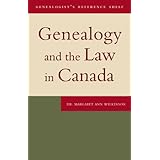
In her introduction Dr. Wilkinson indicates that the book is largely written for people interested in genealogy as a hobby and that chapter 2, on the business of genealogy, is one they can skip. Writing a law book for the hobbyist is a stiff challenge. While principles may be widely applicable the law varies from jurisdiction to jurisdiction so the numerous conditions – ifs, ands, and buts – don't make for entertaining reading, which is presumably why this is published in a reference series.
On the positive side, I did find I gained insight from reading this book on the rationale for some of the seemingly bureaucratic rigmarole one encounters in dealing with various record holding organizations.
The book has a glossary, section on statutes cited, on cases referred to, and notes. What it lacks, and desperately needs to meet the reference requirements of the hobbyist, is an index.
Take legal deposit posed in the book as "If a genealogist publishes a work based on genealogy, must it be deposited in Ottawa?" It's a question more than a few genealogists must have asked themselves. The answer is on page 92 in the chapter on copyright. Although that is perhaps the most obvious place to put it would every hobby genealogist know that topic was even covered? A simple index, or even extended table of contents, would help make this volume more accessible to its target audience.
Genealogy and the Law in Canada, by Dr Margaret Ann Wilkinson, a 125 page paperback, published for the Ontario Genealogical Society by Dundurn Press (2010), ISBN 978-1-55488-452-0, is widely available at online bookstores.
01 January 2011
Public Domain
Information on some of the Canadian authors, and others, whose works enter the public domain today -- and on some that don't, is at
http://publicdomain.xanga.com/
Thanks to WJM for pointing this out.
Scotland's BMDs updated
Annual updates from ScotlandsPeople are now available: births are for 1855-1910, marriages for 1855-1935 and deaths for 1855-1960.
via Scottish GENES
2011 Ottawa and Major Genealogy Events Calendar
Will you be a better genealogist/family historian by the end of the year? One of the ways to make it happen is to attend presentations.
Aside from the talks presented at your local family history society consider attending a conference or two. Here, for your appointment book, is a list of the larger ones, with some smaller Canadian ones added for good measure.
Feb 10-12 - RootsTech (Salt Lake City, UT)
http://rootstech.familysearch.
Feb 26-27, 2011 - Who Do You Think You Are Live (London, UK)
http://www.whodoyouthinkyouarelive.co.uk/
Apr 1-2, 2011 - Gene-O-Rama (Ottawa, ON)
http://ogsottawa.on.ca/?cat=15
Apr 6-10, 2011 - New England Regional Genealogical Conference (Springfield, MA)
http://nergc.org/NERGC2011/
Apr 16-17, 2011 - Alberta Genealogical Society Conference (Edmonton, AB)
http://abgensoc.ca/events.html
May 11-14, 2011 - (US) National Genealogical Society Conference (Charleston, SC)
http://www.ngsgenealogy.org
May 13-15, 2011 - Ontario Genealogical Society Conference (Hamilton, ON)
http://www.ogs.on.ca/conference2011/
Jun 3-5, 2011 - Roots 2011, Quebec Family History Society (Montreal, QC)
http://www.qfhs.ca/roots_program2010.shtml
Jun 10-12, 2011 - Southern California Jamboree (Burbank, CA)
http://www.scgsgenealogy.com
Sep 7-10, 2011 - (US) Federation of Genealogical Societies Conference (Springfield, IL)
http://www.fgs.org
Sep 16-18, 2011 - British Isles Family History Society of Greater Ottawa Conference (Ottawa, ON)
http://www.bifhsgo.ca
31 December 2010
Get a Last-Minute Tax Deduction
Looking to get an income tax deduction? You can make a last-minute online donation and help the federally registered charity of your choice. How? First check out the organization website. I didn't find many genealogy/family history societies that could accept a donation online, but maybe your's is one.
In Canada you can go to CanadaHelps.org, itself a registered charity with a goal to make giving simple. Enter the charity name or part name in the search box. I searched genealogical and "family history" and found many familiar Canadian societies, many of which may not know of the service.
Contributors for 2010
Thanks to everyone who helped this year by posting comments, providing information, or publicizing the blog, including;
Alison, Amy, Anne, Anonymous, Astrid, Audrey, Barb, Bill, Brenda, Brian, Bruce, Bryan, Carol, Caroline, Charles, Chris, Christine, Colleen, Dave, David, Debra, Diane, Dick, Doc, Don, Elizabeth, Ellen, Glenn, Gordon, Hamish, Heather, Helen, Hugh, Hummer, Ian, James, Jane, Janet, Jasia, Jenny, Jeri, Jess, Joan, John, Kathy, Kelvin, Kirsty, Leigh, Lesley, Leslie, Linda, Lisa, Liz, Malcolm, Margaret, Marian, Mary-Anne, MerRhosyn, Michelle, Mike, Miriam, Nancy, Norma, Pat, Paul, Peter, Persephone, Phil, Pierce, Randy, Rick, Ros, Russell, Salabencher, Sandra, Susan, Sylvie, Thomas, Treesrch, William
AND
a blog is nothing without readers. Thank you.
Cromer and Overstrand Resources

Cromer, on the county's north-east coast, is the major subject of a new book A Dictionary of Cromer and Overstrand History.
The companion website includes more lengthy material for a range of topics shown to the left including a city directory from 1890, a cemetery transcription starting in the 1860s, and the opportunity to feedback your impressions and memories.
30 December 2010
Genealogy classes in Ottawa
Colleague Lesley Anderson is offerring genealogy classes through the Ottawa Catholic School Board again in the New Year.
Genealogy Level 1 is "a fun 4-week course on how to get started using both online computer resources and offline community resources. We will concentrate on using Ancestry's genealogical databases and other Internet websites. We will be discussing: Getting Organized, Good Genealogy Websites, Civil Registration, Parish Records, Passenger Lists and Census Records. Two classes will be spent on field trips. Class runs two times a week for four weeks."
Genealogy Level 2 is a 3-week course which will "Review of Level 1 Resources, Parish and Poor Law, Directories, Wills, Military Records and Other Records. We will concentrate on using the Ancestry.ca website and other Internet resources. One class will be taken up with a field trip to the Library and Archives of Canada. Class runs two times a week for three weeks."
Registration starts 3 January 2011 at http://onlineca.activecommunities.com/OttCathSchools/Start/Start.asp?SCheck=867433280&SDT=40058.4191969907
Ontario baby names
You may have seen a newspaper item in the Ottawa Citizen or London Free Press based on an Ontario government press release mentioning that "Ethan has been the most popular name for baby boys for the third year in a row, while Olivia overtook Emma in the top spot for girls' names. The top ten names also include: Jacob, Matthew, Nathan and Joshua for boys and Emma, Ava, Emily and Isabella for girls."
What it doesn't mention is that the baby name statistics are from 2008. It was explained to me that parents have a year to register a birth in Ontario so there is inevitable delay. With online registration a preliminary list could surely be compiled much more quickly, as is done in Scotland.
The tops boys names in Ontario for 2008 were Ethan (1001), Jacob (872), Matthew(840), Nathan (821), Joshua (724), Alexander (722), Lucas(719), Liam (675), Daniel (674), Logan (659).
For girls the top names were: Olivia (904), Emma (897), Ava (752), Emily (677), Isabella (598), Abigail (573), Sarah (518), Madison (435), Ella (465), Hannah (440).
29 December 2010
Ancestry: 50% off

The membership includes:
- Unlimited access to all records from the UK, Ireland, US and more
- Unlimited acces to all Canadian record collections on Ancestry.ca
- Connection into the world's largest online family history community
- Hints in your tree when we discover details about your ancestors
- All the tools you need to build, grow and share your family tree online
- The ability to upload photos, documents and stories to your tree
- Shared access to your tree for family members
Inappropriate surnames
The following poem, attributed to James Smith, was found in the book "Surnames of the United Kingdom: a concise etymological dictionary" (1912) in the Internet Archives.
SURNAMES
Men once were surnamed from their shape or estate,
(You all may from History worm it);
There was Lewis the Bulky, and Henry the Great,
John Laekland, and Peter the Hermit.
But now, when the door-plates of Misters and Dames
Are read, each so constantly varies
From the owner's trade, figure, and calling, Surnames
Seem given by the rule of contraries.
Mr. Box, though provoked, never doubles his fist,
Mr. Burns, in his grate, has no fuel ;
Mr. Playfair won't catch me at hazard or whist,
Mr. Coward was winged in a duel.
Mr. Wise is a dunce, Mr. King is a whig,
Mr. Coffin's uncommonly sprightly,
And huge Mr. Little broke down in a gig,
While driving fat Mrs. Golightly.
Mrs. Drinkwater's apt to indulge in a dram,
Mrs. Angel's an absolute fury.
And meek Mr. Lyon let fierce Mr. Lamb
Tweak his nose in the lobby of Drury.
At Bath, where the feeble go more than the stout,
(A conduct well worthy ot Nero),
Over poor Mr. Lightfoot, confined with the gout,
Mr. Heaviside danced a Bolero.
Miss Joy, wretched maid, when she chose Mr, Love,
Found nothing but sorrow await her:
She now holds in wedlock, as true as a dove.
That fondest of mates, Mr. Hayter.
Mr. Oldcastle dwells in a modern-built hut.
Miss Sage is of madcaps the archest;
Of all the queer bachelors Cupid e'er cut.
Old Mr. Younghusband's the starchest.
Mr. Child, in a passion, knock'd down Mr. Rock,
Mr. Stone like an aspen-leaf shivers;
Miss Poole used to dance, but she stands Jike a stock
Ever since she became Mrs. Rivers ;
Mr. Swift hobbles onward, no mortal knows how.
He moves as though cords had entwin'd him;
Mr. Metcalfe ran off, upon meeting a cow,
With pale Mr. "Turnbull behind him.
Mr. Barker's as mute as a fish in the sea,
Mr. Miles never moves on a journey ;
Mr. Gotobed sits up till half-after three,
Mr. Makepeace was bred an attorney.
Mr. Gardener can't tell a flower from a root,
Mr. Wilde with timidity draws back,
Mr. Ryder performs all his journeys on foot,
Mr. Foote all his journeys on horseback.
Mr. Penny, whose father was rolling in wealth,
Kick'd down all his fortune his dad won,
Large Mr. Le Fever's the picture of health,
Mr. Goodenough is but a bad one.
Mr. Cruickshank stept into three thousand a year,
By shewing his leg to an heiress —
Now I hope you'll acknowledge I've made it quite clear
That surnames ever go by contraries.
Family Chronicle, Jan/Feb 2011 issue

I turned immediately to a couple of articles by local Ottawa writer Elizabeth Lapointe.
"Discovering Family History Centers" likely sat in Family Chronicle's pending file a bit past its best before date. It mentions ordering films through the Family History Centre which is no longer possible in Canada, you have to do that online, and refers to an annual Family History Fair at the Ottawa Stake Family History Centre which occurred in 2009. There was no such event in 2010 in Ottawa
I was pleased to see "Crime and Punishment in Upper Canada: A Book Review." That book, in the OGS/Dundurn Press Genealogists' Reference Shelf series, has been in my reading pile. Elizabeth gives it a favorable review noting the great care that the author, Janice Nickerson, took to get it right. She writes in conclusion, "Written from the historical perspective of a well-seasoned genealogist, the book is the first step in determining if any ancestors came in conflict with the law." A five page article by Janice which follows the review amply illustrates the validity of Elizabeth's review.
Elizabeth isn't the only Ottawa area author in this issue. Anne Moralejo has a short article giving advice on storing and handling old nitrate films. It gives very practical advice, in line with the magazine's billing as the "how-to" genealogy magazine.
There are several other interesting articles. I particularly enjoyed George Morgan's look at "US Records of the War of 1812" which starts out with a useful historical overview; and Richard Jordan's story of his research into his family history in "Murder at the Shingle Mill."
You can view the complete table of contents for this issue at www.familychronicle.com
28 December 2010
Yuletide R&R - 9
Continuing the series with a Canadian comedy sketch, but performed by Welsh-born John Morgan.
Forthcoming Courses and Workshops
The Toronto Branch of the OGS has announced its winter/spring 2011 lineup of family history courses. The Branch will be presenting five courses between February and May 2011, with learning opportunities for both beginners and more advanced researchers:
Biographical Research for Ontario Genealogists
This course is for experienced genealogists who want to learn the stories behind their Ontario ancestors' names, places and dates - ideal preparation for writing the family history book. Instructor: Janice Nickerson
1 Feb - 22 Feb 2011: 4 sessions, Tuesdays (6:30-8:30 p.m.)
Introduction to English Family History Research
Learn about records available for researching English ancestors: civil registration, the census, parish registers, and probate (wills). This course will discuss the indexes and other tools available through the LDS, in local libraries, and on the Internet. Instructor: Linda Reid
3 Mar - 24 Mar 2011: 4 sessions, Thursdays (6:30-8:30 p.m.)
Making the Internet Really Work for Genealogy
This hands-on course is aimed at those who have considerable experience with using the Internet for genealogy, but wish to fine tune their search skills and learn how to take advantage of social networking opportunities. Instructor: Marian Press
23 Mar - 13 Apr 2011: 4 sessions, Wednesdays (6:15-8:15 p.m.)
Introduction to Ontario Family History Research
Do you have Ontario ancestors? This course will introduce you to the records essential to Ontario research and how best to access them. Prerequisite: Basic genealogy course or equivalent experience. Instructor: Jane MacNamara
13 Apr - 4 May 2011: 4 sessions, Wednesdays (2:00-4:00 p.m.)
Palaeography for Family Historians
This course will help students decipher historical documents and gather information from them. Students are invited to bring in their own records for study. Instructor: Cherryl Moote
3 May - 24 May 2011: 4 sessions, Tuesdays (6:30-8:30 p.m.)
For program details, speaker biographies and information on how to register for Toronto Branch courses, visit www.torontofamilyhistory.org/courses.html.
27 December 2010
To come on Ancestry in 2011
Ancesstry have posted a list of the new and updated databases coming online in 2011. For the Canada, Ireland and the UK these include:
• UK: London wills, 1600s-1800s
• Ireland: Improved Griffith's Valuation, 1847-1864
• UK: Parish registers, including West Yorkshire and Dorset, 1700s-1900s
• UK: 1911 Census for England, Wales, Isle of Man and Channel Islands
• Canada: Voter records, 1935-1983
• Canada: War Graves Registry, WWI
See the complete list at http://www.ancestry.com/whatsahead?
Yuletide R&R - 8
There's at least one Doctor Who fan who reads this blog, I recommend to her this year's Christmas Carol episode, I'm sure may appreciate this longer sketch with Rowan Atkinson, and others, in the title role. It includes two ads, but only 20 seconds each.
Mystery emblem

It was given to me by the widow of a former work colleague who had roots in Nova Scotia.
A Google search finds Kinney Concepts in Rhode Island but no company website.
Tracing Your Civil War Ancestors

Moorshead Magazines have a new publication timed for the beginning of the 150th anniversary year of the US Civil War. In the familiar format of their magazines, Tracing Your Civil War Ancestors, written by regular Family Chronicle author David A Norris, looks at the records and resources available to the genealogist researching the event.
The articles are:
The First Steps to Finding a Civil War Ancestor
Some thoughts and tips on getting started in Civil War research
Companies and Regiments: Civil War Army Units
Knowing how the armies were structured will help you understand records and references
Prewar and Postwar Military Records
These records can help you trace your ancestor’s entire military career
Non-Regimental and “Untypical” Soldiers
Some tips for finding soldier ancestors in unusual categories
Emergency Troops, Militia and Home Guard
Records of temporary units might reveal a hard-to-find ancestor’s service
Ensigns and Engineers: Ancestors in the Navies
Though tracking a relative in the navy can be challenging, there are many valuable resources available
US Colored Troops and African-American Sailors
Here are some resources for African-Americans who served in the Civil War
Southern Loyalists and “Galvanized Yankees”
Here are some resources to check for Southern ancestors who served with the Union
To Helmira and Back: Prisoners of War
POW resources can fill in holes in your ancestor’s records, or reveal the fate of a missing ancestor
Medical Records and Hospital Personnel
Records from Civil War hospitals contain a wealth of information on soldiers and staff
Military Pay Resources
Civil War payroll records pay off again for genealogists
The Civil War and the Census
Pre- and postwar censuses offer important information on the lives and families of veterans
The 1865 Parole Lists: To the Very End
These documents list the soldiers who endured to the end of the war
Finding Your Ancestors’ Flags
Regimental flags had important practical and symbolic purposes for Civil War soldiers
Buried in History: Civil War Cemeteries
Finding a soldier’s grave can seem impossible, but it doesn’t have to be a lost cause
Civil War Pension Records and Wartime Relief
Pension records are a genealogical treasure trove for soldiers and their families
Confederate State Pension Resources
A state-by-state guide to locating Confederate pension records
Soldiers’, Sailors’ and Widows’ Homes
The records of these institutions may contain a wealth of detail that can’t be found elsewhere
Civil War Veterans’ Groups
Records of veterans’ organizations might let you follow your ancestor into the 20th century
Wartime Civilian Records
Relatives who weren’t in the military may still have left a wealth of information about their lives
Amnesty Papers and Southern Claims
Some potentially helpful postwar sources for Southern relatives
Spies, Smugglers and “Disloyal Citizens”
Records of civilian prisoners include ordinary citizens, political prisoners and even politicians
Finding Civil War Income Tax Records
You might find that your ancestors’ 1860s tax records are a source of family history
A Gift From the Past: Civil War Newspapers
Here are some tips on finding your newsmaker ancestors
A Picture in Time: Civil War Era Photographs
You can find photos of people and places connected to your family, or even of your ancestors
Best of the Best: Classic Civil War Resources
These records contain the most essential information for Civil War era research
National Archives Records
A soldier’s Compiled Military Service Record contains some of the most essential details of his service
Finding Your Way Through the Civil War With Maps
Maps can help you follow your ancestor during the war or find a family farm near a battlefield
I won't attempt a review of a topic so outside my area of expertise. Spurred by the recollection of a talk on Memorializing the Civil War Dead I attended last year I did dip into the article on Civil War cemeteries. Tracing Your Civil War Ancestors appears to be as accessible as you will be familiar with in other Moorshead publications.
You can order the magazine directly from http://familychronicle.com/Tracing_Civil_War_Ancestors.htm or wait for it to arrive at major newstands in the US and Canada.
26 December 2010
Yuletide R&R - 7
By request, Peter Cook from the legendary "Pleasure at her Majesty's" performance, originally from Beyond The Fringe review.
The rise and fall of the workhouse
BBC History Magazine has an online history of Britain's workhouse system.
Despite the grim reputation, and often reality, "Britain’s system of poor relief arguably saved thousands of people from starvation over the course of its 300-year history."
Included are snapshot histories of ten workhouses: Newbury workhouse, Berkshire; Southwell workhouse, Nottinghamshire; 48 Doughty Street, London; Andover union workhouse, Hampshire; Rhayader union workhouse, Powys; Edinburgh’s charity poorhouse, Edinburgh; Londonderry union workhouse, Londonderry/Derry; Strand union workhouse, London; The Spike, Guildford; Chorlton union workhouse, Lancashire
http://www.historyextra.com/feature/rise-and-fall-workhouse
25 December 2010
Looking for a good book?
BBC History Magazine's website provides access to short book reviews that may be helpful in selecting a good use for the Amazon or other bookworthy gift certificate you received this year. While some may not be easily available in North America others can be purchased in eBook form so you can try out that new eReader.
http://www.historyextra.com/books
24 December 2010
Christmas Greetings
May you feel the joy of Christmas expressed in Dickens' classic "A Christmas Carol."
"I am as light as a feather, I am as happy as an angel, I am as merry as a schoolboy. I am as giddy as a drunken man. A merry Christmas to everybody! A happy New Year to all the world!"
John
Additions to UK Genealogy Archives

Also recently added are biographical transcripts from the book Who Was Who 1897-1916.
There's more free material to consult in this ad-supported site.
If you don't find the Phillimore volume you seek try a search for Phillimore and the county name on the Internet Archive texts at http://www.archive.org/details/texts
BIFHSGO News
I often mention Elizabeth and Mario Lapointe, two of the hardest working people I know in genealogy. In the latest posting on her blog Elizabeth mentions they will be giving a joint presentation as part of the BIFHSGO June meeting.
23 December 2010
e-mapping Victorian Cheshire: Cheshire's Tithe Maps Online

- Where did your ancestors live?
- Who lived in your village or even your house?
- What was land in your area used for?
- Who owned land in your area?
FreeREG update
FreeREG, the little sibling of FreeBMD for parish registers, was updated on 16 December 2010. It now contains over 14 million entries including 7.1 million baptisism, 2.5 million marriages and 4.3 million burials.
The total entries for Norfolk, the county with the largest number of transcriptions, is 3.4 million.
22 December 2010
A Home Child Story
The Lives Lived section of Tuesday's Globe and Mail has a story not unlike some in BIFHSGO's new book British Home Children: Their Stories.
Read about John (Jack) Litchfield, a home child who lived to age 95, at
http://www.theglobeandmail.com/life/facts-and-arguments/john-jack-litchfield/article1844984/
Ancestry updates London, England, Poor Law Records, 1834-1940
"The records haven’t yet been transcribed, it’s not possible to search for your relatives automatically. Instead, you should identify which documents your family members are most likely to appear in, then use our browse options to look for their details."
- Admission and discharge books of workhouses
- Registers of individuals in the infirmary
- Creed registers
- School registers
- Registers of children boarded out or sent to various other institutions
- Registers of apprentices
- Registers of lunatics
- Registers of servants
- Registers of children
- Registers of relief to wives and children
- Registers of inmates
- Registers of indoor poor
- Registers of deserted children


