13 May 2011

32,000 new City of London burials at FindMyPast

18th and early 19th century London burial records are now added at findmypast.co.uk. The details are:

Church
Number of 
records
Years 
covered
St Botolph, Aldersgate
10,797
1754 - 1812
St Giles, Cripplegate
21,423
1754 - 1812

12 May 2011

BIFHSGO May Meeting

14 May 2011 at Library and Archives Canada, 395 Wellington, Ottawa

Yet another interesting presentation in store at 10 AM, Unravelling the Anglicization of an Irish Family to be presented by Irene Ip.


Although Irene's father's family was Irish, when he was born he was registered with a Cornish surname, a bequest from his grandmother. She had wanted her family to shed their Irishness when they decided to settle in London, England, and a change of name was the first order of business. Irene was told that the name had been O'Callaghan and that they had come from Cork, Ireland. Irene's story is how, after almost three decades, she finally tracked down her grandfather's family and found the name that should have been given to her father and so to herself. Irene will explain how name variations, together with hasty assumptions, led her on false trails, seriously impeding her research. She will talk about her visits to the Public Record Office, the National Archives at Kew, the Dublin Record Office, the Ottawa Public Library and her unexpected discovery on her home computer.

Irene Ip was born in London, England, and came to Canada in 1956 on a working holiday but decided to stay. She has been researching her English and Irish ancestors for over 30 years but more seriously since joining BIFHSGO in 2001. She was editor of Anglo-Celtic Roots for three years and is presently a member of the BIFHSGO Writing Group and was a member of the team that conducted two writing workshops for the Society.

The "Before BIFHSGO" educational sessional at 9 AM is Tips on Using PowerPoint for Genealogy Presentations, presented by Brian Glenn.

More genealogy help from Wolfram|Alpha

A computational knowledge engine may not sound promising for genealogy, but a recent blog posting at Wolfram|Alpha points out ways their website can help us. There's more than when I last blogged about it.

Relationships

You can map family relations, like this one for the aunt of the sister's husband. It does have difficulty with more complex relationships like double cousins and step relatives. It also calculates a blood relationship fraction, not the same as the shared DNA which would be nice to have.

Calendar Calculations

You can determine the day of the week for any date. Did you know the 12th of May 1945 was a Saturday (congratulations to those who share a birthday.) Also compute time difference between dates, and other calendar calculations.

Interpreting Ambiguous Words


If you have a word in a document in which you can only make out some of the letters try Wolfram|Alpha's capability to find words that fit the pattern, even when the first letter, or letters, are unreadable.

Also helpful for recreational word puzzles.

11 May 2011

A new version of The Master Genealogist?

Wholly Genes have just released a free beta version of The Master Genealogist, version 8. TMG is genealogy software that I've never got into. Those who do swear by it, other discouraged by its real or reputed steep learning curve swear at it.

If your tempted now would be a good time to try it. The beta version will expire in 30 days.  Find it at http://goo.gl/6GKLV

Deceased Online adds Rushden, Northamptonshire, burial records


View Rushden Cemetery in a larger map

Deceased Online now have approximately 13,650 burial records, with associated burial register scans, available for Rushden Cemetery, in Northamptonshire, from November 1888 to the present. The most recent 3 years are withheld.

Painting the family portrait

As you research further back in your family history the picture of your ancestors fades. All you have left is the begats, who was born where and when, married who where and when, had children where and when, and died where and when. 

Odds are those distant lives were ones of challenge and triumph, but you don't have the option of learning about them from an interview or heart to heart conversation. What you can do is build on what you already know; squeeze more out of the information you already have by looking at it from different perspectives.

That comes across in reading The Pecking Order: which siblings succeed and why by Dalton Conley who is now Dean for Social Sciences at NYU.

Conley is quick to point out that many factors influence how a person develops. Knowing basic family facts doesn't mean we can confidently predict in any particular case. Seemingly random events can have significant ripples across time. Particular talents may trump other factors. But there are some tendencies which when put together with other scraps of evidence may sketch a family portrait.

Here are some of the key points:
  • In a conventional family the children are genetically close and share a family environment, the two biggest factors determining development. 
  • A wealthy family with a bigger resource pie to share can provide more opportunity for the children, including living in more desirable communities with better facilities. 
  • Children of a poor family, or one with many mouths to feed, often have educational opportunities, and future prospects, curtailed for economic reasons.
  • The  resource pie can grow or shrink depending on the success, and survival, of the breadwinner(s) which can differentially influence older and younger children.
  • A local extended family, think of holiday meals with grandparents, aunts and uncles, cousins and second cousins, can compensate for or sometimes aggravate the family situation. 
  • The older child starts out with more individual attention which declines as the resource pie gets shared more with increasing family size.
  • Birth order is less significant than family size and child spacing. Often the oldest and youngest (mistake) children in a large family do better than the middle children. 
  • If a parent dies the eldest child at home is often expected to take on increased domestic responsibilities which may impact on education, but also cause them to accept responsibility more easily. Adult siblings who have already left the family home will likely be relatively less affected.
  • Pre-school children often adjust better to migration than older children.
The Pecking Order: which siblings succeed and why by Dalton Conley, published in 2004, received mixed reviews. Some reviewers didn't like the anecdotal style. Borrow it through your local public library or purchase through Amazon which has multiple copies for resale at http://goo.gl/CjQ8k


10 May 2011

40,000 new Gloucestershire records at Findmypast.co.uk

New records from Cam, Coaley, Dursley, Nympsfield,Owlpen, Slimbridge, Stinchcombe, and Uley in Gloucestershire are added to the Findmypast.co.uk parish records collection. These are baptismal, marriage and burial records for 1695 to 1796.

Separating chromosomes and progress in DNA analysis

A couple of DNA related items in the news (technology phobia alert).

A short article in Technology Review holds out the prospect of being able to analyse each member of a chromosome pair individually rather than as segments which are part of one or other of the chromosomes as at present.  This should mean greater confidence in identifying whether DNA cousins are related by descent rather than just chance matching. See the article at http://goo.gl/Mmazd

Meanwhile, as reported in GenomeWeb Daily News at http://goo.gl/rABbe the cost of DNA analysis continues to fall. The company Complete Genomes service "starts at $9,500 per genome for small order sizes to between $5,000 to $7,500 per genome for orders in the hundreds of genomes." Illumina now offers "human whole-genome sequencing services to $5,000 per genome for projects of 10 samples or more, and $4,000 for projects of 50 samples or more.

Such prices do not include the consumer level database service essential for the genealogist.

09 May 2011

Watson withdraws Whitton nomination

Celebrate. According to an Ottawa Citizen report Ottawa Mayor Jim Watson has withdrawn his nomination of Charlotte Whitton as the person after whom the new City Archives and Library Distribution Centre will be named. http://goo.gl/G7QH0

Lincolnshire parish records online

Lincs To The Past, from the Lincolnshire Archives, is an attractive website which should get high marks for content. You can find some great resources... if you know how! If you don't you can waste lots of time trying to figure it out.

Find Lincolnshire parish register information by going to http://www.lincstothepast.com/home/, clicking on Advanced Search on the ribbon near the top, then enter your search terms and, importantly, click the button for Images before clicking the Search button.

You'll get an array of thumbnail images which when clicked on bring up the Zoomify image browser. Then scroll around the images until you find what you're looking for. Also look for the term in the list beneath the image.

Overall, it's a useful resource for those Lincolnshire roots, spoiled by poor navigation.

BC and Irish genealogy educational handouts

One benefit for us all of a cooperative program between the BC Genealogical Society and the Vancouver Public Library is a series of multi-page handouts available free on various aspects of family history.

The two most recent are Researching your British Columbia Ancestors by BCGS President M. Diane Rogers; and Genealogy in Ireland by Eunice Robinson.

There are earlier handouts, none more than a year old, on Legacy (Family Tree), Scottish Military, Australia and New Zealand Military Records,and Analyzing Historical Photos, as well as quite a few other shorter ones. Browse them all from http://www.bcgs.ca/bcgs_handouts.htm

08 May 2011

Did your ancestor have an accent?

Was your ancestor noticeable in the community for their accent, and did it have an influence on how they were regarded? Was there an immigrant peer community where they lived? Perhaps they were outgoing enough to fit into their new community without feeling different. Or perhaps the new community was not open to newcomers. The introverted may have had particular difficulty fitting in. Consider these factors as you attempt to understand the family place in, or apart from, the community as you write your family history.

There's a throw away line in a book I'm reading that an immigrant, or migrant, retains their accent unless moved to the new environment before around the time of puberty. In the normal course of events, short of intensive speech therapy, your adolescent accent is yours for life. This is something I can attest to having arrived in North America at age 21. However, my speech is noticeably North American to British ears, perhaps a matter of vocabulary as much as accent.

The British Isles map above is from http://www.mywiseowl.com/articles/British_English. There's an interesting map of North American languages and dialects at http://www.quichua.net/AmEng/index_files/AmericanEnglishDialects.gif

Whitton is a questionable choice

Ottawa City Council appears ready to name of the new Central Archives and Ottawa Public Library Technical Services Facility as the “Charlotte Whitton Archives and Library Building."

It is an unfortunate choice.

In an editorial on 23 July 1954 the Ottawa Citizen commented that Mayor Whitton had "running battles" with the Library Board, "starting with her ill-informed opposition to a bookmobile." These had included her opposing the Library Board choice for City Librarian.

On April 22 1969 there is an article "New Library Stalled by Whitton" reporting on her move for reconsideration by Council of a decision to move ahead on the Main Library.

Whitton was a divisive figure in City politics, an advocate for neither library nor archives. Her sharp tongue, as in her well known quote “Whatever women do they must do twice as well as men to be thought half as good. Luckily, this is not difficult” was hurtful. In a facility which is seeing welcome cooperation between those two parts of the city administration which have not always worked cooperatively, it would be unfortunate if the facility were encumbered with a name that fails to engender a cooperative spirit.


It's as if the city built a recreation centre for OCTranspo drivers, and then insisted on naming it after Larry O"Brien.

The facility name should better be one that celebrates the city heritage and cultural achievements, not another monument to a City politician whose contributions to the activities of the organizations housed therein are at best dubious.

07 May 2011

WorldVitalRecords update

With only a few US twigs in my family tree the databases of WorldVitalRecords.com are not usually of much interest for me. While there are UK records many are esoteric, and the larger ones duplicate databases to which I already have access.

The site has been looking tired and there hasn't been much new of late. However, Randy Seaver points out that WVR now has a new look, and some new databases. That's welcome.  Read Randy's blog post here.

A little DNA genealogy analysis

Warning: this posting is on the technical side. If you're math/science averse you may want to skip this one.

In preparation for a presentation at the Roots 2011 conference, and a dress rehearsal at the Ottawa DNA interest group on 28 May, I've been looking at some autosomal DNA results from 23andMe.

I've found a case of a mother-son pair which has almost 150 identifiable partial matches with other people (DNA cousins) in the company (23and Me) database. Each point in the chart below represents a DNA cousin, more often a male, with the position on the horizontal axis the percent shared DNA with the mother, and on the vertical axis with the son.

I expected that at maximum the son would share all the same DNA as with the cousin, and as a minimum none. Whether the son inherits all, most, a little, or none of the DNA the mother has common with the "cousin" is supposedly random. It depends on which sections of chromosomes are inherited by the son.

Surprisingly there were 10 cases where the son had more DNA in common with the "cousin" than did the mother. Did he inherit the excess serendipitously from the father, or is there another explanation?

Notice on the plot that there are no points below 0.1% son shared DNA. The company does not make available results where the percent shared is so small. Also there are only three results where the mother shared DNA is less than about 0.28%, likely as the son's shared DNA is less than 0.1% in these cases.
A best fit trend line through the data (in red) and a best fit line forced to go through the origin (in black) are shown. The latter, which goes some way to compensating for the lack of data below 0.1%, has a slope a bit less than 70%. On the face of it on average the son inherits a bit less than 70% of the mother's shared DNA, not the average 50% according to theory.

06 May 2011

Historical Account of the ... Regiment

Just added to the Internet Archive are a series of potted histories of British Regiments from their formation to about the mid-19th century. You won't find mention of individuals, other than commanding officers. Use these publications to see what actions the regiment was engaged in while your ancestor was enlisted.

There's a list of these histories below, but its best to browse the listing here which may also surface other publications of British military interest at the Internet Archive.

Historical record of the First, or Royal Regiment of Foot [microform] : containing an account of the origin of the regiment in the reign of King James VI of Scotland and of its subsequent services to 1846

Historical record of the Forty-second, or, the Royal Highland Regiment of Foot [microform] : containing an account of the formation of six companies of Highlanders in 1729 ... and were regimented in 1739 and of the subsequent services of the regiment to 1844

Historical record of the Forty-Sixth, or the South Devonshire Regiment of Foot [microform] : containing an account of the formation of the regiment in 1741 and of its subsequent services to 1851

Historical record of the Fourteenth, or the Buckinghamshire Regiment of Foot [microform] : containing an account of the formation of the regiment in 1865 and of its subsequent services to 1845

Historical record of The Fourth, or, Royal Irish Regiment of Dragoon Guards [microform] : containing an account of the formation of the regiment in 1685, and of its subsequent services to 1838

Historical record of The Fourth, or, The King's Own Regiment of Foot [microform] : containing an account of the formation of the regiment in 1680, and of its subsequent services to 1839

Historical record of The Fourth, or The Queen's Own Regiment of Light Dragoons [microform] : containing an account of the formation of the regiment in 1685 and of its subsequent services to 1842

Historical record of The Nineteenth, or, The First Yorkshire North Riding Regiment of Foot [microform] : containing an account of the formation of the regiment in 1688 and of its subsequent services to 1848

Historical record of The Second, or, Queen's Regiment of Dragoon Guards, (Queen's Bays) [microform] : containing an account of the formation of the regiment in 1685 and of its subsequent services to 1837


Historical record of the Seventh, or, Princess Royal's Regiment of Dragoon Guards [microform] : containing an account of the formation of the regiment in 1688 and of its subsequent services to 1839

Historical record of the Seventh Regiment of Light Dragoons-Lancers [microform] : containing an account of the formation of the regiment in 1759 and of its subsequent services to 1841

Historical record of the Seventh Regiment, or, The Royal Fusiliers [microform] : containing an account of the formation of the regiment in 1685, and of its subsequent services to 1846

Historical record of the Seventh, or, The Surrey Regiment of Foot [microform] : containing an account of the formation of the regiment in 1758, and of its subsequent services to 1848

Historical record of the Seventy-First Regiment, Highland Light Infantry [microform] : containing an account of the formation of the regiment in 1777, and of its subsequent services to 1852

Historical record of the Seventy-fourth Regiment (Highlanders) [microform] : containing an account of the formation of the regiment in 1787, and of its subsequent services to 1850

Historical record of the Seventy-Third Regiment [microform] : containing an account of the formation of the regiment from the period of its being raised as the Second Battalion of the Forty-Second Royal Highlanders in 1870 and of its subsequent services to 1851.

Historical record of The Sixty-Seventh, or, The South Hampshire Regiment [microform] : containing an account of the formation of the regiment in 1758 and of its subsequent services to 1849

Historical record of The Thirty-ninth, or, The Dorsetshire Regiment of Foot [microform] : containing an account of the regiment in 1702 and of its subsequent services to 1853

Historical record of The Thirty-Fourth, or, The Cumberland Regiment of Foot [microform] : containing in account of the formation of the regiment in 1702, and its subsequent services to 1844

Historical record of the Thirty-first, or, The Huntingdonshire Regiment of Foot [microform] : containing an account of the formation of the regiment in 1702, and of its subsequent services to 1850, to which is appended an account of the services of the Marine Corps, from 1664 to 1748 : the Thirtieth, Thirty-First and Thirty-Second Regments having been formed in 1702 as Marine Corps, and retained from 1714 on the establishment of the army as regiments of regular infantry

Historical record of the Twenty-Third Regiment, or, The Royal Welsh Fusiliers [microform] : containing an account of the formation of the regiment in 1689 and of its subsequent services to 1850

Historical record of The Twentieth, or, The East Devonshire Regiment of Foot [microform] : containing an account of the formation of the regiment in 1688, and of its subsequent services to 1848

Historical record of the Sixteenth, or, The Queen's Regiment of Light Dragoons, Lancers [microform] : containing an account of the formation of the regiment in 1759 and of its subsequent services to 1841

Historical record of the Sixteenth, or the Bedfordshire Regiment of Foot [microform] : containing an account of the formation of the regiment in 1688 and of its subsequent services to 1848

Historical record of the Thirteenth, First Somerset, or the Prince Albert's Regiment of Light Infantry [microform] : containing an account of the formation of the regiment in 1865 and of its subsequent services to 1848

Historical record of the Twelfth, or the East Suffolk Regiment of Foot [microform] : containing an account of the formation of the regiment in 1685 and of its subsequent services to 1847

Historical record of the Tenth, the Prince of Wales's Own Royal Regiment of Hussars [microform] : containing an account of the formation of the regiment in 1715, and of its subsequent services to 1842

Historical record of the Tenth, or the North Lincolnshire Regiment of Foot [microform] : containing an account of the formation of the regiment in 1685, and its subsequent services to 1847

Historical record of the Sixth, or Inniskilling Regiment of Dragoons [microform] : containing an account of the formation of the regiment in 1689, and of its subsequent services to 1846

Historical record of the Sixth, or Royal First Warwickshire Regiment of Foot [microform] : containing an account of the formation of the regiment in the year 1674, and of its subsequent services to 1838

Historical record of the Sixth Regiment of Dragoon Guards, or the Carabineers [microform] : containing an account of the formation of the regiment in 1685, and of its subsequent services to 1839

Historical record of the Third, or Prince of Wales' Regiment of Dragoon Guards [microform] : containing an account of the formation of the Regiment in 1685, and of its subsequent services to 1838

Do you know TONI?

One of the Ontario Genealogical Society 50th anniversary projects is The Ontario Name Index, TONI for short.


With just 79,621 records available at present it's just getting started. Only records contributed by Wellington (the majority) and Kawartha Branches are now online. There is a promise that it will "quickly become large – perhaps as many as fifty million entries."

Here's a sample of a search on everyone's favourite surname.


As indicated by the t in the sources column, most of the data at present is from tombstones, likely a duplication of the data from the Ontario Cemetery Ancestor Index but with pay per view access to a more complete record. 

Other sources to be added are birth, christening/baptism, death, funeral card, family history, marriage, newspaper article, obit, township papers and Tweedsmuir history.

Even with the starter database it's easy to anticipate problems with common names not being well enough distinguished to make a pay per view purchase attractive. 

05 May 2011

Top US baby names 2010

The US Social Security Administration has just released their top name list for 2010.

For baby boys the top five are: Jacob, Ethan, Michael, Jayden and William

For baby girls it's: Isabella, Sophia, Emma, Olivia and Ava.

See the complete list of the top ten, and explore US fashions in names at http://www.ssa.gov/oact/babynames/

I try and keep track of baby names in Canada and the UK. There is an amazing difference in when the list is released, if at all. Scotland is usually first, before the end of the year. Jack and Sophie were Scotland’s top baby names in 2010.

Improved searching at Findmypast.co.uk

Findmypast are now providing a single search capability combining their records for England & Wales births 1837-2006, British nationals born overseas 1818-2005, British nationals born in the army 1761-2005, and British nationals born at sea 1854-1887. 


There is a similar capability for England & Wales marriages 1837-2005, British nationals married overseas 1818-2005, British nationals married in the army 1796-2005, British nationals married at sea 1854-1908.

For death records? Early last year paying clients were promised a complete indexing of England and Wales death records by the end of the year. It didn't happen. The company reneged on the commitment choosing to pursue other priorities. That's a black mark on their record. Why couldn't they deliver "half a loaf" as they did with the phased release of Chelsea Pensioner records?

This present announcement claims "We're very close to completing our project to fully name index our death records. Once this is complete, we will combine all our death records into one search to finish the series."

Canada's vulnerable federal records

In the US, by law, federal agencies have 30 years to turn over all the records that must be permanently retained by the National Archives.  But the US National Archivist David Ferriero, in testimony before the US House of Representatives, stated his belief that such a long time-frame is a recipe for lost documents and a spotty historical record, especially in this age of electronic records.


In Canada, by contrast, there is no law requiring such deposit.  As long as the agency or department claims they are working records they may retain them with their files. Thus we have the absurd situation that only incoming ships passenger lists up to 1935 are held at Library and Archives Canada. Canada's National Librarian and Archivist apparently sees no problem with this.

04 May 2011

More on the census logo

My last post was barely published when Sherri Pettit, coordinator of the CanadaGenWeb & OntarioGenWeb emailed me letting me know about the origin of the census logo that SGS is using on their website.

Sherri originally created the logo for the OntarioGenWeb's Census Project (http://ontariocensus.rootsweb.com) for the 2006 census and updated it earlier this year to reflect the 2011 census. The updated logo first appeared on the census project website in early March and was later added to CanadaGenWeb (http://canadagenweb.org) and the CanadaGenWeb update blog (http://canadagenweb.blogspot.com).

Thanks for your initiative Sherri.

I've added the logo to this blog for the duration of the census campaign as a reminder. Hopefully others in the Canadian genealogical community will also add the logo. I've also added links to the organizations that add the logo or otherwise publicize the need to make a positive decision.


Canada census 2011

A mailing from Statistics Canada arrived on May 3, but it didn't contain a census form. Instead it had a web address for providing the information online, www.census2011.gc.ca/, and a 15 digit access code. Also included were instructions on how to obtain a paper copy which involved calling a 1-866 telephone number and entering the 15 digit code. Successfully doing that was acknowledged with the information that the paper copy should arrive in five days.

On the website a section called "Genealogy corner" includes the information that:

The 2011 Census questionnaire contains a question that permits you to be part of the history of Canada. If you check yes to this permission question, your descendants will be able to do family and genealogical research on you and your family in the future.
There is further information in a Q/A
Q. Why am I being asked for permission to make my census information available in 92 years?
A. Starting in 2006, respondents to the census are asked if they want their personal census information publicly released after 92 years. For those who give explicit permission for the public release of their 2011 Census information, Statistics Canada will transfer that information to Library and Archives Canada in 2103, which in turn will make it publicly available. For those who do not give permission, their personal information will not be transferred.
Sadly, the information provides no encouragement to provide permission in recognition of the value of the information for historical social research.

The logo at the top is from the Saskatchewan Genealogical Society website. It's unfortunate that none of the other Canadian genealogical or family history societies websites I visited, including AFHS, AGS, BCGS, BIFHSGO, OGS, and QFHS, reflect any effort to encourage members and others to provide such permission. 


As the ultimate custodian of these records, which ideally would be as complete as possible, why would LAC not also encourage providing permission?


03 May 2011

Scottish Monumental Inscriptions and Deceasedonline

In the latest news posting on the Scottish monumental inscriptions website they report they now have over 100,000 images from various cemeteries across Scotland available on CD. They are photographing 1 to 8 burial grounds per day at the moment, (mainly weekends) and transcribing of over 300 cemeteries across Scotland is going well.

They now have an agreement with Deceasedonline. Records for Fife, Inverness and Perthshire were added to the deceasedonline website in February and more is promised. This is welcome as few of us have any need for more data CDs beside our computer containing only one or two items of interest.

02 May 2011

England Jurisdictions 1851

Here's one of the great resources for English family history research that seems to be not as well known as it should be. It's not totally new, but because it gets overlooked, I'll briefly profile it again.

Can't find the ancestors' record in the home parish, then look in adjacent ones. In which Poor Law Union, where your needy ancestors might find help, was the ancestor's parish? Experienced family historians know that maps can be a best friend and help sort out confusing situations.

Here's an example from my ancestry. The parish of Ellastone is in Staffordshire. It's in the rural Deanery of Uttoxeter, also in Staffordshire. However, the Poor Law District is Ashbourne, named for the larger community which, like most of the District, is in Derbyshire.

Try it at http://maps.familysearch.org/. You'll like it.

01 May 2011

Londonremembers.com

One of the first things visitors to London learn is that it's packed with history. Walk down almost any street and you'll find a monument, or one of the famous blue plaques marking where something notable happened, often the residents of a renowned person.


Londonremembers.com aims to capture all the memorials in London, 8311 subjects (people, events, etc.) to date on 1966 memorials, at 1534 sites. It's better experienced than described, and contains an amazing variety of items. Why would Ottawa find its way onto the site?

30 April 2011

Canadian Army Newsreels

The War Amps, in cooperation with the Library and Archives Canada  and veterans of the Canadian Army Film Unit, has  available a six DVD set containing more than 20 hours of footage from 106 newsreels filmed and produced by the CAFU during the Second World War.
The CAFU front-line cameramen were soldiers first. In addition to camera instruction, they received infantry training and took guns into battle along with their 35 mm movie cameras to record the Canadian infantry in action, notably during the invasion of Sicily and D-Day.
The newsreels, popular in home front movie theatres, also feature the daily routines of the soldiers behind the lines, life on the home front in Canada and historic footage of politicians and generals from the Allied and Axis countries.

This, and many other Canadian military related DVDs, are available from the War Amps at 


Genealogy in London

Else Churchill from the Society of Genealogists has prepared a summary of a 20 April meeting of invited representatives of the London area genealogy community to update the family history community on issues affecting the London Metropolitan Archives (LMA), Here are highlights.

CUTS


LMA will close on Fridays and will be open only one Saturday a month. This will take place from November. Longer opening hours on Wednesdays, meaning late night opening to 7.30pm on Tuesday, Wednesday and Thursday, are being added. 

DIGITISATION

Many C of E parish registers, Board of Guardian Records, School and Nonconformist registers from the LMA collection are now online through the partnership with Ancestry.co.uk. The Guildhall Library and LMA Collections of Poll Books and the Overseas Returns are in progress. London wills, numbering near 400,000, are coming. Parish confirmations, Middlesex transported convict records, Surrey Marriage Bonds and Allegations, London Land Tax and London Poll books will be included. 


City livery company records deposited the Guildhall Library are being negotiated. 


2012 will see the inclusion of the City and Tower Hamlets Cemetery records and some Session Records.

PUBLIC ROOMS

A service lift at LAN is to be refurbished between November and December which will affect the production
of records. Avoid making a visit in this period and give lots of notice using the advanced ordering facility on the online catalogue if you do plan a visit. 


29 April 2011

Delay in opening of new Ottawa City Archives

Construction work is ongoing on the exterior of the new Archives building at Woodroffe and Tallwood. A call to the archives, where I listened to a message that they expect to be open by the end of April, received a prompt response that they now do not expect to be open for another two weeks. With construction continuing safety on the site could be an issue for public access.

The Art of Mourning in Ottawa: ReVisioning Victorian Bereavement Artefacts

The following is a notice from the Bytown Museum


Saskatchewan-born, Ottawa-based artist and academic Cindy Stelmackowich will present the findings of her artist-in-residence project at the Bytown Museum. During the winter of 2011, Ms. Stelmackowich unearthed and researched a wide range of Victorian mourning artefacts from the Museum's collection. From her study of these artefacts she intends to create new artworks that will highlight the intimately-charged visual languages of mourning, mortality, beauty and death.

Mourning artefacts in the Bytown Museum's collection comprise a wide range of decorative, domestic and public memorabilia, and include hair wreaths, veils, clothing, jewelry such as lockets, bracelets and earrings which incorporate hair, and decorative items such as memory ware jugs.

The Bytown Museum's acting curator, Judith Parker, inaugurated the residency program in 2011 to facilitate access to the Museum's significant collection. The residency program supports innovative research and creative interpretation of this important cultural repository that reflects Ottawa's early history.

· Public talk given by artist Cindy Stelmackowich
· Saturday 30 April, 2011, from 2 - 3 pm
· In English
· Bytown Museum. Free admission

West Yorkshire baptism records added by findmypast

Find 211,905 West Yorkshire parish baptism records added at findmypast.co.uk

Parishes 
covered
Years 
covered
Number of 
records
  
Almondbury All Hallows
1703-1930
49,184


Dewsbury All Saints
1655-1950
57,160


Huddersfield St Peter
1563-1923
66,299


Kirkburton All Hallows
1686-1963
39,262


28 April 2011

A portrait miniaturist in the family?

Edition 13 of the Family and Local History Handbook has an article by Australian genealogist Sandra Hargreaves on "The History of Portrait Miniatures." Portrait miniaturists were eclipsed with the arrival of photographers in the mid nineteenth century; prior to that there were many of them in the UK, perhaps someone in your family tree.

The focus of the article is on an unrelated Hargreaves, Thomas (1774-1846), who was sufficiently prominent to have a listing in the Dictionary of National Biography.

An interesting web site at http://www.vam.ac.uk/collections/paintings/miniatures/index.html includes a directory of some prominent miniaturists, but not Hargreaves. Neither is he mentioned in the blog referenced at http://portrait-miniature.blogspot.com/.

I was drawn to the article as a practitioner of that art is in a distant branch of my family tree, William Derby (1786–1847). He and his son Alfred Thomas Derby(1821–1873), shown in a stylish self-portrait, are both also in the DNB but not in the other references above.

And a note on a development since I wrote the above, one where superior service deserves mention. I noticed a genealogical  error in some material on Alfred Thomas Derby on the National Portrait Gallery website, emailed them reporting the matter and received two replies within the hour, the second saying the matter is corrected in their internal database and will migrate to the public website.

The first genealogical society

I have been on a bit of a kick looking at genealogical history. An article from the July/August 1999 issue of Family Chronicle magazine deals with the early history, up to the founding of the New England Historic Genealogical Society in 1845. Read it at: http://www.familychronicle.com/HistoryOfGenealogy.html

I was surprised to read that "The New England Historic Genealogical Society was chartered in that year, two full years before a similar society was begun in England."


Thanks to lots more digitized material available since 1999 that statement has to be revised. The Morning Post (London, England), Wednesday, March 11, 1846; has an item on the London Genealogical Society. An article from Punch, of which the first part is shown, is also from 1846.

The NEHGS retains bragging rights by a small margin. 

27 April 2011

Changes to the English Records program at the National Institute of Genealogical Studies

The following is extracted from a press release from the National Institute for Genealogical Studies (NIGS).

English Studies Director, Dr. Penelope Christensen, has announced her retirement from NIGS. Dr. Christensen has been the Director of the English Certificate Programme ever since she founded it in 2000. She is starting her well-deserved retirement to concentrate on completing her family genealogy books, doing some traveling, and tending to her beautiful garden. 
Kirsty Gray, residing about 40 miles (64 km) outside London, England, has been appointed the new Director of English Studies. In her new position, Kirsty will be reviewing and updating the record courses from Census and Civil Registration to the much more advanced records such as Land, Property, Education, and Court Records. 
Kirsty grew up in Dorset and studied at the University of Reading (England) and Ottawa University (Canada), was awarded a Master's degree in Chemistry in June 2000, then took up genealogy professionally while training to be a teacher in 2002. Kirsty is an author, having written for the magazine Practical Family History and currently writing for Family Tree Magazine and Your Family Tree on various topics for beginners to more advanced levels. A sought-after lecturer, her knowledge, and her energetic and infectious personality wows audiences across the UK. 
After serving as Secretary of the Guild of One-Name Studies (GOONS), she took on the role of Chairman in April 2010, and is credited with “turning the Guild around and bringing it back to life.”
For more information on NIGS see: www.genealogicalstudies.com


HSO April Meeting: Mike More presentation

The next meeting of the Historical Society of Ottawa features a presentation by Mike More, Chair of the Ottawa Branch of the Ontario Genealogical Society, on "The Descendants of Roger Billings of Milton, Mass".
The Billings family arrived in Canada soon after the American Revolution and took up land NW of Brockville, Upper Canada. From there a son, Bradish Billings, made his way to Gloucester Twp on the banks of the Rideau River becoming one of the first settlers in what is now the capital of Canada. Mike, who is a distant Billings relative by marriage, will speak on the project he has underway for the City Archives.
The meeting on Friday, April 29, starts at 1pm at the Routhier Community Centre, 172 Gigues Ave in Ottawa.
If not able to get to the meeting you may still be interested in the information available on line on the extended Billings family at http://www.ogsottawa.on.ca/billings/. Mike's compilation is from a variety of sources, many derivative. He warns that not all have been verified and researchers should check the originals whenever possible.


Tyler Collection of Misc Notes and Pedigrees of Kent Families

This addition to Ancestry is "a collection of books that were compiled by Frank Watt Tyler of vital records for families from East Kent. It is called the Tyler Collection because he put together 3,240 books from parish registers for baptisms, marriages, and burials. Some books also contain a family tree or a family history."


The collection, of which only 11 are listed, is a motley one: C.C. depositions; Conveyances and leases; Correspondence with Rev Dr Arthur Adams, Trinity College, Hartford, Connecticut, USA; Cranbrooke file and misc;  Extract of Acts Books; Fourth and Last Supplement to Notices of the Ellises of England, Scotland and Ireland, 1881;  Indentures;  Kent Families Part 1; Kent Families Part 2; Kentish Gazette - obituaries; Misc Pedigrees.

There is no name indexing which is what we expect from Ancestry's subscription service when manuscript items are added to the collection. Here clicking on the title leads to an image of the front cover of a browsable file. Often you have to scroll across to see the information, a clumsy arrangement with seemingly little thought given to the convenience of the client.

26 April 2011

Hall of Names

Whenever I see one of those display stands selling family crests I act like the priest and the Levite, and unlike the good Samaritan, and pass by on the other side.

At the Ottawa Historical Association meeting last Thursday I learned that most of these kiosks are franchise operations of Kingston, Ontario-based Swyrich Corporation, operating as Hall of Names: http://www.hallofnames.com/

According to the web site Hall of Names was founded in Toronto researching family surnames in 1971. It now has "over 300 Hall of Names software licensees world-wide and countless more sub-licensees. This product line employs an estimated 500 people world-wide and is blended into hundreds of other products." A recent application by David Richardson, cited as general manager of Swyrich, to join the Kingston Chamber of Commerce states that the company as a whole has 14 direct employees.

Would that make it Ontario's most successful genealogy-related enterprise? The corporation website has an Alexa traffic rank of 1,868,816 which places it below genealogicalstudies.com at 1,093,695,

ogs.on.ca at 1,289,655, and just above familychronicle.com at 1,881,611. 

For potential franchisees the company website advertises that Hall of Names features: Great Impulse Sales, Appeals to All Ages, Appeals to All Walks of Life, Authentic Histories, Full Color Coats of Arms, Excellent Profit Potential, Over 1,000,000 Surname Histories, 50,000 First Name Histories, 35,000 Scottish Clan Histories, 24,000 Irish Sept Histories, and more.

At the OHA meeting I asked how the company had managed to avoid the type of legal problems that Halbert encountered. The reply was they avoided making exaggerated claims, as indicated in the following item from their FAQ:
Question: What information does a history contain? 
Answer: The history begins with the earliest record of the surname and then follows the family as it branched through the Old Country and subsequently through the New World. The history lists the names of the earliest settlers as they migrated to North America, modern notables of the family name and variations in spelling.
Note that there is no claim, at least on the website, that the material supplied has special relevance to the client aside from the common name. One wonders whether folks making those impulse purchases appreciate the nuance.
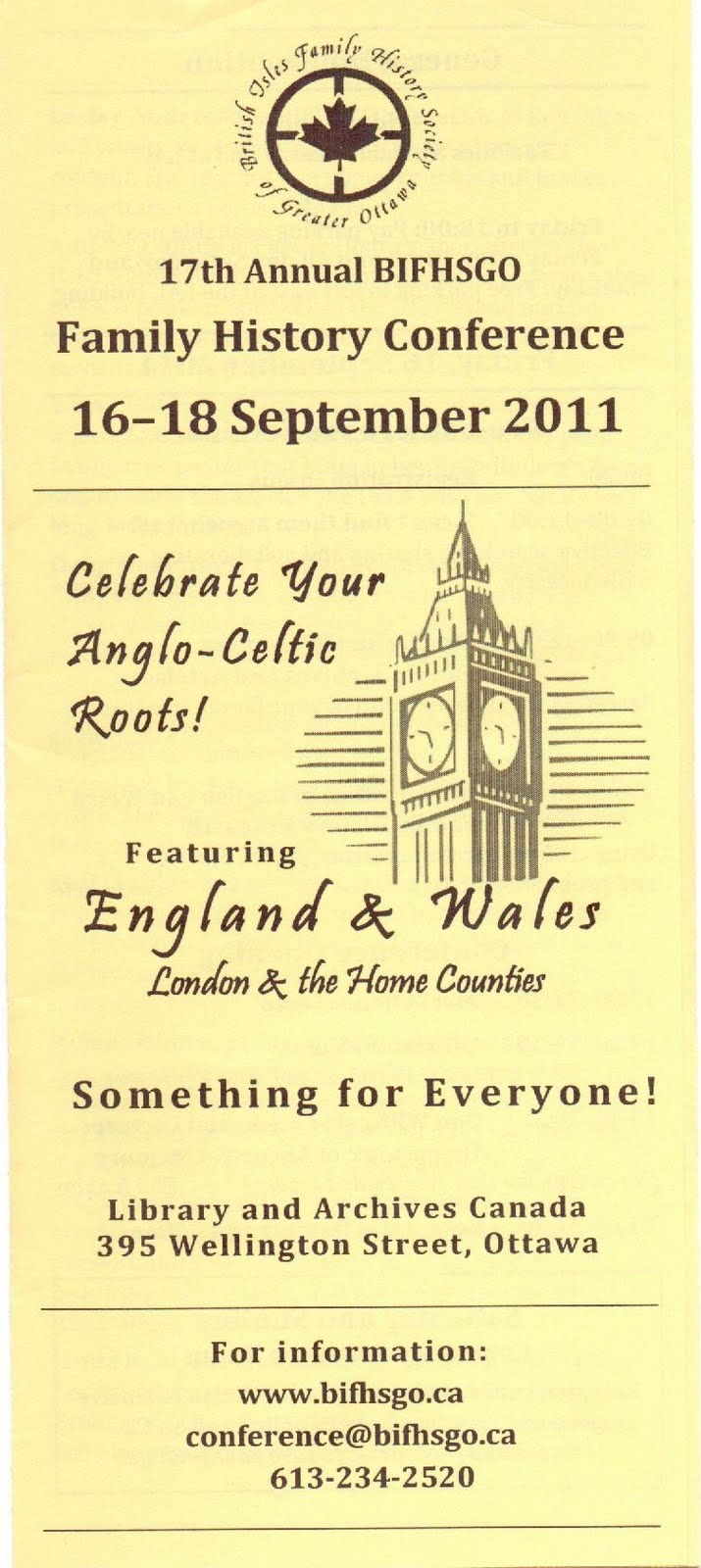
Introduction to English and Welsh Family History Research

At each BIFHSGO monthly meeting there are discovery tables, one each for England and Wales, Scotland, and Ireland where resource publications and advice from experts are available. What hasn't been available recently is a local lecture series or workshop where members, and others, can get instruction on the basics with a focus on England and Wales, Scotland, or Ireland.

This September, as a pre-conference session, BIFHSGO will be offering "Introduction to English and Welsh Family History Research," a 2-1/2 hour session to be given by Linda Reid who has offered a similar session for OGS Toronto branch. Linda, who is a retired librarian and Family History Centre volunteer, was coming to the conference to make two presentations anyway so it seemed like an ideal opportunity to benefit from her experience.

The session is aimed at those who are starting to research their English or Welsh family history, and will be of interest to those who need a refresher to learn about the online resources that have become available. It will cover the basics: civil registration, the census, parish registers and, time permitting, probate records, a topic Linda will be covering from a different angle in a conference session.

Find out more about this session, other pre-conference sessions, as well as the conference proper and how to register, at www.bifhsgo.ca