In a previous posting I suggested delivery of electronic versions of NewsLeaf and Families in pdf form could substantially reduce costs and likely obviate the need for an OGS fee increase.
This is an option as in recent years OGS has made considerable efforts to install a web server and software appropriate for administering the Society, assisted by a grant from the Trillium Foundation. During the past year experience has been gained in Internet distribution of some issues of the Society newsletter, NewsLeaf.
One advantage of adopting such technology is opening up options for improving service and operational efficiency. For the savings to be achieved it requires a willingness on the part of Society management to exploit the technology, AND on the part of the membership to accept a change in the way service is delivered.
The May 2008 issue of NewsLeaf provides information on 2007 expenditures which can be used to assess possible cost savings.
Families $20,380
Newsleaf $14,726
Postage $14,255
It appears that postage for other purposes, e.g. membership renewals, was recognized elsewhere in the statements.
If the first $1,000 of production for each publication ($250 per print run) are fixed costs, and there's a print run of 4,000, variable cost per member per year would be $11.84.
There would also be some relatively minor offsetting costs for electronic formatting and distribution, but the net saving would surely be a minimum of $10 per member. If the print run was actually only 3,500, the potential savings per member rise to $12-13.
How important is it to you to receive these publications in hardcopy? Or would you prefer to receive the same information over the Internet and save $10 - 12 annually? Would it be acceptable to increase fees only for members who do not want to accept the service change?
17 April 2009
Avoiding the OGS membership fee increase

16 April 2009
Dealing with Genealogy Society deficits
A notice has been distributed informing Ontario Genealogical Society members that a motion will be introduced at the next AGM proposing that fees be increased from $45 to $60 beginning with the 2010 membership year. The notice points out that "due to inflation during the past eleven years, our fee should be $57.00 just to match the $45.00 of 1998."
In the UK the Society of Genealogists is also dealing with a deficit situation, largely the result of the general economic situation. Instead of raising fees they are reducing service -- closing the library on Fridays, in addition to the regular Monday closure. There has a been a spirited discussion on this, and other thoughts on the Society finances, including the idea of distributing the Society magazine electronically in pdf, on the SOG mailing list.
As the OGS notice points out, economically this is not the best time to increase fees. Even at the current level of fees I understand the Society is experiencing a decline in membership, something that is sure to accelerate if fees are increased.
What options for cost reduction, including service reductions, did OGS consider? Would OGS be prepared to offer a discount for members who opted to receive Families and all issues of Newsleaf electronically?
15 April 2009
OGS Conference 2010 - Call for Speakers - Selective Deadline Extension
The following is from Paul Jones of the Toronto Branch of OGS
Further to the recent call for presentations for the Ontario Genealogical Society's Conference 2010, prospective speakers may wish to know that the deadline has been extended to 1 June 2009 for proposals for Italian and Dutch lecture streams only. This extension is to allow for more complete outreach to these communities. The deadline remains unchanged (1 May 2009) for submission of all other topics.
Those needing more details about Conference 2010 should visit http://www.ogs.on.ca/
Ian Wilson, Librarian and Archivist of Canada, Retiring
LAC has posted a notice that Ian Wilson will be retiring effective April 24th 2009. I'd heard he would be retiring this year, but hadn't expected it so soon, or so suddenly.
Ian leaves an important legacy. He provided strong leadership for the amalgamation of the National Archives and National Library, has been an eloquent proponent for archives and libraries and a steadfast proponent for opening up records, notably in the fight to release the post-1901 censuses.
13 April 2009
1911 census for England complete online
The 1911 census information website reports that the last three counties have now been added. They're working on Wales.
11 April 2009
They will all starve together
During last Tuesday's visit to TNA at Kew I took the opportunity to attend one in a regular series of presentations, many of which I've blogged when they become available as podcasts.
Admission is by free ticket, but the room with seating set out for 66 was only a bit over half full, with room for a few extra chairs, so turning up at the last minute didn't seem to be an issue. That may not be the case for the best known speakers.
The topic was "They will all starve together .. pauper records for England and Wales 1834 - 1900." The speakers were Paul Carter and Natalie Whistance.
The first part of the presentation was an explanation of the Poor Law system, with emphasis on the reformed Poor Law after 1834. The system was set up with a national Poor Law Commission and Commissioners at Somerset House in London. They attempted to impose uniformity on the locally run Poor Law Unions. This involved a good deal of correspondence between the commissioners on the one hand and the local Board of Guardians and workhouse management on the other. The London end of this correspondence is archived at TNA in the series MH12, Poor Law Union Correspondence, in 16,741 volumes, an estimated 4,352,660,000 words. Local Board of Guardians records, where they survive, are usually found in county record offices.
The presentation's second part went into more detail on the MH12 records. Although every person ever involved with the Poor Law isn't named quite a few are. The difficulty has been that the records are not indexed in depth, but this is changing. TNA is making available online images of the records for local groups to index. The project is a cooperative one with TNA providing training, as well as the images, so that local indexers can benefit from other's experience.
The first Union to be completed is that for Southwell. Several examples were shown including a July 1871 letter regarding a Mrs Amy Freeman seeking authority to send her and her children Mary Ann, Rebecca, Samuel, Emma, William, Adeline and Lydia to Canada where they have family and friends.
The presentation was informative and there were many questions. Some in the audience were hearing challenged and Natalie had to speak close to the microphone which caused some distortion. Paul had a powerful voice and didn't need the microphone, but I wonder how this will play out as a podcast. In the feedback form I put in a suggestion for using over the ear microphone technology and making the visuals available online as well as the audio podcast.
09 April 2009
Genealogy heaven
 A visit to The (UK) National Archives last Tuesday, my first in two years, was a pleasure. Not only did I find the information I sought but the atmosphere made the occasion.
This started when I entered through the barrier into the FREE parking lot. You take a ticket to open the barrier and validate it inside the building just before leaving to exit the lot.
You know you're entering a building of significance as the entrance is suitably impressive. The information desk, staffed by two people and a security person with, as elsewhere in the building, security in the background. The atmosphere is one of welcoming visitors and facilitating their experience rather than regulating it.
The entrance also has a desk to sign up for FREE one hour access to the indexed 1911 census, available on 66 dedicated computers. When there is excess capacity you can book additional time.
There is a small cyber-cafe available in the entrance too. You walk past this, the bookstore, a small museum and adequate restaurant to the lockers and toilets. The main research room is up a flight of stairs. What was a series of rooms on my previous visits is now opened up into a large research room. Most of the space that was taken up with microfilm machines is now occupied by computers. They are modern so that response is usually fast, and there are lots of them.
The change of layout puzzled me for a bit. A staff member approached and asked if I needed help. She provided a ticket for the afternoon lecture and directed me to where I wanted to go. When I had trouble getting started on the computer a distinctively dressed person, with a name tag, all staff wore a name tag, was there to help. In 90 minutes, 60 with the 1911 census, 30 with Documents Online, I'd found more new information than I'd dreamed. Rather than making printouts I took digital camera images of the screen -- quite adequate for research purposes.
There was a wide selection of "How to .." guides, mostly just a single page with step by step instructions aimed a t solving a particular problem rather than explaining a larger area of records. Examples are: "How to decide whether a seaman is a commissioned officer, warrant officer or rating", "How to find a Death Duty Register 1858-1903" and "How to find a Metropolitan Police Officer's record, 1830-1933 (MEPO 4)."
A large collection of historic publications, like military and street directories, were in the open area. Apparently the security cameras and other unobtrusive security were considered adequate protection so no reader pass was required to access any of the areas I visited that day. I noticed an area where reader passes were being issued for people who needed to access original documents.
Not everything was perfect. I couldn't get my laptop connected to the wi-fi system, and was told at the information desk it was OK to take pictures only to be told later my a security person that shots with other people in were not allowed, information that came a bit late.
These were small matters, ones I might have resolved with more time. I did drop a note in one of the prominently displayed suggestion boxes. A poster with the photos, names and responsibilities of TNA's senior managers displayed discretely in the entrance hall suggested another avenue for comment.
After attending a FREE afternoon lecture, which I'll blog later, I left feeling very positive about the experience, and it didn't cost a thing. But on leaving I did stop at the bookstore for the purchase of $100 worth of books.
08 April 2009
National Institute for Genealogical Studies
 Louise St Denis of the National Institute for Genealogical Studies was an exhibitor and speaker at Gene-o-rama at the end of March. The stand was displaying two new books by Penelope Christensen, Researching English Church Court Records, and Researching English Civil and Criminal Court Records.
To celebrate their 10th anniversary, the Institute, in partnership with the University of Toronto, Faculty of Information Studies, Professional Learning Centre, is providing each registrant of OGS Conference 2009 with a Gift Certificate for a free online course in their Certificate in Genealogical Studies program (1-800-580-0165 or www.genealogicalstudies.com/).
07 April 2009
Toronto "Summer Camp"
For many years I've been hearing BIFHSGO Librarian Betty Warburton mention the "Summer Camp" run by OGS Toronto Branch. She's been back many times so it must have quite something going for it. This year the sites visited include the new Ontario Archives at York University, an opportunity to become familiar with the new facility.
Here's the announcement from Toronto Branch.
14th Genealogy "Summer Camp"
Toronto, 7-12 June 2009
Ontario Genealogical Society, Toronto Branch
Co-ordinator: Jane MacNamara
Now in its 14th year, Genealogy Summer Camp is an innovative week-long program that brings both out-of-town and local researchers with Ontario roots to the wonderful cluster of archives and libraries in Toronto. Each day, participants will travel as a group to a different repository, including the Archives of Ontario in its new location at York University, where they will receive tutorials on available records and spend time doing hands-on research under the guidance of local experts. The fee for 2009 is $200. This covers approximately 7 hours of tours and tutorials, 25 hours of instructor-guided personal research, and all worksheets and handouts. Both out-of-town researchers and local “day campers” are welcome.
For complete details, including lists of venues, resources and tutorials, accommodation information and an application form, please visit www.torontofamilyhistory.org/summer.html,
call 416-733-2608 (voice mail),
e-mail info@torontofamilyhistory.org.
Applications should be submitted by May 1, although earlier contact is appreciated.
06 April 2009
Gravestone Photographs
The site at www.gravestonephotos.com mentioned in the article Top 50 British Sites for British and Irish Research in Discovering Family History magazine was news to me. It has free transcriptions of monumental inscriptions in 22 English counties, especially strong for Norfolk and Suffolk. The small Norfolk churchyard where my grandfather is buried, it was in Suffolk at the time but they move the county boundary in 1974, is included. Unfortunately he and my step-grandmother were missed.
A very few graveyards in Scotland, Ireland and Wales are included, and in the US, Canada (Nova Scotta (sic)), Australia and Cyprus.
05 April 2009
Global Genealogy at Gene-O-Rama
 Some of the new publications Global Genealogy have produced were on display at Gene-O-Rama. Rick Roberts explained that since closing his company physical store in Campbellville he has had more time to work on adding to their catalogue of productions from Global Heritage Press.
The Picturesque St Lawrence River, History of Brant County, Jubilee History of Thorold Tow nship and Town, 1897-8, and Lunenburgh or the Old Eastern District (Eastern Ontario). These are all reproductions of historic publications, the latter two so new I couldn't yet find them on the website.
Global continues to carry a wide range of other products, including genealogy software. I understand they'd sold out of copies of Family Tree Maker 2009 only 10 minutes after the conclusion of Doug Hoddinott's FTM seminar.
04 April 2009
LAC's plans and priorities for genealogy
The beginning of April marks the start of a new fiscal year for The Government of Canada. Library and Archives Canada's 2009–2010 Report on Plans and Priorities, Part III of the Estimates, was tabled last week explaining the programs that will be delivered and forming the basis on which Parliament grants departmental funding.
What does it have to say about LAC programs of genealogical relevance? Here are all three extracts from the document that mention genealogy.
1. Reference requests: Clients can make requests for information or to locate records in Reference Services (which includes the Canadian Genealogy Centre) by various channels including telephone, post, email, the LAC website and in-person.
2. LAC will increase the relevance and accessibility of LAC collection and expertise to
Canadians outside the National Capital Region (NCR)
Some 2009-10 actions:
Expand current digitization initiatives and post more items from the LAC collection online;
Develop targeted strategies aimed at groups such as genealogists, multicultural communities and teachers.
3. LAC is developing a corporate research plan to align our research initiatives with corporate priorities; among these activities we will undertake further research with clients in 2009-10. Through a Services Strategy to be completed in 2009-10, we expect to address opportunities linked to the four most common reasons that people seek out items in our collection: genealogical research, academic and educational research, research to establish rights/benefits or to support litigation (veterans' benefits, land claims), and to produce media or cultural industry products (books, films). In 2009-10 LAC will continue to value the advice provided by a volunteer Services Advisory Board representing clients and partners (www.collectionscanada.gc.ca/the-public/pcsab/index-e.html).
The document is light on specifics. For each of the three program activities: Managing the disposition of the Government of Canada records of continuing value; Managing the documentary heritage of interest to Canada; and Making the documentary heritage known and accessible for use; there is a general statement of expected results and specific performance indicators, but no indicator targets.
For "Making the documentary heritage known and accessible for use" the indicators, by client segmant, are: (1) Number of programs, exhibitions, events, digital collections, and web products developed and launched. (2) Number of clients who intend to act on their LAC experience (e.g. read more, learn more, visit again, support LAC). (3) Percentage of clients who agree that access has improved. Not only are there no targets, there's no baseline data shown against which to measure progress!
Elsewhere in the document there are two specifics of interest for genealogists:
(1) The document repeats the promise that "LAC will launch a strategic digitization plan that aims to create up to 30 million digital images of items in our collection between 2009-10 and 2013-14. This will enable us to put those images online for Canadians and users around the world with documentation that will make locating images easier."
30 million images is less than one per Canadian. How does it compare with comparable institutions internationally?
(2) Of concern, as it does not reference records of genealogical value, is the statement that "Canadians (will) have easier access to government records of business or archival value, including in support of their access to information and privacy requests. Disposal of records of no business or archival value eliminates related storage costs. There are records, perhaps old pension records, which although likely of little archival value are genealogically interesting. Will they be lost under the policy?
At some point LAC will be called to answer questions from members of a parliamntary committee examining there Estimates. What questions would you suggest?
03 April 2009
Hogs Back Dam
A favourite spot in Ottawa at this time of year is Hogs Back Falls. The spring runoff is near a peak and the rush of water attracts locals and visitors to view, hear and feel the spectacle of rushing water.
180 years ago, on April 3rd, 1829, this was the site of a setback for the Rideau Canal when the first dam was washed out. Col John By reported that "at about ten o'clock in the morning the water began to flow over the top (of the dam) without carrying off any of the coping stones. ... I felt it (the dam) tremble, and instantly ordered the men to run. I stood and looked at it for a few seconds, when the stones fell from under my feet as I ran off.
02 April 2009
Bytown or Bust
I was surprised at Gene-O-Rama to find that one of our long time BIFHSGO members, with roots in the Ottawa Valley, was not aware of the Bytown or Bust website. It's a local treasure of a resource, over 1,100 pages of information, for migration and settlement in the Ottawa area in the 1800's, especially for the Irish.
If you visit often enough you'll either learn to love or hate the background music "When You and I Were Young, Maggie" that plays on the main page.
01 April 2009
Four genealogy magazine hot tips
 I had a good conversation at Gene-O-Rama with Ed Zapletal, editor of Moorshead magazines: Family Chronicle - the longest established, History Magazine, Internet Genealogy, and the newest - Discovering Family History.
Tip 1. According to Ed about half their sales are at newsstands, half by subscription. Subscribers save. The cover price for Discovering Family History is $6.95, that's $41.60 for six issues during a year. A one year subscription is $28, $22.50 for the online special advertised in the February issue, and sometimes less if you subscribe at their stand at a conference.
Tip 2. We're advised not to judge a book by its cover, but it's certain you're more likely to pick up a magazine that has an eye-catching cover. Ed told me that when the cover features a "best websites" or "hot tips" article it's usually a sales winner. Think about that when you're choosing the title for your next presentation or article.
Tip 3. Moorshead magazines are always looking for article proposals. Information for prospective authors, which should be read carefully, is at http://discoveringfamilyhistory.com/anotes_dfh.htm
Tip 4. The company have recently moved to less expensive offices and renegotiated their printing contract. Has your society asked for a rebid on your magazine printing costs recently? With the recession your Society may be paying too much. Keeping costs under control should be just as important for a genealogy society, especially one where membership is declining, as for a company like Moorshead.
31 March 2009
Manitoba newspaper online archives
Earlier in the month M. Diane Rogers wrote an informative posting in her CanadaGenealogy or "Jane's Your Aunt" blog about Manitoba newspapers online. It was prompted by the Winnipeg Free Press now offering a pay service for its archive - back to 1874.
The part of Diane's item that caught my attention, and impressed me when I tried it, is the site for free historical Manitoba newspapers available through Manitobia.ca
30 March 2009
Genealogy Canada at Gene-O-Rama
 Elizabeth and Mario Lapointe, pictured with friend Evelyn Burke, at the Ottawa Branch OGS Gene-o-rama meeting on Saturday. Elizabeth was busy gathering material for her Genealogy Canada blog, for the OGS NewsLeaf and E-NewsLeaf and her writing for Ancestry.ca. Mario wields a mean camera -- this is by way of getting my own back!
I only got to one of the presentations, Friday evening's Pat Horton lecture by Bruce Curtis, although heard good reports on others. No doubt Elizabeth will have something to say on the presentations.
I was helping out in one or other of the computer rooms at different times. It's a thrill to help someone find information they've been seeking, especially when the search is successful.
Expect posts on news and new items I discovered at some of the vendors in coming days.
29 March 2009
Guess who's missing?
JSTOR is a British "not–for–profit organization dedicated to helping the scholarly community discover, use, and build upon a wide range of intellectual content in a trusted digital archive. Our overarching aims are to preserve a record of scholarship for posterity and to advance research and teaching in cost–effective ways. We operate a research platform that deploys information technology and tools to increase productivity and facilitate new forms of scholarship. We collaborate with organizations that can help us achieve our objectives and maximize the benefits for the scholarly community."
At the JSTOR web site you can read about the contents.
Someone, or more likely a committee, has judged that JSTOR isn't relevant for Canadian researchers who use Library and Archives Canada.
Testimony to this lack or relevance is given by this list of Canadian institutions that do subscribe.
- Acadia University
- Alberta College of Art and Design
- Alexander College
- Alliance and Nazarene University College
- Athabasca University
- Atlantic Baptist University
- Bank of Canada
- Bibliotheque et Archives nationales du Quebec
- Bishop's University
- Booth College
- Brandon University
- Branksome Hall
- Briercrest College & Seminary
- British Columbia Ministry of Forests
- Brock University
- Camosun College
- Canadian Agriculture Library
- Canadian Centre for Architecture
- Canadian Forces College
- Canadian Forces Virtual Library
- Canadian Forestry Service - Pacific Forestry Centre
- Canadian Forestry Service - Great Lakes Forestry Centre
- Canadian Forestry Service - Laurentian Forestry Centre
- Canadian Forest Service - Pacific Forestry Centre
- Canadian Mennonite University
- Carleton University
- College Sturgeon Heights Collegiate
- Colonel By Secondary School
- Columbia Power Corporation
- Concordia University
- Concordia University College of Alberta
- Dalhousie University
- Dawson College
- Department of Finance/Treasury Board Secretariat
- Department of Foreign Affairs and International Trade
- Douglas College
- Ducks Unlimited Canada
- École de Hautes Études Commerciales
- Fort Frontenac Library
- Grande Prairie Regional College
- Grant MacEwan College
- Hill Crest Community School
- Human Resources and Social Development, Seniors and Pensions Policy Secretariat (HRSDC)
- Humber College Institute of Technology & Advanced Learning
- John Abbott College
- Keyano College
- Kwantlen University College
- King's University College
- Langara College
- Laurentian University
- Lakehead University
- Lakeland College
- Lester B. Pearson College
- Library of Parliament
- Malaspina University-College
- Marianopolis College
- McGill University
- McMaster University
- Memorial University of Newfoundland
- Michael Power / St. Joseph High School
- Mount Allison University
- Mount Royal College
- Mount Saint Vincent University
- National Gallery of Canada
- Newfoundland and Labrador Inland Fish & Wildlife Division
- Nipissing University
- Northern Lakes College
- Nova Scotia Agricultural College
- Okanagan College
- Ontario College of Art and Design
- Ontario Ministry of Finance
- Ontario Ministry of Natural Resources, Science and Information Resources Division
- Ontario Securities Commission
- Parks Canada
- Public Safety Canada, Library and Information Centre
- Privy Council Office
- Queen's University
- Quest University
- Red Deer College
- Redeemer University College
- Royal Conservatory of Music
- Royal Military College
- Royal Roads University
- Ryerson University
- Seneca College of Applied Arts & Technology
- Saint Mary's University
- Saskatchewan Legislative Library
- Shastri Indo-Canadian Institute
- Sheridan College Institute of Technology and Advanced Learning
- Simon Fraser University
- St. Francis Xavier University
- Statistics Canada
- Thompson Rivers University
- Toronto French School
- Trent University
- Trinity Western University
- Tyndale University College & Seminary
- Université de Moncton
- Université de Montréal
- Université du Québec - École Nationale d'Administration Publique
- Université du Québec - Institut National de la Recherche Scientifique
- Université du Québec à Chicoutimi
- Université du Québec à Montréal
- Université du Québec à Trois-Riviéres
- Universite du Quebec en Abitibi-Temiscamingue
- Université Laval
- University College of Cape Breton
- University College of the Fraser Valley
- University of Alberta
- University of British Columbia
- University of Calgary
- University of Guelph
- University of Lethbridge
- University of Manitoba
- University of New Brunswick
- University of Northern British Columbia
- University of Ottawa
- University of Ontario Institute of Technology
- University of Prince Edward Island
- University of Regina
- University of Saskatchewan
- University of Toronto
- University of Victoria
- University of Waterloo
- University of Western Ontario
- University of Windsor
- University of Winnipeg
- Upper Canada College
- Vanier College
- Wilfrid Laurier University
- York House School
- York University
28 March 2009
Search The Irish Times Archive FREE
To celebrate the paper's 150th anniversary search the archive of The Irish Times for free until April 5th.
More on the Ancestry/LMA database release
Chris Paton on his always informative Scottish Genealogy News and Events blog has an item coming out of the official launch event for the new London historical records series from Ancestry.
Apparently Ancestry senior vice-president Josh Hanna claims that when the Ancestry/LMA collaboration is complete in late 2010 one in two Britons will find a connection.
I was surprised it isn't much larger, but it depends what constitutes "a connection."
Adding to the confusion is the following from background material sent by Ancestry "In order to estimate the percentage of the population with London roots in four major countries (Australia, Canada, U.S. and the UK), more than 9,000 people who had researched their family history were surveyed using Zoomerang International. The percentages of people who found London ancestors (more than three generations back) in each country was as follows: Australia (70.8%), UK (60%), U.S. (55.6%) and Canada (59.6%). "
"Do you have London ancestors more than three generations back?" seems like an unlikely question to ask. Why the restriction? What about cousins? I've asked Ancestry for clarification on the question.
27 March 2009
Death or Canada survivor?
The following is from Charmaine Lindsay
The City of Toronto Archives is sponsoring a panel discussion on the famine migration to Toronto in 1847 on Tuesday April 7th at 7 p.m.
Gene-o-Rama reminder
Ottawa Branch of the Ontario Genealogical Society holds its annual Gene-o-Rama event, starting on the evening of March 27th and continuing on Saturday the 28th, 2009
This year's speakers are Louise St Denis, Bruce Curtis, Mel Wolfgang, and Terry Findley in the main hall, and Elizabeth Kipp, Doug Hoddinott, Robert Wilkins and Sara Chatfield in the seminar room.
As usual the marketplace will be a significant attraction so bring a credit card. I shall be helping out some of the time in one of the computer/internet demonstration rooms.
The event, co-sponsored by the Ottawa Public Library is at Ben Franklin Place, 101 Centrepointe Drive in Ottawa (Nepean). The official website is here.
26 March 2009
Ancestry.co.uk posts first LMA records

London, England, Poor Law Records, 1840-1938
For the boroughs of Camden, Islington, Lambeth, Southwark, Tower Hamlets, Wandsworth and Westminster there are records from various poor law unions. For Camden, for example, there are records for Hampstead, Holborn and Saint Pancras Unions. Drilling down one step further, for Hampstead there are registers of Admission and Discharge, Apprenticeship Papers and Miscellaneous Register of Children.
Dipping into the Admission and Discharge register you might find a scan of a page showing that on September 16, 1911, a Saturday, at 6 (am?) Susan Withers was admitted, she was age 62 and a charwoman. She had slept at Notting Hill the previous night, had one penny in her possession, and was discharged three days later at 7:30 (am?).
These records are not (yet?) name indexed.
London, England, Births and Baptisms, 1834-1906
These are Board of Guardian Poor Law records from the boroughs of Camden, Islington, Lambeth. Southwark. Tower Hamlets. Wandsworth and Westminster. You can read a scan of a page showing that on the 4th of August 1868 at St Giles Workhouse a daughter was born to James and Elizabeth Adams. The daughter was named Elizabeth and baptized into the Church of England at Christ Church on the 30th of August. The father was a porter.
These records are name indexed.
London, England, Deaths and Burials, 1834-1934
These are also Board of Guardian records from the boroughs of Camden, Islington, Lambeth, Southwark, Tower Hamlets, Wandsworth and Westminster; fully name indexed with good quality images. You might read that on 22 January 1901 (the same day Queen Victoria died) James Sullivan, age 61, died at St Pancras workhouse and was buried at Finchley Cemetery.
Labourers on the Rideau Canal
 The launch of this new book took place on Tuesday evening, accompanied by a generous helping of Irish music, poetry and good humour.
Labourers on the Rideau Canal tells the story of the people involved in its construction, not the engineering achievement it represented which has been Parks Canada's normal approach.
It's in three main parts. William Wylie from Parks Canada contributes a chapter "Poverty, Distress and Disease: Labour and the Construction of the Rideau Canal 1826 - 1832." Katherine McKenna writes on "Working Life at the Isthmas, Rideau Canal, 1827-1831." Bruce Elliott's chapter is "Tracing Your Rideau Canal Ancestors: Records of Labourers, Squatters and Tenants on the Rideau Canal."
It's the final chapter that will be of most interest to those researching their Rideau Canal ancestors. Although many people claim canal workers as ancestors most of those employed on the project, including more than 1,000 thought to have died, remain unidentified. But this chapter goes beyond the construction phase to cover records for people involved with the canal, or who lived adjacent to it, after construction. There is an amazing wealth of records, including some that mention Bruce's ancestors and that he only found out about after years working in the field.
It seems clear that the majority of workers on the Canal were not of Irish origin, although the Irish probably suffered disproportionately.
The book, which contains some nice reproductions of early canal watercolours by Thomas Burrowes, is published by Borealis Press. There's more information here.
24 March 2009
Wills and Grants for England and Wales could be online
Now John Briden HMCS (Her Majesty's Courts Service) is hoping to get the Probate Calendar Indexes to in England and Wales online. Immediate action is needed.
The index includes the full name and address of the deceased and date of death. See
He has put together a short questionnaire and would like to receive as many responses as possible by Friday 27th March.
- Q1. If the probate calendar was available on the internet, would you use it?
Q2. If you would use it - how often would you use it?
Q3. What probate information would you be interested in seeing online, and why that particular information?
Q4. Would you like to order copies online, and be prepared to pay for them online?
Q5. Would you prefer to access the calendar online, but order and pay for copies by post, or by telephone?
Q6. Would you be prepared to pay a premium to the fee, in addition to the normal cost for a more immediate service?
via FFHS
23 March 2009
Chickens in Newcastle
Google books has made available a scan of "A Descriptive and Historical Account of the Town and County of Newcastle Upon Tyne: Including the Borough of Gateshead" published in 1827. It's full of names starting with a six-page subscriber list, definitely worth a look if you have roots going in that direction.
One of the names in my family tree with links to that part of the world is Chicken. Mary Chicken was the daughter of Robert Chicken, much before the time for which the situation of St. John's Poor-house is described in this volume.
"This house occupies a remarkably airy and pleasant situation, near to the Lunatic Asylum. It was built by the parish upon a plot of the Warden's Close, for which a. small ground-rent is paid to the corporation. It has lately been enlarged and improved, and now contains every necessary convenience. The rooms and beds are uncommonly clean, and admit of a free circulation of air. Behind is a large flagged yard, with wash-house, bake-house, coal-house, dead-house, and every other requisite office. Further back is a lumber-yard, piggery, and three rooms, below which are two cells, the illegal use of which is discontinued. The paupers seem to be treated with proper humanity by Mr. Robert Chicken, the master, and also by Mrs. Chicken, who is evidently well adapted for the management of such an establishment. The present number of inmates is only 28 ; but 54 have been in the house at one time. The children are sent to the Sunday-school, and, during the week, to St. Nicholas* Enlarged Charity-school. The master reads on Sundays to those old or infirm people that cannot attend the church ; and the Methodists frequently visit the house. The " Bill of Fare" is as follows :—
Breakfasts, — Hasty pudding, and one gill of milk. Those whose stomachs are too delicate for this food get bread and milk, and the sick coffee.
Sunday, Dinner, — Boiled beef or mutton, with potatoes or vegetables, and broth.
Supper, — Broth and bread.
Monday, Dinner, — Cold meat, with potatoes, and occasionally broth.
Supper, — Bread and milk.
Tuesday, Dinner, — Plum puddings.
Supper, — Bread and milk.
Wednesday, Dinner, — Boiled mutton, with mashed potatoes, and broth.
Supper, — Bread and broth.
Thursday, Dinner, — Cold meat, with potatoes, &c.
Supper, — Bread and milk.
Friday, Dinner, — Bullock's head stewed, with potatoes.
Supper, — Bread and milk.
Saturday, Dinner, — Plum puddings,
Supper, — Bread and milk.
22 March 2009
An archive of Pat Wohler's newspaper columns
Most of us have an organization we consider our "home." For the late Pat Wohler it was the Arnprior & McNab/Braeside Archives.
You can access all 228 of his Family Historian series of newspaper columns directly on line or through the main Archives homepage.
Thanks to Don Pounder for pointing out this valuable resource.
Prohibited degrees of kinship and autozygosity
The Table of Kindred and Affinity in the Church of England's Book of Common Prayer was probably one of the early influences responsible for my interest in family history. According to Wikipedia the table states that:
- A Man may not marry his mother, daughter, adopted daughter, father's mother, mother's mother, son's daughter, daughter's daughter, sister, wife's mother, wife's daughter, father's wife, son's wife, father's father's wife, mother's father's wife, wife's father's mother, wife's mother's mother, wife's daughter's daughter, wife's son's daughter, son's son's wife, daughter's son's wife, father's sister, mother's sister, brother's daughter, sister's daughter.
- A Woman may not marry with her father, son, adopted son, father's father, mother's father, son's son, daughter's son, brother, husband's father, husband's son, mother's husband, daughter's husband, father's mother's husband, mother's mother's husband, husband's father's father, husband's mother's father, husband's son's son, husband's daughter's son, son's daughter's husband, daughter's daughter's husband, father's brother, mother's brother, brother's son, sister's son.
I don't recall that the reason for these prohibitions was explained to me. Perhaps vague talk of the dangers of inbreeding.
This came back to me, although not the detail, while reading, or attempting to read, the article Measures of Autozygosity in Decline: Globalization, Urbanization, and Its Implications for Medical Genetics published PLoS Genetics.
It shows that for two groups of Americans of European origin their DNA exhibits more genetic diversity the younger they are. As they put it, genetic changes occurring over the past century ... have been likely brought about by recent increases in mobility, urbanization, and population admixture. This "may help to slightly reduce the burden of rare recessive diseases in the future."
21 March 2009
Remembering Pat Wohler
Genealogy is richer and poorer. Poorer as John Patrick (Pat) Wohler passed away on March 14 in his 70th year. Richer for the contributions he made to family history and his community.
Pat was a BIFHSGO member, had given a Society monthly meeting presentation and only last September chaired a session at the Society annual conference. He practically accused me of high-jacking him to fill that role, which he performed with accustomed dispatch and good humour!
For several years Pat published a genealogy column in a local paper. He was always ready to boost local family history. In January I noticed the column was not appearing and enquiries told me he was not well. Contacted by email he wrote "I have had a great time and have no regrets."
My condolences to his wife and family.
The following is extracted from the notice in the Ottawa Citizen.
WOHLER, John Patrick
Pat returned to God, exactly as he wished, peacefully at home, in the loving arms of his wife, Judy on Saturday, March 14, 2009, after more than 44 years of the most beautiful marriage. He embraced the end of this life with us as he had always lived-with faith, dignity and grace we can only hope ourselves. Born in Montreal, July 24, 1939, son of the late John and Hilda (Hannan) Wohler, he met his bride one fateful evening when a table was moved and so was he; together they lived in Yellowknife, St. John's, Fredericton and Nepean, before settling outside Carp, near Almonte, raising their loving family all the way. From the Museum of Man to Signal Hill to Algonquin College he was always a man who did what was right, not what was easy or fashionable. He was a scholar, curator, woodworker, author, beekeeper, genealogist, columnist, ("The Family Historian"), farmer, historian, volunteer, philosopher, and so much more...yet always, a teacher. As his physical abilities changed to the end, so did his pursuits to match; baking sprang into his day and his recipes are already treasured by his family, his spice cake is swiftly approaching legend. But to him, his most important roles were husband and father, followed so closely by brother and son. Pat was a man you couldn't measure easily; he was full of contradictions of the best kind, the kind that make you think about yourself, what you believe and what you should believe. Though he is remembered for his intelligence, compassion, faith, integrity, wit and profound wisdom, it is love for which he will always be known. His legacy is foremost, not in the works he created, but in the hearts of those who had the privilege of knowing him. He has been, and remains, a beacon for that which guided his life


20 March 2009
Black Country Burials
The March issue of Ancestors magazine has an article on resources for researching Black Country ancestors online. The Black Country is the area around Wolverhampton, including Dudley.
I found several people in my local Northwood surname one name study in an index of burials in seven Dudley cemeteries at www2.dudley.gov.uk/burial_records/regenq.asp. The cemeteries are: Brierley Hill, Dudley, Halesowen, Stourbridge, Gornal wood, Lye / Wollescote and Cradley.
Exceptionally, of the 14 Northwoods eight died at less than one year of age, the remainder in their 80s and 90s with the earliest of these burials in 1952. However, other names show dates much earlier with burials having started in 1859 at Cradley and Halesowen.
19 March 2009
More nice online newspapers - but not in Canada eh!
Dick Eastman points to a new US newspaper site, for the state of Wyoming -- here. It appears to work very well -- I found far too many hits for several of the names I research, a number than could be reduced by more selective searching.
The Wyoming site "was made possible by the Wyoming Legislature, the support of Governor Dave Freudenthal, and the Library Services Technology Act federal program." Wyoming has a population of 522,830, less than that of the City of Ottawa, yet they can take this initiative where Canada, Ontario and Ottawa remain paralysed.
It's getting increasingly frustrating that Canada is falling so far behind. As was commented by the speaker at Tuesday's OGS Ottawa Branch meeting, the loss of the Canadian papers in Paper of Record, despite its technical problems, is a national disgrace.
LAC, which by mandate has the national lead role, continues to be missing in action. The Ontario Archives, with the mandate to lead for Ontario papers, seems to be totally preoccupied with their move -- the same seems to be the case locally for the Ottawa City Archives and Ottawa Public Library. And OGS seems not to care about the issue -- at least I've read nothing in the material that comes my way.
18 March 2009
More in Irish famine emigration
Partly inspired by watching Death or Canada on Monday, partly motivated by exploring an ancestor who it appears may have escaped to Liverpool from Ireland, I've been scanning Thomas Burke's 1910 Catholic history of Liverpool .
Here are some extracts that help put the experience in perspective.
"From the first day of November, 1846, to the twelfth day of May, 1847, the total number of Irish immigrants into Liverpool amounted to 196,338. Deducting the numbers actually recorded as sailing to America, no less than 137, 519 persons had been added to the population of Liverpool. When the year ended, the total number of immigrants, excluding those who were bound for America, reached the immense total of 296,231, all "apparently paupers.""
"The Poor Law authorities returned 24,529 to their native parishes during the years 1847 and 1848 ; it was only a drop in the ocean, for vessels were arriving daily with fresh contingents. Deck passages from Dublin cost as small a sum as sixpence, which probably tempted thousands to try their fortune in our midst. It stands to the infinite credit of the citizens that distinctions of race, religion, and party were obliterated in presence of this awful visitation, and that they united to succour the sick and hungry, both in the town and the country from whence they came."
"The year 1848 opened with a great improvement in the death-rate from " Irish fever," but scarlatina and influenza now began to play havoc with the juvenile population. The deaths from fever during 1848 had fallen to 989; scarlatina claimed 1,516, and other zymotic diseases accounted for 4,350."
"From January, 1848, to April, 1849, 1,786 fatal cases of scarlatina occurred with children under 15 years of age, and when, in 1849, the horrors of Asiatic cholera were superadded, out of 5,245 deaths 1,510 cases were those of the same tender years, not including the 1,059 carried off by dysentery. The importance of these figures from the point of view of Catholic Liverpool is that seven-eighths of the dead were Irish; famine at home being exchanged for death abroad."
"In the year 1851, the official census gave the population of Liverpool as numbering 375,955. It was then considered, owing to the immense influx from Ireland, from 1846 to that date (1851), that the Catholic body was one-third of the inhabitants."
Save: OGS Conference 29-31 May 2009
If you're thinking of going to the OGS annual conference, this year at Sheridan College in Oakville, a reminder that the early bird registration deadline, saving you a few bucks, is 1 April.
Go to the OGS website for more information and easy online registration.
See you there.
Megan's Malcolm Musings
I'm a fan of both US genealogist Megan Smolenyak Smolenyak and British-born Canadian journalist, author, and pop sociologist Malcolm Gladwell.
View Larger Map
An online an article by Megan from Ancestry Magazine reflects on her husband's family experience -- coming from the same region of Italy known for longevity as discussed by Gladwell in his book Outliers. The health of these people, from Roseto Valfortore, was attributed to coming from a close-knit, extended-family environment. Even immigrants from Roseto Valfortore who settled together in communities in the US had death rate from almost any cause about 35 percent lower than elsewhere in the US.
Does your family experience confirm or contradict this trend?
16 March 2009
Learn: OGS Ottawa Branch Monthly Meeting
Tuesday March 17, 2009 7:30 PM
Library and Archives Canada
Speaker: Larry Cotton
Topic: Whiskey & Wickedness
Larry Cotton is a retired land use planner. The focus of his talk will be the role alcohol played in the early social life and political development of Ottawa into a City (1825-1850).
15 March 2009
Death or Canada
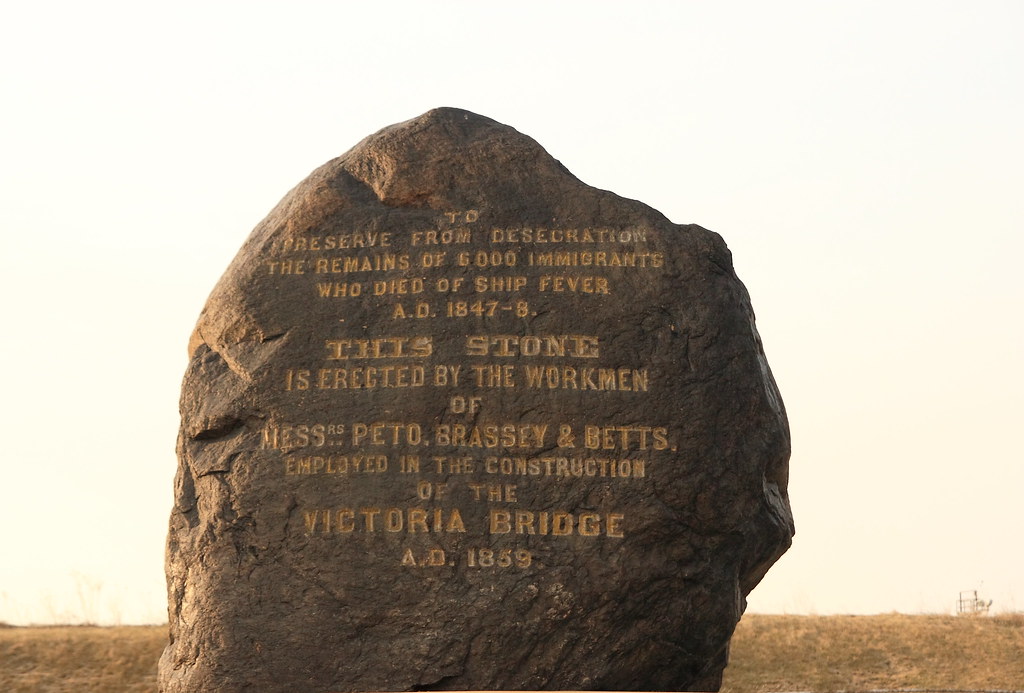
On Monday, at 1pm and 8pm, and Tuesday at midnight, all EDT, there will be opportunities to view the docudrama Death or Canada on History Television Canada. It follows the story of John and Mary Willis and family who set out on a rotten coffin ship in 1847 fleeing the Irish Famine for new lives in Toronto. They lost four of their five children.
Read more about Death or Canada from History Television Canada here, rather more extensively from RTÉ One when the film was first shown on Irish TV last November here, and most comprehensively from the film's producers here.
While this film illustrates the story for Toronto, where 1,000 new immigrants died, the impact in Canada was more widespread. In Montreal 3,000 - 6,000 died; this memorial stone stands near the entrance to the Victoria Bridge. In Ottawa typhus-stricken victims began to arrive on
A changing genealogical ecosystem?
Warning: This item contains opinion.
On returning from another interesting BIFHSGO meeting on Saturday I sat down to go through my RSS feeds. The item that attracted my attention was the text of a talk by Steven Berlin Johnson.
Johnson writes engagingly on the intersection of science, technology and personal experience. He first came to my attention as author of The Ghost Map, named for the influential map of deaths in London's 1854 cholera epidemic.
Research on victims of the epidemic was the topic of last month's BIFHSGO talk.
Johnson's talk was Old Growth Media And The Future Of News a timely one given the rate at which newspapers are collapsing and other media contracting, also the topic of a segment on Steve Pakin's TVO program on Friday evening.
One section toward the talk's end caught my eye "There should have been a ten-year evolutionary process: the ecosystem steadily diversifying and establishing its complex relationships, the new business models evolving, the papers slowly transferring from print to digital, along with the advertisers."
It reminded me of a line used in government ... we only ever make progress by accident. When an accident came along the government contained the public reaction by funding the improvements we all knew years before were needed, everyone except the keepers of the purse strings at Treasury Board. Expect to see it happen again following the recent helicopter crash off Newfoundland.
Similarly, ecosystems evolve through disaster. It's wishful thinking to expect them to anticipate a trend. Pine beetles infest and kill off vast areas of forest. Fire ravages forest acreages. The forest doesn't grow back as it did before if the trees were stressed and especially vulnerable to the attack owing to, say, climate change.
Such abrupt disruption is the norm. The news-media are wrestling with it in nature's way, described by Tennyson as "bloody in tooth and claw."
How about genealogical media? Will the response to technological change be continuing to sleepwalk to disaster?
14 March 2009
OGS 2010 call for papers
The Toronto Branch of OGS has issued the following call for papers. Note that the date of the conference is mid-May, significantly earlier than usual.
Ontario Genealogical Society Conference 2010
Essentials, Innovations and Delights
Call for Papers
Deadline: 1 May 2009
The Ontario Genealogical Society’s Toronto Branch will host the Society’s annual conference on May 14-16, 2010, at the Doubletree by Hilton – Toronto Airport. The Ontario Genealogical Society, founded in 1961, is a not-for-profit organization with more than 4,500 members. The Conference theme will be: “Essentials, Innovations and Delights.”
In keeping with this theme, the Conference aims to present information that is both relentlessly practical and inspiring. We will be especially interested in lectures that deal with (a) practical essentials, (b) recent innovations or (c) one-of-a-kind case histories.
Consistent with this direction, you are invited to submit proposals for lectures on any aspect of genealogical or social history research in Canada and/or countries of origin (especially England, Ireland and Scotland) or intermediate settlement, including (but not limited to) sources, research techniques, historical background, migration or settlement, libraries, archives, online resources and technological advances.
In addition we are planning half-day in-depth programs on Italian and Dutch ancestry. We encourage proposals for lectures that could be part of these streams or form the entire half-day.
Normally sessions will be one hour long, including 5-10 minutes for questions. Topics for longer 2-2½ hour workshops will also be considered. Presentations should have a visual component. Speakers will be required to submit Syllabus material in early 2010.
Speakers will receive an honorarium, plus appropriate expenses and complimentary registration for the Conference.
Please submit your lecture proposals by e-mail. Be sure to include your full name, mailing address, telephone number, e-mail address, website address (if applicable) and biographical information, including recent speaking credits. For each proposal, please provide a unique title, a detailed outline up to 250 words, a summary of 50 words or less suitable for publicity, identification of the intended audience (beginner, intermediate, advanced) and A/V requirements. Multiple proposals are encouraged, but only one per page, please.
DEADLINE FOR PROPOSALS: 1 May 2009
To submit proposals or ask a question about the event, please contact the Conference 2010 Program Committee at conference2010@ogs.on.ca
For more information about our organization, visit the Ontario Genealogical Society and Toronto Branch.
A milestone
This blog had its first posting, about Library Elf, still a useful resource, on 14 March 2006.
Three years, 950 postings and getting more popular. February was a record setting month for page views, unique visitors and return visitors here at Anglo-Celtic Connections. March looks set to beat that pace.
The most popular post looks to be this one.
Also today, celebrate Pi Day -- 3.14
13 March 2009
New WW1 data
An amazing story from the BBC about long-overlooked records of First World War soldiers; 20 million sets of details, carefully entered on card indexes, or written into ledgers, in the basement of the Red Cross headquarters in Geneva.
Researcher Peter Barton who uncovered them said that "To a military historian, this was like finding Tutankhamen's tomb and the terracotta warriors on the same day,"
There's a short video clip.
If it was closer to April Fools Day I'd be thinking someone was pulling our collective leg.
12 March 2009
BIFHSGO monthly meeting
10:00 a.m., 14 March 2009 at Library & Archives Canada 395 Wellington Street
"And The Walls Came Tumbling Down"
Presented by Sharon Moor.
Sharon will talk about all the different resources that helped her to crash through three walls in different branches of her family.
Images of 1881 Scottish Census now online
Scotlandspeople, "the official government source of genealogical data for Scotland" announce the availability of images of the 1881 census on their site.
To date only transcripts for 1881 have been available, starting with those originally produced by the GSU on microfiche and CD. Ancestry have transcripts online, but Scottish authorities have been careful to guard their rights, and market, by refusing requests to make original images available to others.
Newspaper coverage of the release mentions some of the better known people found in the census:
- Mary Garden, a renowned opera singer in the 20th century;
- Bertie Charles Forbes, financial journalist;
- James Matthew Barrie, who was to write Peter Pan;
- James Keir Hardie, founder of the Scottish Labour Party;
Others not mentioned, but in the census are:
- Arthur Conan Doyle, Sherlock Holmes author;
- John Buchan, became 1st Baron Tweedsmuir and Governor General of Canada.
Scottish births up, marriages down
The Registrar General for Scotland, Duncan Macniven, has released information on civil registration trends for 2008.
"More than 60,000 births were registered in 2008 - the highest number in Scotland since 1995 - the Registrar General announced today.
New figures also show the number of marriages in Scotland dropped from 29,866 in 2007 to 28,903, the lowest level since Victorian times."
Some findings in the press release:
- the 60,041 birth total for the year was the highest since 1995. This is the sixth annual increase in a row.
- the proportion of births to unmarried parents topped 50 per cent for the first time in a whole year.
- the number of marriages dropped to 28,903, their lowest level since Victorian times.
- the number of divorces fell by more than a quarter.
And a note for BIFHSGO: negotiations are underway to have Duncan Macniven as a speaker at September's BIFHSGO conference.
11 March 2009
Genealogy 101 - Getting Started
On Saturday March 21, 2009, BIFHSGO and Ottawa Branch of OGS are presenting the next annual session on first steps in family history -- more about that coming soon -- or you can click through from the BIFHSGO or Ottawa Branch websites for more information.
Browsing around I found slides, downloadable as a pdf from here, from a similar session presented by Bob Dawes of the Quinte Branch of OGS. I see he uses the same seven golden rules I do, although with a bit of a different spin. Good for a refresher and certainly worth a look.
Also kudos to Quinte Branch for the nice website.
Local (UK) History Online
This site describes itself as one of the UK's premier sites for local history, with over 300 links to sites both in the UK and overseas, regularly updated News and Calendar sections, directories of local history organisations and course providers and an on-line Bookshop, with stock at discounted prices.
Worth a look, especially if you're planning a trip to the UK.
10 March 2009
The Ottawa Irish Festival
From Library and Archives Canada
A celebration of Irish and Irish-Canadian culture and heritage, takes place the week of March 10 to 17, 2009. Library and Archives Canada is proud to support a number of events marking our shared heritage, in partnership with the Irish Society of the National Capital Region.
This website is a portal to various resources on Irish heritage and culture available at Library and Archives Canada and elsewhere on the World Wide Web. It is also your guide to festival activities happening at Library and Archives Canada.
Visit the Irish Society of the National Capital Region website at www.irishsocietyncr.com for a schedule of the week's events.
View the Library and Archives Canada What's On page for information on festival activities at 395 Wellington Street.
Free E-book: Best of the Photo Detective
Dick Eastman in his Online Genealogy Newsletter (blog) points out that Family Tree Magazine is giving away a free e-book to those who sign up for the magazine's free, weekly e-mail newsletter. The book is the 42-page Best of the Photo Detective, a step-by-step guide that helps you examine old family photos for hidden clues to when they were taken and who’s in them. It includes an exclusive excerpt from Uncovering Your Ancestry Through Family Photographs by the Photo Detective, Maureen A. Taylor.
Dick suggests signing up at http://www.familytreemagazine.com/enews. After you submit your registration, you’ll get a link to download the book as a PDF file. You can then view it on your computer's screen or print it on your local printer.
Map Of North West Kent 1789
I`ve previously written about MAPCO which aims is to provide genealogists, students and historians with free access to high quality scans of rare and beautiful antique maps and views.
The most recent addition is a Map Of North West Kent 1789 taken from a map of Twenty-Five Miles Round London Planned From A Scale Of One Mile To An Inch.
It includes a comprehensive search feature for place names enabling a targeted search of the entire 1789 map of North West Kent.
Beechwood as Canada`s National Cemetery
Last Friday the House of Commons completed all stages of Bill C-17, the National Cemetery of Canada Act. The debate on the Bill, which was supported by all parties, touched on some of the historical significance of Beechwood. You can read it here.
It was particularly pleasing to see BIFHSGO member David Roger mentioned.
09 March 2009
Web Tech Guy and Angry Staff Person
Does this sound familiar at your archives, library, society?
"Deanna said she thought the animation "was filmed inside the Library of Congress" and many many attendees told me that the script cut very close to home"
What did they do?
Rootsweb has lots of useful genealogical resources. Dictionary of Ancient Occupations and Trades, Ranks, Offices, and Titles is one. Did you know that a ripper was a a seller of fish, a hacker a maker of hoes, and a catchpole a sheriff's officer, especially one who arrests debtors?
08 March 2009
Ottawa woman returns dead man's penny
After soldier Walter Thomas Baker was killed during the Battle of the Somme in 1916, a medal commemorating his brave sacrifice was sent to his widow.
Now more than 90 years later, thanks to an Ottawa woman who found it in her attic, and research by Ancestry, the medal - known as the Dead Man's Penny - has been returned to his closest living relative in Lowestoft, Suffolk.
Read the full story from the Eastern Daily Press here. Another article from the Hamilton Spectator.
Celebrating International Women's Day
This is the first International Women's Day on which BIFHSGO is led by a woman President, Mary Anne Sharpe. The Society has existed for 15 years , it has a majority of women members including several who are genealogy community leaders, so a woman in this leadership role has been long overdue.
Mary Anne has made it a priority to increase the number of members who volunteer for the Society. You can find a list of the jobs here. Many require a minimal time commitment. Others, like one of the best jobs on the Board, Director of Research, are more demanding ... and satisfying.
07 March 2009
Genetic genealogy frustration
Is this your experience? You get a a DNA test done and hope for matches. Perhaps like me you've got lots of matches, over 500 at 12 Y-DNA markers, but spread out all over the map. I have a greater percentage in Australia than anywhere else, and the second most in Portugal. Neither are places I expect to have paternal roots. No new matches at 25 or more markers have appeared in over a year.
Perhaps, like some BIFHSGO friends, you're a genetic outlier with no 12 marker matches.
It tries your patience.
So like the fisherman who catches nothing and thinks maybe there are no fish in the lake, it helps to see others get a bite.
That happened for genetic genealogy last weekend at the WDYTYA show in London, and was recorded by Roots Television. See it here.
06 March 2009
TNA podcast - tracing Scottish ancestors
This podcast presentation by Audrey Collins describes the records held at The (UK) National Archives (TNA), some now available online through cooperative digitization projects, that may have information on Scottish ancestors.
For Scottish ancestors who served with the UK government, be it in the military (Army, Royal Navy, Air Force), merchant navy, coast guard or customs and excise, TNA is the place to look for their occupational records.
Also mentioned are PCC wills, non-parochial records, out-bound and in-bound passenger lists.
Prisoner records from the 1745 rebellion, maps and images are also covered.
Not mentioned, because they are not held at TNA, are records of the India Office and East India Company held at the British Library, and records for the Hudson's Bay Company (also at Library and Archives Canada) both of which recruited in Scotland.
More Greater London cemeteries online
Four Greater London Boroughs, Havering, Brent, Islington and Camden, have added data at Deceased Online.
Hampstead Cemetery
Approximately 72,000 burial register records are available, with a mixture of register scans and computerized records starting in 1876.
Trent Park Cemetery
Approximately 6,520 burial register records, with a mixture of register scans and computerized records.
Rainham Cemetery
5,452 burials starting in 1902 with burial register scans available and additional fully computerized records from August 1994 with no associated register scans.
Upminster Cemetery
9,572 burials from 1902 to 1994 available as burial register scans and thereafter as fully computerized records with no associated register scans.
Locate these and other London area cemeteries on this map.
View Larger Map
Read more about Deceased Online.
05 March 2009
Éire á Móradh: Singing the Praises of Ireland
From New Zealand's Otago University the online exhibition Éire á Móradh: Singing the Praises of Ireland aims to celebrate the Irish and Ireland. Very much like a traditional exhibition you see selected covers or pages from books and manuscripts with explanatory material. The range is from the Book of Kells and Book of Durrow to significant 'modern' Irish writers such as W.B. Yeats, James Joyce, and Seán O'Faoláin.
It's unfortunate those putting together the exhibit choose not to take advantage of the linking opportunity of the web to guide the reader into greater depth material.
Kudos Ottawa Branch News
The March-April issue of Ottawa Branch (OGS) News arrived in my mailbox on Thursday. Full of news and short articles, matching my ever-decreasing attention span, it's one of the best benefits of being an OGS and Ottawa Branch member. Even before I was a member I'd make a point of reading it at the Centrepointe library.
It's a nice mix of local genealogy news, short local articles, reprints of the most pertinent material from Eastman's Online Genealogy Newsletter, interesting web sites, contents lists from other genealogical publications and conference announcements.
Editor Ed Kipp and a host of steady contributors are to be congratulated.
The issue announced change coming to the publication, including moving from an booklet format to 8-1/2 by 11 journal format favoured by other OGS publications. The suggestion is this will make a move to a more reader-friendly two-column format and an electronic version easier.
The Branch also wants to change the name, no problems with that: "a rose by any other name would smell as sweet."
Nathalie Ceeney's LAC visit
Back last September Nathalie Ceeney, Chief Executive Officer of the United Kingdom National Archives (TNA), visited LAC. As a genealogist I welcome that. She has put genealogy front and centre at TNA; just look at the real estate devoted to genealogy on the TNA website front page, and then see how the profile at the LAC site pales by comparison. That's despite genealogists being the number one user at LAC.
Judging by the proactive disclosure for Ian Wilson, Nathalie Ceeney had a busy time.
Starting on Sunday September 14th the two of them had a business lunch at L'Orée du Bois in Chelsea -- $61.24.
On the 15th she had a lunch with 8 Government of Canada employees -- $302.46.
On the 16th 4 Government of Canada employees met with her and refreshments were served -- $22.26. A lunch was hosted by Assistant Deputy Minister Daniel J. Caron with 4 Government of Canada employees -- $100.31.
On the morning of the 17th she gave a presentation to 74 Government of Canada employees at which refreshments were served -- $336.68. Then she went to lunch with 4 Government of Canada employees -- $214.99. That evening there was dinner with 8 Government of Canada employees, a much more lavish affair than two days previous -- $1,020.73.
The 18th was the final day of her visit. There were refreshments with 4 Government of Canada employees -- $17.59. and a final lunch for two at the Jessicam (sic) Restaurant in Ottawa -- $22.60.
That's a total of just over $2,100 for hospitality.
Nathalie Ceeney spent four working days with LAC. In my view the hospitality expense was generous but appropriate. Still, it would be nice to know about the tangible benefits from Nathalie Ceeney's visit.
04 March 2009
Genealogy in Time
It's a pleasure to welcome a new Ottawa participant to the online genealogy world.
Miles Whittingham, president of Missing Link Software Corporation, has recently opened his website Genealogy in Time containing genealogy news, articles and links.
Originally from Vancouver, Miles Whittingham has lived in Ottawa for 15 years. Working as a materials engineer, and more recently in finance, he got into genealogy several years ago following the death of his 102 year old grandmother.
Exploring the online world of genealogy he found lots of excellent websites but that it was difficult to find information that wasn't overwhelming. Miles says that Genealogy in Time and a weekly newsletter "coming soon" will not focus so much on breaking the latest news, Dick Eastman does that well, especially for US news, but take a more Canadian and international perspective. It will focus on insight, the how and why, rather than the what of the news.
The site went online in January and so far about half the visitors to the site have come through word of mouth, a quarter through Google searches and the rest through links. Miles says he's getting lots of positive feedback and welcomes more, especially news stories.
Thanks to Don Pounder for the lead.
03 March 2009
Who Do You Think You Are? Live!
This genealogy show in London last weekend seems to have been a success despite initial concerns over the earlier date. There are several reports online. Chris Paton gives a Scottish perspective - it's relatively short and newsy. Dick Eastman has more detailed coverage here, here and here.
02 March 2009
Ontario - Bill 149, Inactive Cemeteries Protection Act, 2009
The following, via OGS and Linda Reid, is posted without comment.
The Bill was introduced by Mr. Jim Brownell, MPP for Stormont, Dundas and South Glengarry, jbrownell.mpp@liberal.ola.org.
The Bill prohibits the relocation of inactive cemeteries despite anything to the contrary in another Act or regulation dealing with cemeteries.
The preamble to the Act states that:
Ontario's cemeteries are unique repositories of human history and the resting places of human remains and associated artifacts like grave markers, tombstones and monuments. They are important elements of our collective heritage, a priceless authentic historical record of the past and witnesses to the continuity of life in Ontario. Many of Ontario's cemeteries also contain significant ecological features invaluable to the natural heritage of Ontario.
If you are unsure of how to contact your local MPP you can look at MPP Addresses and Contact Information. If you need additional assistance, Find Your Electoral District will assist you in finding your local MPP.


